
Arrow-right Camera
The Spokesman-Review Newspaper
Spokane, Washington  Est. May 19, 1883

This day in history: ‘Portly gentleman’ Isaac Stern impressed S-R reviewer. Salvation Army staff successfully evacuated smoke-filled shelter

The Salvation Army Home for Women on Garland Avenue was evacuated by fire and staff successfully got everyone out, the Spokane Daily Chronicle reported on Dec. 2, 1925. The newspaper also reported that six employees of the Home Telephone and Telegraph Company in Spokane won the "gold star service emblem of the Bell system," including John Nelson, who had worked at the company since 1910 except for a two-year leave starting in 1917 when he served in the 411th Telegraph Battalion.   (Spokesman-Review archives)
By Jim Kershner The Spokesman-Review

From 1975: World-famous violin virtuoso Isaac Stern “filled the (Spokane) Opera House Monday night with some of the most superb violin music this generation is likely to hear.”

“The listener at a Stern concert hardly knows what to expect when this portly gentleman with the shock of white hair (he is actually middle-aged) ambles onstage like an Alfred Hitchcock in tails,” wrote Spokesman-Review critic Larry Young. “But when he starts to play, the fireworks begin.”

Violinist Isaac Stern played the Spokane Opera House and "avoided the flashy show pieces favored by other violinists," which resulted in a "thoroughly enjoyable program," The Spokesman-Review's review Larry Young wrote in the edition on Dec. 2, 1975. Among the pieces he played was Hoe-Down from Aaron Copeland's Rodeo.  (Spokesman-Review archives)
Violinist Isaac Stern played the Spokane Opera House and “avoided the flashy show pieces favored by other violinists,” which resulted in a “thoroughly enjoyable program,” The Spokesman-Review’s review Larry Young wrote in the edition on Dec. 2, 1975. Among the pieces he played was Hoe-Down from Aaron Copeland’s Rodeo. (Spokesman-Review archives)

This was Stern’s second Spokane appearance in two years. He played to a capacity audience at Expo ’74. Young said he was careful “not to repeat any part of the previous program.”

The audience this time at the Opera House was not quite as full. Young described the crowd as “small.”
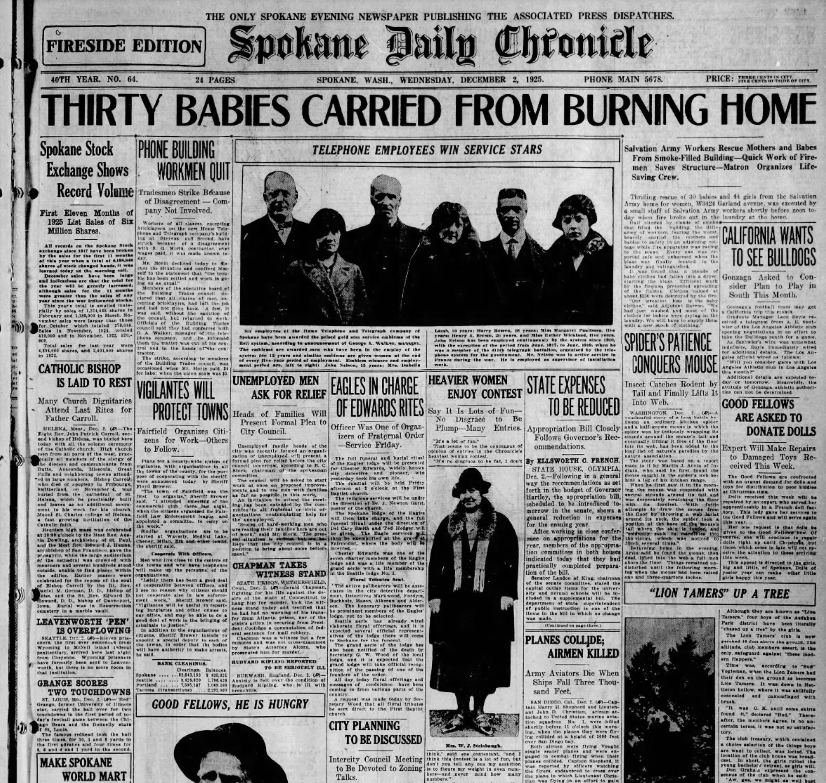
The Salvation Army Home for Women on Garland Avenue was evacuated by fire and staff successfully got everyone out, the Spokane Daily Chronicle reported on Dec. 2, 1925. The newspaper also reported that six employees of the Home Telephone and Telegraph Company in Spokane won the “gold star service emblem of the Bell system,” including John Nelson, who had worked at the company since 1910 except for a two-year leave starting in 1917 when he served in the 411th Telegraph Battalion.  (Spokesman-Review archives)
The Salvation Army Home for Women on Garland Avenue was evacuated by fire and staff successfully got everyone out, the Spokane Daily Chronicle reported on Dec. 2, 1925. The newspaper also reported that six employees of the Home Telephone and Telegraph Company in Spokane won the “gold star service emblem of the Bell system,” including John Nelson, who had worked at the company since 1910 except for a two-year leave starting in 1917 when he served in the 411th Telegraph Battalion. (Spokesman-Review archives)

From 1925: Staff members staged a “thrilling rescue of 30 babies and 44 girls” from the smoke-filled Salvation Army home for women on Garland Avenue.

“Half-blinded by clouds of smoke that filled the building, the little army of workers, fearing the worst, carried the mothers and babies to safety in an adjoining cottage,” said the Spokane Chronicle. “Every one was reported safe and unharmed when the blaze was finally located in the laundry and extinguished.”

The fire broke out when a bundle of baby clothes fell into a dryer. Firefighters extinguished it before it could spread.

Also on this day

(From onthisday.com)

1927: Anthropologist Davidson Black announces to the Geological Society of China that ancient humanlike fossils from Zhoukoudian, China, are a new species, which he names “Sinanthropus pekinensis” (Peking Man), now known as Homo erectus.