
Cool Critters: The house finch – from Hollywood celebrity to backyard fixture
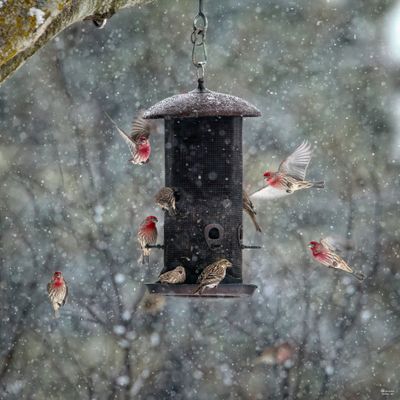

The hummingbirds, warblers and butterflies are gone. But this time of year, house finches congregate at bird feeders like kids at a candy store.
With their rose-colored faces and cheery dispositions, these small songbirds remind us that amid a December in Washington gripped by damaging winds, heavy rains and flooding, life goes on.
Unlike most birds that go quiet in winter, the house finches’ cheeps and chirps spill out from branches and backyard feeders. As if splashed by cranberry juice, the males sport rosy-red plumage on their heads, upper breasts and rumps. The more subdued females are dusky brown covered with wide streaks of gray and crème. Both sexes resemble a slender version of a house sparrow.
Whoever came up with the idiom “eats like a bird” obviously never observed the perky little house finch in winter. Stock a bird feeder with sunflower seeds and it won’t be long before they clamor for a seat at the table, said Alan McCoy, president of the Spokane Audubon Society.
It often starts with one or two finches that show up to dine at a cylinder-shaped feeder in McCoy’s Spokane-area yard. “They eat one sunflower seed after another” by cracking the shells with their beaks and using their tongues to retrieve the kernels, he said.
Before long, a horde of finches joins them at the feeder. Muscling their way into position for choice morsels, the entire flock “stuffs themselves as much as possible,” McCoy explained. While occasionally appearing argumentative, for the most part they’re cooperative, he said. No avian fight club among house finches.
Not long ago, the house finch was found mainly in the western United States and Mexico. But almost overnight, it arrived in New York City – and not on its own. According to the National Audubon Society, unscrupulous pet dealers in 1940 shipped 100,000 of these blushing, cheery-voiced birds from California to the Big Apple. There, the finches were sold in cages as “Hollywood finches.”
Later, faced with prosecution for selling wild birds, pet store owners let their would-be profits fly out their doors.
The freed birds “eventually settled in Long Island and the surrounding countryside,” the Audubon Society says.
Can you guess what happened next?
As their numbers expanded, the birds began popping up in urban locations. Needless to say, humans were charmed by their new avian neighbors.
In 1969, the New York Times wrote: “The spread of these friendly and attractive birds into parks and even into some of the city’s residential streets is one of the nicer things happening in our city this year.”
Within 50 years, house finches expanded their range across the eastern U.S., eventually melding with our native population in the west, according to historical accounts.
Thanks to the bird’s adaptability and sociability, the house finch is now one of the most widespread bird species in the country, the Audubon Society says.
From Maine to Florida to Washington state, this congenial bird thrives close to people and chows down at our backyard feeders. (Speaking of which, experts advise that bird feeders be cleaned regularly to prevent the spread of a bacterial eye disease that can cause blindness among house finches.)
“Reddish birds seem to catch one’s eyes this time of year,” said Carl Barrentine of Spokane, a naturalist and retired biology professor whose photograph of house finches accompanies today’s column. While our region lacks the brilliantly-red cardinals found in the midwestern and eastern states, the house finch adds cheer to the often-gray backdrop of winter in the Pacific Northwest, he added.