
Difference Makers: Spokane’s Repair Café and Mend-It Café reframe relationship with household items
Tucked away in an event space in a local library, surrounded by a small but dexterous group of neighbors and volunteers fiddling and futzing with a sweater that needs buttons or an umbrella with a busted rib, Chris Oxford is taking apart a brass-bottomed lamp.
The lamp is old – it’s not clear how old, given that the baseplate, which likely had the manufacturer’s stamp, is long gone, but the vintage wiring and burnt-out cardboard insulators confirm it’s certainly not fresh off the shelf. It was a second-hand steal, $25 for the heavy, three-headed lamp with stained-glass shades, but it’s never worked quite right.
After about 10 minutes of probing, Oxford thinks he’s figured it out. As it turns out, the lamp was a fire hazard.
“One of the little contacts is falling out, and it’s actually really good that you brought it in, because it was not safe,” he says. “It was about to short out and – hopefully – pop the breakers.”
Oxford and the rest of the Repair Café crew have tools and decades of experience among them, but he doesn’t have the part on hand, so he mentions a shop that could repair it or sell the specific parts necessary. With those parts in hand, he adds, he or someone else from the Repair Café would be happy to finish the job at their going rate – for free.
A second life
For decades, the American economy has become increasingly geared toward fast fashion and cheap, disposable consumer goods, marking a shift toward what is critically called a “throwaway society.”
Many forces have driven this trend, including rising wages that make quick replacements an economically efficient use of people’s time, low or stagnant costs for imported goods that would cost more to repair than replace, and a sharp decline in the ability of the average American, particularly younger Americans, to repair what they own.
In some ways, things are changing. Following the pandemic, average wages have stagnated compared with inflation, tariffs are raising the costs of many cheap imported goods and thrifting saw a notable uptick, particularly among younger generations.
Two Spokane organizations, which launched independently just months apart, are part of an international movement to help people extend the life of their belongings – and encourage them to buy things with lives worth extending – by repairing them for free and teaching anyone interested how to do those repairs in the future.
For the most part, the volunteers learned their skills through their careers or, just as frequently, from their parents and grandparents. In a time when fewer and fewer families still have these skills in circulation, the Spokane Repair Café and Mend-It Café provide an answer even for those without money to spend at a repair shop.
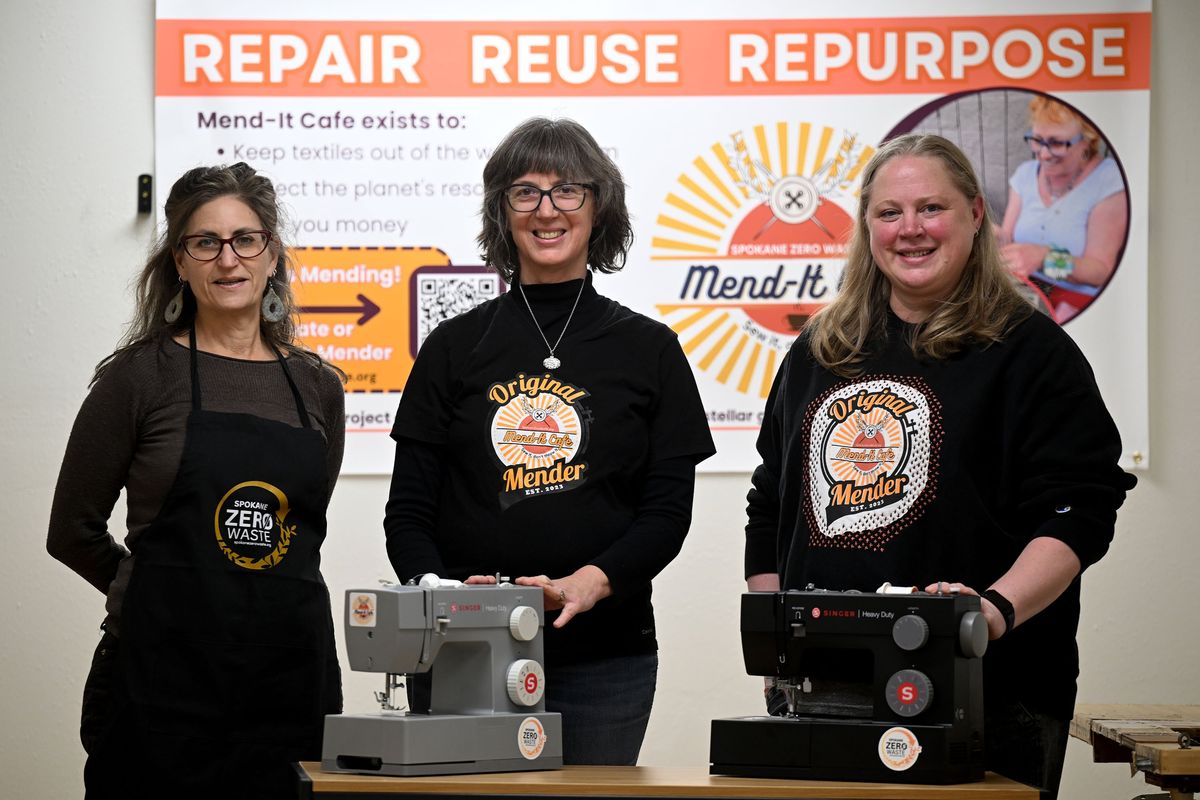
The Mend-It Café, specializing in clothes and textiles, launched in May 2023 with its first mending event hosted in partnership with Art Salvage and Spokane Zero Waste. That latter organization’s executive director, Elyse Hochstadt, started Spokane Zero Waste to help address, as the name suggests, a local waste stream choked with cheap disposables that contribute to greenhouse gas emissions.
“Initially, we were working on plastic waste, but it’s such a massive problem, and dealing with corporate change is really around policy,” Hochstadt said. “We can as individuals take action, but it’s not nearly as impactful as we’d like it to be.”
But Hochstadt has a personal background in textiles as a fiber artist, drawing her attention to a specific aspect of the waste stream: clothes, most of which are themselves made with petroleum products.
“Textiles are something that we engage in every day,” she said. “There’s a creative aspect to mending and making, and it just felt really Spokane – there’s so many people that sew and mend and make things, and with textile waste issues becoming so popular in the news, it just seemed like a perfect storm to act on it.”
For the better part of three years, Hochstadt and a growing cohort of volunteers and now one employee have been stitching, hemming, buttoning and otherwise mending the jackets, pants and even occasionally shoes that walk into one of their events.
They host a variety of classes tailored for people with little experience or who have never touched a sewing machine at the Spokane Zero Waste headquarters on North Hamilton Street, but the Mend-It Café, where people bring in objects for repair, happen anywhere that will host them and as often as they can manage. Farmers markets, libraries across the county and, after a short break for the holidays, at the Scale House Market on Jan. 7, the team comes together to try to mend whatever people bring them.
Sometimes it’s that quality thrifted item that needs a little TLC – an event at Gonzaga proved incredibly popular among the students – and sometimes its a family trying to make what they have last. Erin Bietz, manager of the Mend-It Café, recalls a mother of five boys whose clothes have to last so they can be inherited by a younger sibling.
“And she had these boots, these little leather moccasin-type boots, that the heels were worn out and the toes were blown out, and she said, ‘I want to get one more winter out of these,’” Bietz said. “So I took them home and fixed them for her. … We’ll probably see the kids this winter in them.”
Spokane Zero Waste has a couple other programs trying to limit waste, such as ReCraftLAB, which doubles as a job training program for immigrant and refugee women and upcycles flexible waste materials like turning vinyl billboards into handbags, and is trying to launch the Inland Northwest Woolshed to create a regional processor and new markets for wool, much of which is destroyed due to poor quality or rock bottom commodity prices.
But the Mend-It Café alone has diverted more than 2,300 pounds of textiles from the landfill since 2023 by repairing over 930 pieces of clothing brought by more than 530 people.
The Spokane Repair Café was launched the same year by a group of Perry District neighbors who were already swapping tools and helping each other repair each other’s things. While their events and volunteers are more limited than the Mend-It Café, they will try to fix just about anything that a person can carry, as long as it’s not gas-powered.
Chris DeForest first heard about the international Repair Café community through his sister, who frequents a repair café location in Seattle. He shared the idea with his friends and neighbors, Kent Larson and his wife Julie Goltz, who filed the paperwork with the Repair Café International Foundation in Amsterdam to launch one in Spokane.
They’ve made their home at the Perry Street Market, which has offered the group a no-cost space to offer free repairs on the second Thursday of every month between May and October.
Toys with a broken hinge, jewelry with a snapped clasp, odds and ends of all kinds. They’ve fixed a hundred-year-old barber’s pole, puffy jackets that “looked like it was attacked by a bear,” and an old Teddy Ruxpin doll held dear by parents whose son had died.
“A lot of times this process is like being Sherlock Holmes,” said Levi Westra, a mechanical engineer who works to improve energy efficiency at Avista. “How did the designer who built this, what was their thought process?”
Pointing at the brass-bottomed lamp, he adds: “Right now that’s what Chris is doing. This is an older lamp – what were the manufacturing processes? Was this hand assembled? You just have to work backwards.”
Nearly 240 items have been brought into the Repair Café in the last three years, about 75% of which the group has managed to fix. Often, like with the lamp, if they can’t fix it on site, the volunteers point people to repair shops or the parts they’d need so they could return to the Café and try again. The Repair Café model is intended to not replace, but supplement what’s left of a local community’s professional repair shops.
Like the Spokane Mend-It Café, the local Repair Café hopes to not just extend the life of everyday objects but to educate the public on the importance of repairing what they have – and, when they can, how people can make those repairs themselves.
Oxford recalls a young teen who came in with his mother with a little handheld fighting robot toy.
“He comes in and he’s already taken the thing completely apart, and he said, ‘I think I could fix a couple things, but it’s broken right here, and I don’t understand how to do that,’” Oxford said. “I got to sit there and hand him tools and help him with a couple parts that were tricky, and he did the whole repair.”
The boy’s mother walked over to Oxford afterward and explained her son didn’t really care that much about the toy, really.
“It was just the fact that he got to fix this thing, and that sense of accomplishment – nothing will ever top that.”
Get involved
Both organizations rely heavily on donations and the labor of their volunteers and hope to be able to grow with the public’s support.
The Mend-It Café is seeking volunteers with expertise in stretchy fabrics or specialists of any kind, but any willing hands are welcome, Hochstadt said. Many of their events have lines stretching out the door, and the need is significant.
The Repair Café would like to be able to offer more regular events and need more than their roughly 10 volunteers to do that, and are also happy to have volunteers regardless of their expertise, even if only to operate their social media or draw people to their booth. They also hope more people will bring things for them to fix, because while some months are quite busy, others can be sleepy.
Those interested in getting involved can contact the Mend-It Café at menditCafé@spokanezerowaste.org and the Repair Café at RepairCafeSpokane@gmail.com. The next Mend-It Café event is at the Scale House Market at 4 p.m. Jan. 7, and the next beginner sewing class is at their Hamilton Street office at 1 p.m. Jan. 10. The Repair Café reopens for the year at the Perry Street Market in May.
Editor’s note: This article was changed on Dec. 29, 2025 to correct the name of Inland Northwest Woolshed and clarify how other organization partnered in its first event.