
Conservationists celebrate as Blue Fern surprisingly backs out of one Thorpe Road development
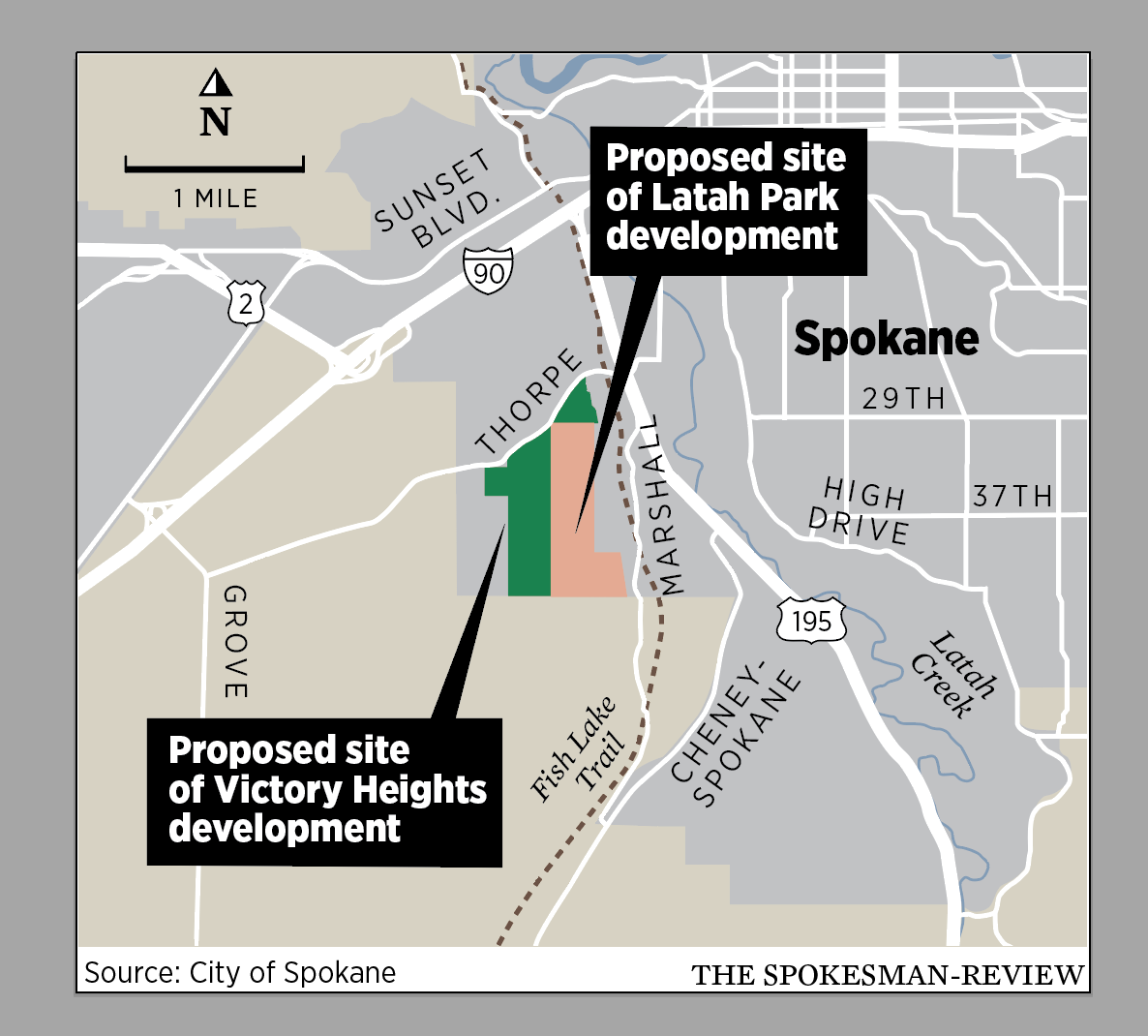
Local conservationists are celebrating after a Redmond, Washington-based developer unexpectedly pulled out of plans to build 1,000 homes in an undeveloped, wooded area along U.S. Highway 195 near Thorpe Road.
It may only be a temporary reprieve, however.
Advocates will have two years to try to find a permanent solution to keep the land available to the public, or else it may once again be made available for housing development.
Blue Fern Development has been in the news frequently in recent months for two adjoining 1,000-home proposals in the Latah Valley. Those include the Victory Heights development, which is much closer to breaking ground, and the Latah Park development.
An agreement with the state Department of Natural Resources to transfer state land for the Latah Park development to Blue Fern had seemed like a foregone conclusion despite efforts to halt or reverse the agency’s decision – until Friday.
Late last week, conservationists and local officials who had opposed the transfer learned that Blue Fern and the Department of Natural Resources had “mutually agreed” to cancel the deal. The final deadline to pull out of the agreement was Tuesday.
“It is surprising news,” said Brian Muegge, a local conservationist who had spent months advocating for the land to remain undeveloped. “Now my question is – who broke? Who blinked?”
An agency spokesman confirmed Monday that it was Blue Fern itself that requested the cancellation, but could not confirm the developer’s reasoning. Blue Fern CEO Benjamin Paulus could not be reached for comment.
“And we saw an opportunity,” said Michael Kelly, communications director for the Department of Natural Resources. “There had been so much community concern about this land, and it seemed like an opportunity to reset.”
The land in question is a small part of the Department of Natural Resources’ Common Schools Trust Fund, 3 million acres of land managed by the agency to produce nontax revenue that pays for, among other things, building schools. This revenue is typically generated through leases, including woodlands to logging companies.
The Thorpe Road property is relatively unproductive, however, and currently costs the Department of Natural Resources more than it brings in due to dumping, trespassing and encampments, according to an agency analysis provided to the board during the Jan. 7 meeting.
The city of Spokane’s parks department applied last year to a competitive program in which DNR considers transferring ownership of its trust land and is compensated by the state, not the recipient – meaning Spokane, if it had been successful, could have received the land at no cost to the city.
The city had proposed folding the land into its parks portfolio, conserving much of it as wildland.
But among the 30 properties considered last year through DNR’s trust land transfer program, there was only enough funding from the Legislature for eight. Spokane’s application ranked 18th, a ranking local conservationists and City Councilman Paul Dillon have argued was flawed due to an inadequate consideration of the land’s natural resources and a lack of tribal input.
Jeff Lambert, another local conservationist best known for his work as the former executive director of the Dishman Hills Conservancy, noted that the trust land transfer program had only recently reformed its processes and argued that mistakes had been made both in how properties were ranked and what the agency did with them if they failed to make the cut.
“Because the Department of Natural Resources has not gone through this process before … there’s been some confusion,” Lambert said. “But, historically, when a property was accepted for the trust land transfer process, it stayed on that list until it was funded. The Glenrose trailhead property, 160 acres transferred from DNR to Spokane County, I think it was on the list for 10 years.”
Instead, the state agency, under the leadership of then-Lands Commissioner Hilary Franz, moved to quickly exchange the land to Blue Fern, which proposed building around 1,000 homes in what it calls the Latah Park development. In exchange for the Thorpe Road land, which was valued at around $8 million, as well as another $7 million of agency funds, Blue Fern agreed to trade a 4-acre commercial property in Whatcom County with a Haggen grocery store.
Conservation activists attempted to slow or stop the transfer, arguing the wooded area contains geological, ecological and cultural features that are increasingly rare in city limits and would be lost under the construction. Several testified to the state agency board in opposition to the transfer, and the Spokane City Council voted in December to formally ask for a delay to pursue alternatives.
Their efforts failed and the DNR board voted unanimously on Jan. 7 to approve the trade.
Activists discovered a clause in the agreement that allowed it to be terminated no later than April 6, and attempted to appeal directly to the board and Lands Commissioner Dave Upthegrove. That effort was unsuccessful, leaving conservationists to believe they had exhausted their options.
“We were under the impression that, really, the only way to get out of the deal was that 90-day opt-out deadline,” Muegge said. “After that … we were just at this point of, oh boy, are we going to have to take this to Superior Court?”
While it remains unclear why Blue Fern pulled out of the land swap agreement after overcoming the efforts of conservationists like Muegge, Lambert and numerous others, Upthegrove, who had expressed sympathy for their cause, informed them directly on Friday that the deal had been canceled.
“It’s very welcome news,” said Councilman Paul Dillon. “I think it shows why advocacy matters, and it opens up more opportunities.”
“I think the next step is to reconvene with the stakeholders, the city, DNR, neighbors – around what we want to prioritize for the next two years.”
Conservationists say they’re eyeing another attempt at the trust land transfer program, which is open for applications through Sept. 30, though it’s uncertain that a nomination for the land would be accepted or if it would be ranked highly enough for funding.
“I’m hopeful,” Dillon said. “I think (the trust land transfer program) should be front and center in the conversation, but it’s not the only option. … I’m very grateful that we have more time, but we certainly don’t want to rest on our laurels.”