
A mill town lost its mill. What is it now?
CANTON, N.C. — The first thing the mill workers noticed on what they later deemed “Black Monday” was the series of dark SUVs pulling up near the paper mill, at the heart of Canton, North Carolina. The mill’s hulking towers and plumes of smoke were visible for miles, rising above the Pigeon River and the trees that stretched like green ribbon across the mountains.
Jody Mathis, who managed the mill’s warehouse and coached the high school football team, was called to a meeting just after 5 p.m. When he arrived, men were streaming out of an earlier meeting, their faces twisted in pain.
“We’re done,” Mathis, 52, recalled a friend saying. He replied, “Done? What do you mean?” Then he noticed that all around him were burly men in their overalls weeping.
Like a metronome, Canton’s paper mill set the rhythm of life here for some 115 years. Residents in neighboring communities said they could smell the mill from as far away as Asheville, 20 miles east. It was putrid, like rotten eggs. People in Canton learned not to complain; to them, it was “the smell of money.” Curious children, hearing their parents repeat this, buried their faces in dollar bills to check.
If the odor kept visitors away, nobody minded. The locals were proud of the mill, which employed hundreds in town and allowed its residents to build homes and send their children to college.
But with the announcement in March 2023 that the mill was closing, Canton lost its life source and with it any sense of certainty about its economic future. It became one of more than 60,000 manufacturing hubs that have been wiped off America’s map since the late 1990s. For every 100 factory jobs lost in a community, 744 other jobs disappear, according to the Economic Policy Institute.
For a town like Canton, the loss of its jobs is also a loss of its identity. Many of the dozens of former mill workers who were interviewed said that losing the factory felt like a family death. Just over a year after it closed, Hurricane Helene destroyed more than 30 homes and businesses in the area. Dealt blow after blow, residents were left wondering what would happen to the town and who would be able to afford to call it home.
But in January, a new sense of possibility swept through. A Missouri industrial developer and demolition expert, Eric Spirtas, closed a deal to buy the mill site for some $3.36 million (a cost, Spirtas said, that doesn’t include the investment he is putting into fixing it up).
He arrived in a flurry of ideas.
“This can be the hometown of tomorrow,” Spirtas, 59, said. He has ideas for reeling in tourists. He has ideas for flood-resilient construction. He has a boundless appetite for more ideas.
“People are going to look toward the construction and the effort we do,” he continued, “and say, ‘We have got to go see Canton.’”
The mayor, Zeb Smathers, 42, is eager to work with Spirtas and hopeful about all these ideas. But he also feels the pressure from his neighbors, who are watching how he answers the hazy questions now crystallizing in stark and immediate terms for his town of 4,500.
“How do you keep being a mill town without a mill?” Smathers asked. “Who are we now?”
‘A Cheesecake Factory or a Factory?’
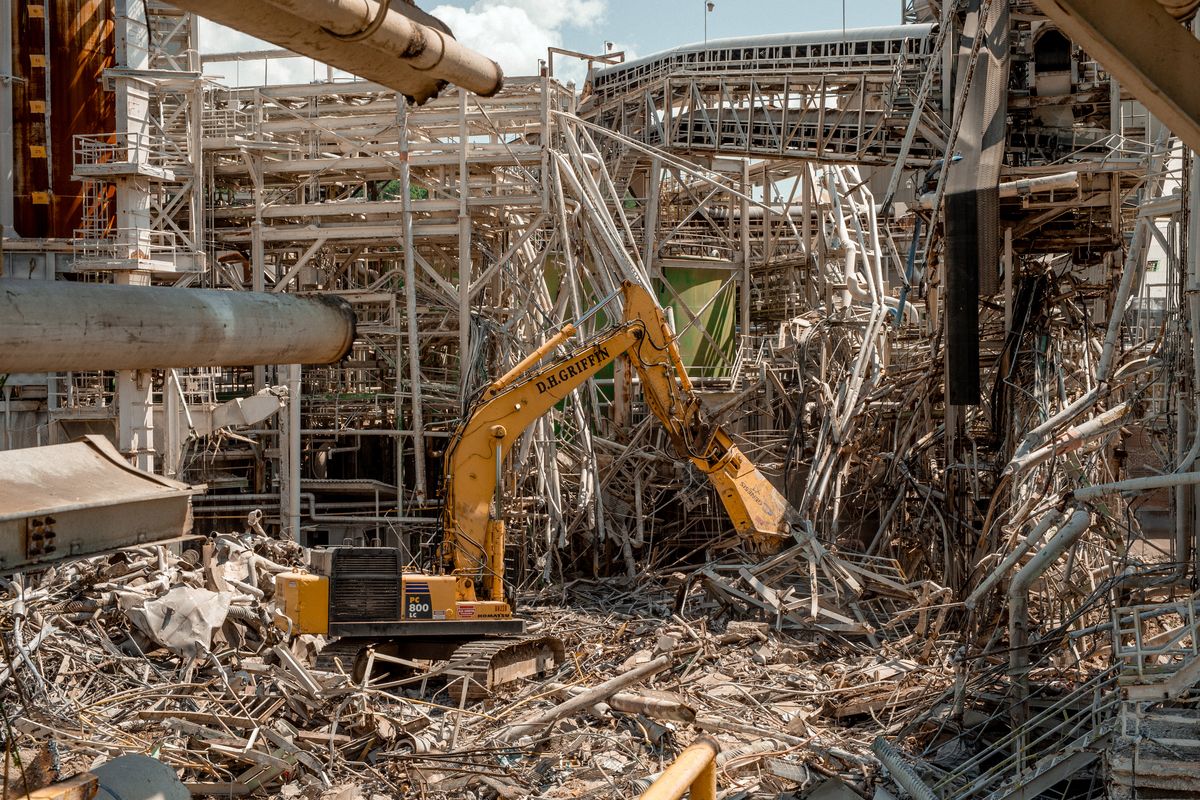
“Welcome to the apocalypse,” Smathers said on a recent Thursday, as he walked onto the former mill site, now being torn down. To those driving by Canton, the mill has always been an eyesore, a morass of smells and clangs. But those who worked there took pride in its bulk, its racket signaling the work always underway.
The paper mill was often called a rumor mill, because it directed the flow of talk in town just as much as money. Mill workers told stories. They recycled workplace jokes. They told gruesome tales.
Larry Henson, who spent 46 years working there, was once running to put out a fire when he stepped squarely on a metal spike, which pierced his boot and his skin. His foot ballooned and turned purple. He heard about a co-worker who was decapitated by a cable. A friend was killed when a piece of grating collapsed.
“We were so loyal that we’d put ourselves in danger if it meant making the factory run faster,” Henson, 72, said.
Records from the North Carolina Department of Labor revealed safety concerns in the months before the mill closed, like exposure to noxious gases and chemicals. But the way the workers saw it, the mill gave them everything, from their livelihoods right down to Christmas baskets for the needy.
“I’ve talked to no less than 100 people,” Henson said. “Every single one of them feels they’d go back in a heartbeat.”
To Smathers, it is evident that the mill jobs aren’t coming back. So he needs to find a middle ground among the worldly ambitions of the site’s new owner, the nostalgia-inflected hopes of the town and the need to bring back jobs.
If Canton had royals, it would be Smathers’ family. His grandparents owned its downtown grocery store. His father was mayor for 12 years. When Zeb Smathers graduated from law school at the University of North Carolina and returned to become involved in local politics, he didn’t anticipate feeling like he was governing through the end of times. “We went through COVID, Tropical Storm Fred, the mill closure, Hurricane Helene,” he said, noting that Helene swelled Canton’s river to more than 25 feet, submerged the mill site and destroyed his sister’s home.
“It was supposed to be a hundred-year flood,” said the mayor pro tem, the spunky 77-year-old Gail Mull, who worked in the mill. “We had two in three years.”
When Spirtas purchased the site, some saw it as a reason for hope. Recently, Spirtas and the mayor have made the mill’s front office into a war room, where they talk frenziedly about Canton’s future. Sitting with Smathers and a handful of former mill workers recently, Spirtas spouted ideas. He talked quickly, “the human embodiment of the dog from the movie ‘Up,’” as the mayor put it.
“This becomes a destination,” Spirtas said, gesturing beyond the walls of the conference room, beyond the once bustling warehouses and toward the mountains jutting into the sun.
“You’ve heard of Red Rocks?” Spirtas continued, referring to the amphitheater in Colorado where stars like Stevie Nicks, Bob Dylan and U2 have played. “We’re titling this ‘Green Mountain.’”
Smathers, in a blazer and bluejeans, later jumped in: “I’ve got families asking me, ‘Are we getting a Cheesecake Factory or a factory?’” In other words, would the town become home to a big chain, geared toward tourists? Or something that would make Canton still feel like Canton?
Smathers and Spirtas want whatever comes next to be resilient in the event of another storm like Helene and to bring at least as many jobs as were lost, around 1,100, when the mill shuttered.
Many jobs at the mill, for all their risks, paid over $100,000. Turning the town into a destination for tourists could drive up prices, especially on homes, making it a harder place to live for the families who have been there for generations.
“I don’t lose sleep over a lot,” Smathers said. “But I lose sleep over this — affordability. Hospitality jobs are great. Tourist jobs are great. But they are not high-paying jobs.”
Spirtas told the mayor he understood those worries. “What is that word?” Spirtas said. “Is it a bad word or a good word?” He paused, searching. “Gentrification!”
‘A Hallmark Movie Town’
On July 4, Henson and two friends from the mill sat in a garage away from the heat, sifting through memorabilia. They pulled out crinkled copies of “The Log,” the newsletter that mill workers distributed. They held up photos of themselves as spry twentysomethings, standing by the papermaking machines.
They reminisced about the eras of the mill: the golden days when it was owned by Champion and workers felt taken care of; the deal the union finagled in 1999 to form an Employee Stock Ownership Plan; the purchase in 2006 by a firm that later became a conglomerate, Pactiv Evergreen, which they said made them feel more like cogs in a soulless machine. Their boss was a New Zealand scion. (Pactiv Evergreen did not respond to requests for comment.)
The dream for many Canton locals was once to be buried under a headstone that read “Champion Old Timer,” honoring somebody who had worked at the mill for at least 25 years. But now, many of the former mill workers have taken jobs outside of Canton, at warehouses in Asheville or at the casino in Cherokee. Others moved away. It wasn’t until Spirtas’ company began tearing down the mill that many realized it would never reopen, that their way of life was evaporating.
“I worked with a lot of my buddies’ grandpas, some grandmas, their daddies,” Henson said. “You knew where every person lived, and you knew if they played ball. We’ve lost that forever.”
The three men mused over what could happen to the site. In some nearby towns that lost factories years ago, the local economies shifted from manufacturing to tourism. Canton is wary of becoming Asheville, with its acclaimed restaurants and galleries, where home prices have soared.
“We’re not going to be Asheville,” said Mathis, the former warehouse manager and coach, standing at the football field and wearing a shirt that read “Milltown Mentality.”
Smathers knows that many of the locals do not want hospitality jobs. They want high-paying manufacturing jobs. They talk excitedly about President Donald Trump’s promises to make America once again a “manufacturing superpower.”
“I’ve butted heads with Zeb about this,” Mathis added, referring to the mayor. “It’s never going to be a tourist town. I’m a blue-collar guy.”
Already, as the mill’s smell has vanished, new businesses have arrived. Canton’s main street has welcomed an apothecary, a record shop and a guitar store. Amanda Barta, who moved from Texas during the pandemic, opened a soap boutique, Country Comfort, weeks after Helene.
“It’s sad to see the mill close, but it’s a little more palatable without the smell,” Barta said. “Canton feels like a Hallmark movie town.”
‘Two Steps Forward’
Hours before Canton’s Fifth of July fireworks show, Smathers sat in his home getting ready, anxiously scrolling on his phone.
There was an article about Trump’s “Big Beautiful Bill,” which is poised to affect health insurance for thousands of people in Haywood County, where Canton sits — a new layer of economic uncertainty. There were articles about the floods in Texas that killed more than 100, especially devastating to read about in a region that had not so long ago been underwater.
He keeps trying to muster optimism in the face of all this. “I’m pressing the gas on our future,” Smathers said. “In a post-flood world, in a post-mill world, there are people who want to call this place home. And they need jobs.”
That evening, thousands of people gathered downtown. Steps away was the ghost of the mill: machines that hadn’t churned in over two years, a cloudless sky where locals were accustomed to seeing smoke.
Hundreds of the mill’s former workers attended the celebration. They ate funnel cakes and sundaes, played carnival games, rode the Ferris wheel and danced to “Have You Ever Seen the Rain?” Newcomers who bought homes in Canton last year mingled.
Mull, the mayor pro tem, looked around shrewdly. “As my mother would say,” she said, “these are not locals.”
A former mill worker stopped to greet Mull. “Everything going good with the town?” he asked.
“You know how it is,” Mull replied. “Two steps forward, three steps back.”
This article originally appeared in The New York Times.