
To live up to a legacy, they had two days to build a house
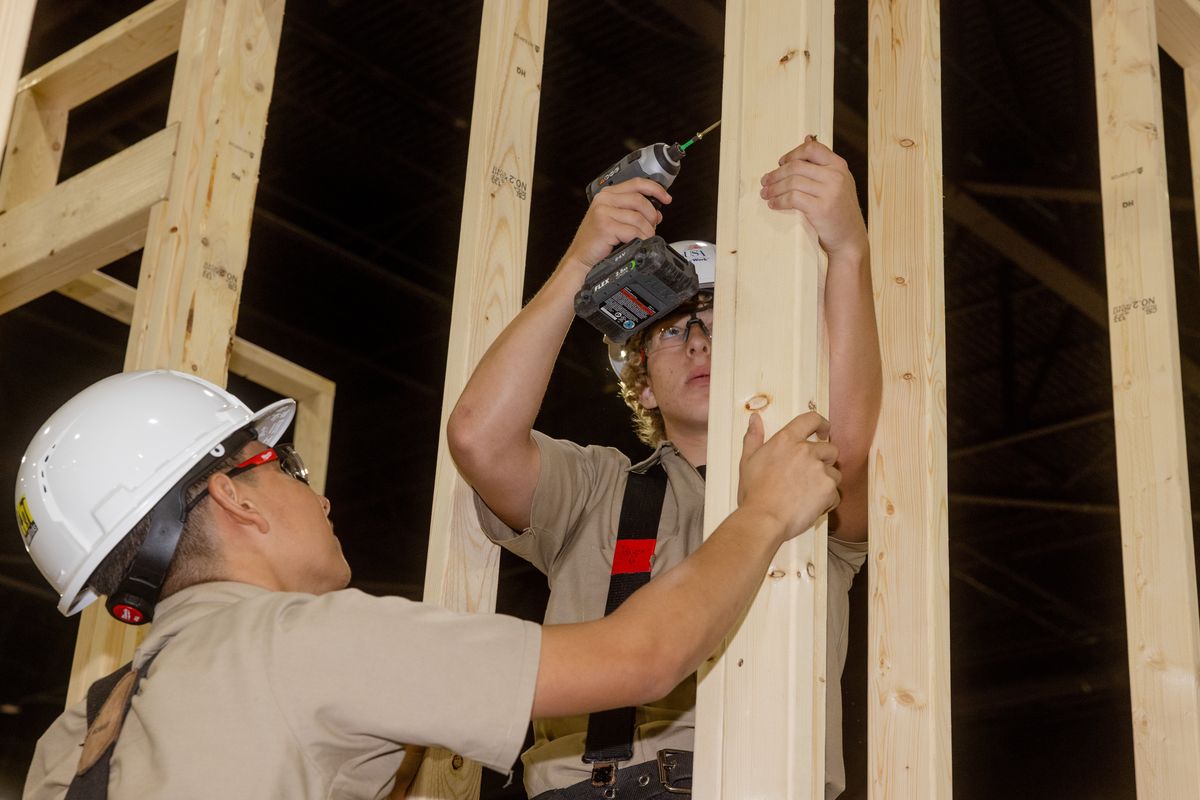
The plumber, the mason, the electrician and the carpenter arrived a full hour early to collect their blueprints. They had two days in June to build an 8-foot-by-10-foot tiny home inside the convention center in downtown Atlanta. They knew little else about their assignment, but they were eager to get started.
And they were ready to win.
The four-person crew, all students at Belton High School in Belton, Texas, were defending the school’s title as the reigning national champions of mock tiny home construction. Every year, about 6,700 students participate in roughly 115 trade contests at the SkillsUSA Championships.
In Belton, a town halfway between Waco and Austin, the prize for home construction could make the students stars. The teens could get attention from local and national homebuilders who scout their school and the convention for talent.
Belton High was the winningest in the 23-year history of the national TeamWorks contest, taking the top prize three times, including last year. But those boys had graduated and the new crew had never competed at this level.
And yet, the new team – plumber Joseph Fuentes, mason Bryson Necessary, electrician Erik Schiller and carpenter Jack Clark – knew that winning was expected.
“It’s a lot of pressure,” Joseph, 17, the team captain, said during a practice in Texas. “It’s big shoes to fill.”
The new team won the state competition to represent Texas in Atlanta, but they were now facing 37 other state championship teams.
On that morning in late June, Joseph, Bryson, Erik and Jack watched other contenders arrive, a hum rising from the dense crowd of teenagers. When the doors opened for orientation, they were the first to grab their seats. “These boys are all business,” said their coach, Michael Carrillo. “They just want to build.”
The road to nationals
Carrillo, 43, had been coaching young tradespeople to homebuilding victory for nine years. He knew the 2025 team lacked the experience and confidence of the seniors who made up the 2024 team.
This new crew was formed with limited options from his advanced construction classes – only five students tried out for the four spots.
Still, Carrillo saw the potential to mold a winning team.
Joseph was a junior, but his decision-making skills and ability to see the full picture made him an obvious choice for captain, Carrillo said. Fascinated by how gravity moved water through pipes, Joseph had wanted to be a plumber as soon as he took his first construction class his freshman year at Belton. His older brother was a plumber, and told Joseph that if he learned all he could from Carrillo and went to Texas State Technical College in Waco, where Carrillo once taught, he could go even further.
At 18, Jack, a senior who graduated in May, hadn’t thought about joining until Carrillo suggested it. Jack wanted to learn electrical, but Carrillo needed him to be the team’s carpenter.
Bryson, 17, joined Carrillo’s class thinking he might weld, but Carrillo directed him to masonry.
He wants to go into construction management. He recruited Erik, his friend since first grade, to enroll in Carrillo’s class.
Erik spent last summer digging a trench to lay electrical line to the family’s party barn. The work was backbreaking, but he was amazed to watch his great-uncle, an electrician, weave wires through pipes in the earth.
The team’s tempo was, at times, interrupted by Jack’s absence. As a senior and a striker on the high school soccer team, Jack ran with a different crowd and missed practices.
In April in Corpus Christi, the team beat 12 other Texas teams to win the state title. On that trip, all four boys really bonded, staying up late to goof off in the hotel room they shared, thrilled to be away from home.
But in late May, practice was more difficult. Jack was missing again – this time he was on a family trip to Rhode Island.
Building contest begins
Two weeks later, Carrillo, the team and their families were among 18,000 competitors and fans to descend on the Georgia World Congress Center.
The competition would last two days, but first they needed to get through the orientation. Jack worried that he would be asked to build a roof that was too complicated for him. Joseph’s plumbing would be tested to make sure it was airtight. Erik was so anxious that he lost his appetite.
The judges explained the rules: This design, the team learned as they unfurled their blueprints, would include three stories, a Juliet balcony, a window with an awning and a short brick wall. They would have to install rough plumbing and the electrical panel, outlets and wiring. Jack and Joseph filled their little black notebooks with directions from the judges that the team would later decipher back at the hotel room.
Hours later, the boys huddled in Joseph and Erik’s room with Carrillo until 12:30 a.m. The three-story design meant stairs and stairs meant math, and Jack would have to rely on measuring tape and memory to calculate their rise. “If you can figure it out, we’re money,” Carrillo said.
Several hours later, the teams stood at their stations, lumber at their feet, tool belts on their hips. The shriek of a red hand-held horn rang out at 8 a.m.
Within minutes, the Belton team had a big problem: All around them, framing began to rise, but not theirs.
Jack needed to cut the wood for the framing, but always a perfectionist, he measured and measured again before each cut. At 9:37 a.m., with only a corner piece of wall up, they stopped and took stock, whispering in a huddle about what they had to do to win. Without ever discussing it, they came to an agreement about what they had to stop doing to win: No more jostling to outdo one another. Time was the true adversary.
At 9:52 a.m., Bryson and Jack heaved up a wall, holding it in place while Joseph drilled the screws. After months of perfecting hammering a nail in a single blow, they had learned the day before that this build would use only screws. In a span of 40 minutes, three more walls rose.
By lunchtime, Belton had the basic structure built. By 1 p.m., Erik was installing the electrical panel and outlet boxes. They were among six teams that were “in good shape,” a judge said.
After the horn ended the first day of the competition, Carrillo worried the team was behind on the roof. Bryson was nervous about the sharply angled corner that would finish the small brick wall. To create corner, several pieces would need to be chiseled at sharp angles, a task difficult to complete without a brick saw.
Carrillo drove the team to Lowe’s to buy bricks and a chisel so that Bryson could practice.
Brotherhood and sawdust
Day 2 would be, as a judge put it, where the wheat separated from the chaff. By midmorning, the air smelled of butane and mortar. Only a few teams would finish, and it was not clear if Belton would be among them.
Bryson had planned to finish his brick wall by 2 p.m. to help Jack build the stairs, but the angled pieces were vexing. The bricks kept crumbling in his hands.
With 30 minutes left, at 3:30 p.m., the stairs were installed, but the treads were too short – Jack had grabbed the wrong size lumber and by the time he realized his mistake, he had already marked the wood to cut. Joseph made the call to keep going rather than start over and lose time. Bryson shattered his last remaining brick, ending his chances of chiseling the corner.
By 3:45, their fans gathered by the sidelines. “I’m about to throw up,” said Claudia Knox, Belton’s principal. Carrillo could see victory slipping away.
Then the boys attached the siding and the shingles, and with eight minutes to spare, they finished.
Bryson stepped back to admire his work, shrugging off the missing corner – no team figured out how to do it correctly. “It’s still the best wall I’ve ever done,” he said. Joseph passed his plumbing test, but he had made a glaring error: He had misread the blueprint and installed the supply lines for the shower 16 inches apart, not 8. He hoped the mistake wouldn’t cost the team too many points. Erik hoped the judges wouldn’t ding him for the missing wing nuts on his outlet boxes.
But only five high school teams had completed their tiny house.
‘Let’s go!’
First place was the only place that mattered to the Belton team, who wore red blazers with the SkillsUSA logo and 10-gallon hats to the awards ceremony. They had made a pact to only celebrate if they were No. 1.
Michigan, Pennsylvania, Texas, an announcer said.
“Let’s go! Let’s go!” shouted Carrillo, bouncing from his seat. The boys rushed to get to the stage. Joseph reminded them: Smile only for gold.
“Michigan.” The announcer called Bay-Arenac ISD in Bay City for the bronze medal.
Erik’s heart beat heavy in his chest. Bryson and Jack thought about that extra wall the Pennsylvania team had built. How could they possibly win with such a mistake? Joseph still had a sinking feeling about the stairs.
“Texas,” the announcer said. Belton had taken silver.
A flicker of disappointment crossed Carrillo’s face, before he replaced it with a smile. “It’s hard,” he said. “It’s hard to win here.”
Jack, head down, kicked the floor with his boot. Was it the stairs that cost them? Bryson didn’t mince words: “I wanted to be first.”
Joseph twisted his mouth, as he did whenever he was considering a problem. “It stings,” Joseph said. “You’re right there.”
He would go home to Belton to his first job – working as a plumber’s apprentice.
This article originally appeared in The New York Times.