
Two World War II bombers grace the Spokane Airport’s runways this weekend for anyone wanting to soar through the sky
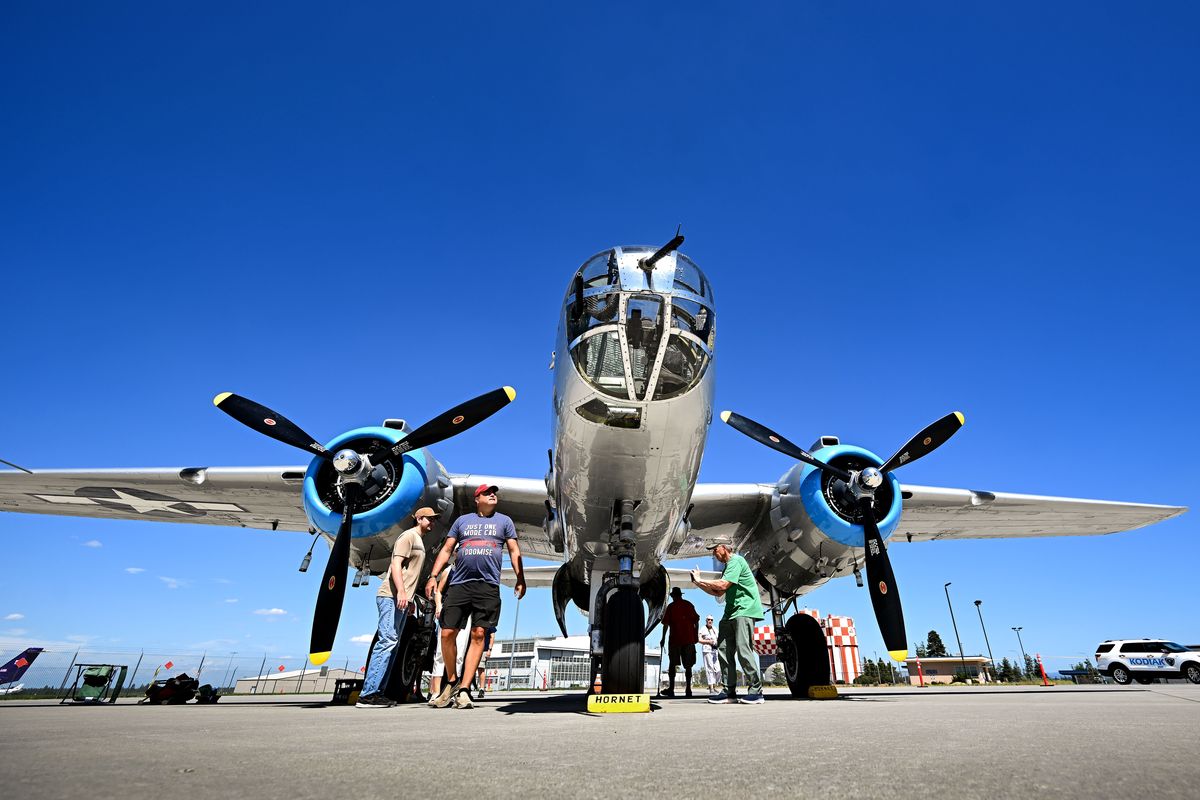
Sketched into the sides of the Maid in the Shade’s bomb bay doors are the signatures of dozens of veterans who served in World War II.
Some of the names are of crew chiefs during the war, some are soldiers who landed on Utah Beach, some are women who worked on production lines manufacturing planes and some are service members during the Doolittle Raids that saw all but one of the 16 B-25s sent to bomb Japan crash-land either in China, in the ocean or behind enemy lines. The most recent signatures are of children or grandchildren of veterans who served in the Second World War.
“We’re probably not going to have many more signings just because there aren’t any (people) left,” said John Smutny, a volunteer for the Commemorative Air Force. “So this plane becomes their voice.”
For anyone who has ever dreamed of flying in a plane from WWII, the opportunity has now touched down in Spokane. While the B-25 Mitchell nicknamed Maid in the Shade has been sitting at Signature Aviation, next to the Spokane International Airport, since Tuesday for ground tours, a slightly larger B-17 Flying Fortress called the Sentimental Journey graced the runway Friday. Both planes are now available for people to fly in this Saturday and Sunday.
For $375, anyone can fly in the waist gunner compartment near the middle of the Maid in the Shade. For $590, they can sit in the forward compartment. Similarly, the B-17 offers rides in the sky for $475 for passengers to sit in either the gunner or radio room section of the plane. For $850, passengers can ride in the nose of the plane called the bombardier seats. The B-25 allows for seven passengers per flight, while the B-17 can accommodate eight.
Anyone interested can book online at flyinglegendtour.com or call (480) 462-2992. Every flight requires four crew members on board.
Smutny is a load master. As part of his job, he briefs passengers on what they can expect from the ride and ensures that everyone is safe. Smutny said he has been interested in old planes since he was 15-years old and that volunteering for the Commemorative Air Force was a great way for him to be close to older aircrafts without having to buy one. His end goal is to become a crew chief.
“You can go to a museum and see one of these in a museum,” Smutny said. “But when you hear one, when you smell one, when you feel one, when you taste one, it’s a completely different world. It’s very visceral.”
Between the rumble of the engine, the taste of the smoke and the shaking of the plane, Smutny said that people who go for a ride sometimes experience a bit of sensory overload. Regardless of how shaken up someone might be during the flight, Smutny said everyone is always smiling once the wheels hit the ground.
The Maid in the Shade is one of 34 B-25s still flying today out of the nearly 10,000 produced. It’s also one of only two remaining B-25s to see combat during World War II. The Maid in the Shade is nearly 53 feet long. At one point, it contained 11 .50-caliber machine guns in eight positions, and mostly targeted supply lines as a low-altitude bomber. With a top speed of 239 miles per hour, the Maid in the Shade served two missions in Yugoslavia and 13 missions in Italy.
“If you would have told those guys 80 years ago that 80 years later we’d still be flying these, they’d laugh in your face,” Smutny said.
The Flying Fortress named Sentimental Journey is one of about 10 B-17s still soaring through the sky. About 13,000 were produced between 1936 and 1945 and 8,000 of them were lost during the war. With a length of 74 feet, max speed of 302 miles per hour, and with 13 machine guns in eight positions, the Sentimental Journey is a long-range, high-flying aircraft that earned the name “flying fortress” due to its ability to withstand heavy damage. Fortunately for the Sentimental Journey, the war was nearly over by the time it was ready to hit the sky in November 1944.
The B-17 got its nickname from Seattle Times reporter Richard Williams who saw the prototype Boeing plane in 1935 and exclaimed, “why it’s a flying fortress!” Not long afterwards, Boeing trademarked “Flying Fortress” for their four-engine heavy-bomber aircraft.
All the money raised from tours will go to repair and upkeep for both air vessels.
Additionally, All 17 people at Signature Aviation this weekend are volunteers who love keeping a piece of living history around for future generations.
“It’s just keeping history alive,” Smutny said as he touched the metal plating on the side of the B-25. “The voices on the inside of the bomb bay door are going silent. Pretty soon, this will be the only voice that’s left to talk for them.”