
Then and Now: Monroe Street Dam
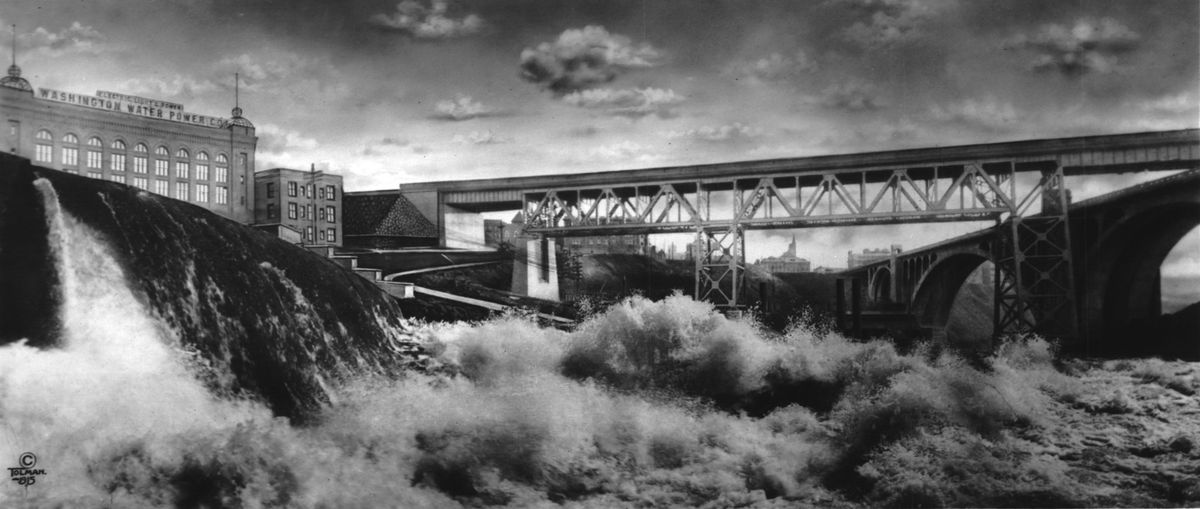
The thunderous spring runoff over the Monroe Street Dam on the Spokane River, thrilling visitors to Huntington Park in downtown Spokane, isn’t what Native people of the region or its first settlers saw before 1890, when the dusty settlement was called Spokane Falls and the river was a series of rapids stretching from Division Street to the Monroe Street Dam.
The year was 1889 when Spokane’s most successful business people formed Washington Water Power Company to use the energy of the flowing water to generate electrical power, which would transform the daily lives of people across the region.
The company’s first project was to create 18-foot high rock crib dam west of the Post Street Bridge to pool the water above the intake to the penstocks, the massive pipes which would feed the generators in the powerhouse at the foot of the Monroe Street bridge.
Rock crib construction, common in the 1800s, was a combination of stacked logs or timbers packed with rock inside. The mass of rock and wood was simple in design, but builders expected seasonal damage and knew that poured concrete would be more durable.
Engineers could see that heavy springtime flows and debris building up behind the dam could cause a failure.
In the 1930s, the WWP company would begin regular dredging behind the dam and other maintenance. But the decades of wear took its toll and the dam was noticeably damaged in 1971 and 1972. The utility planned to rebuild with a new concrete dam 30 feet downstream.
Environmental groups, including the Sierra Club and the Washington Environmental Protection Agency, collected signatures to push the Federal Power Commission to hold a full hearing on the plan. The Environmental Protection Agency, and an alliance of 13 environmental groups argued against the new dam in hopes that the river could to return to its original condition, at least through the world’s fair, which had an environmental theme. The debate raged in hearings and in local newspaper editorials for months.
But the new dam was approved and the structure was hastily completed in the winter of 1972. A 14-foot-diameter concrete penstock and intake structure with a public view deck on top was completed in 1973.