
Gay marriages have doubled in 10 years since Supreme Court ruling
A few months after Frank Bennedetti and Gary Trowbridge met, they went to a wedding. It was 1964. They stood at the back of the church. Trowbridge took Bennedetti’s hand, and he whispered, “This is as close as we’ll ever get.”
It was the easiest, surest commitment of their lives, and for the first 50 years of their relationship, they never believed they’d make it up the aisle themselves.
“It just seemed too far-fetched,” Trowbridge said. “I really didn’t think we’d ever get married.”
They did tie the knot in July 2014, on their 50th anniversary, at New York City Hall. But same-sex marriage was still illegal in North Carolina, where they lived, and in more than a dozen other states, so it didn’t feel completely real.
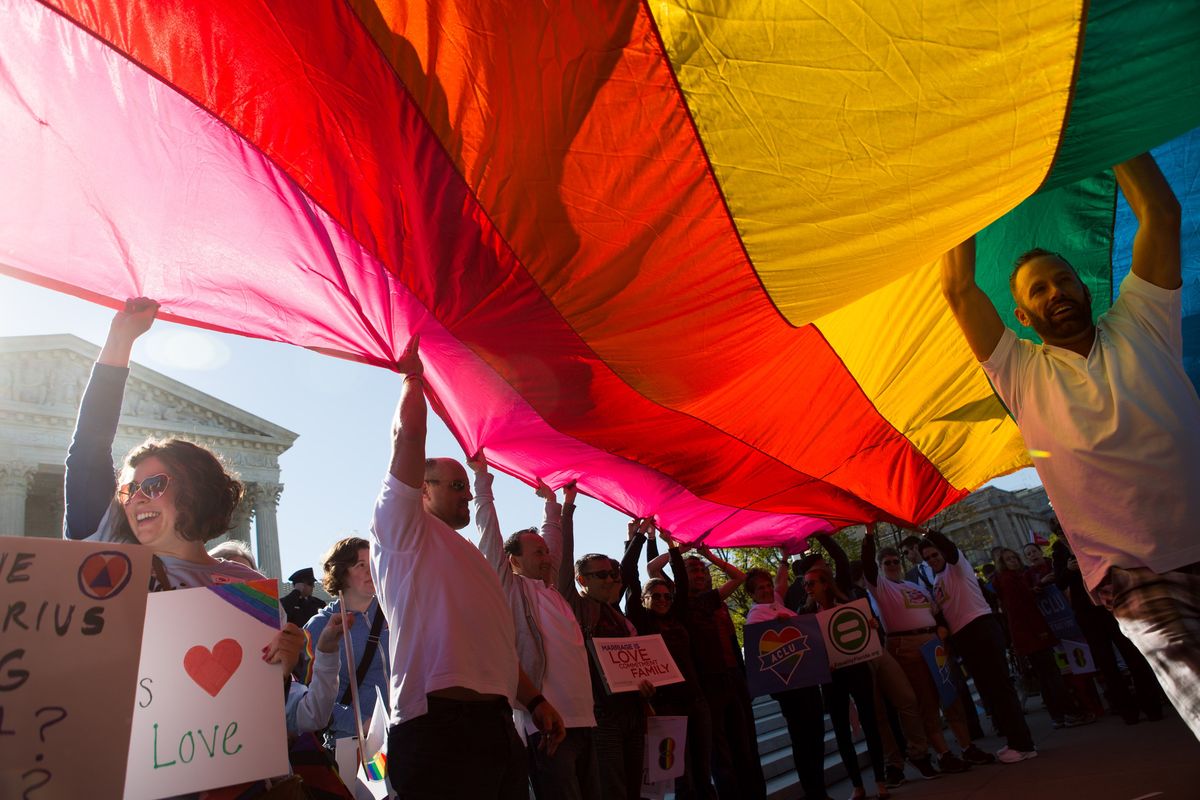
Then, in June 2015, the Supreme Court announced it would rule in Obergefell v. Hodges. Bennedetti and Trowbridge traveled to the courthouse in Washington, D.C. to see if the far-fetched had become a reality. When the Court announced same-sex couples would be allowed to marry no matter where they live, Bennedetti and Trowbridge cried, celebrated and hightailed it home to marry in their own state.
“We felt so relieved and justified,” Bennedetti said. “We had been fighting for this for so many years, but at long last, it was happening.”
In the decade since the Supreme Court ruled in Obergefell, hundreds of thousands of gay couples have married, according to reports from Gallup, the Pew Center and the Williams Institute at UCLA Law. The organizations estimate there are now between 820,000 and 930,000 same-sex married couples – up from 390,000 in 2014. That increase has also marked an enormous shift in public opinion. Today, nearly 70% of Americans believe gay people should have the right to marry, according to Gallup, up from 27% three decades ago.
But what once seemed like linear progress toward LGBTQ+ rights may be slowing. A growing number of state houses and public officials have said this year that Obergefell should be overturned. Public support has begun to decline slightly, and the share of gay couples who choose to marry has tipped down, too.
Before the Supreme Court ruled on June 26, 2015, that state-level bans on same-sex marriage violate the Constitution, gay people had fought for the right to marry since at least the 1970s. In the decades after the Stonewall Riots, gay couples sued, with varying success, to marry each other. States such as Massachusetts and Iowa eventually granted them the right, but dozens of others enshrined bans on same-sex marriage in law. By 2015, gay couples in more than a quarter of U.S. states still could not marry.
No region’s gay community benefited more from Obergefell than the South. According to data analyzed by the Williams Institute, the percentage of married same-sex couples there grew by 21% between 2014 and 2023. Today, 59% of Southern gay couples are married, up from 38% a decade ago. In states such as Texas and Georgia, the number of married same-sex couples has more than tripled.
Like Bennedetti and Trowbridge, Andy Miller and Brian Stephens spent the beginning of their relationship pretty sure they would never marry. They started dating in Texas in 2003, and they adopted their son, Clark, in 2007. Texas has banned same-sex marriage since 1973, and it reaffirmed that ban in the state constitution in 2005. The men knew they would stay together and raise a family, but they resolved themselves to creating that family outside the context of legal recognition.
For years, they taught other gay men how to navigate the adoption process. Before Obergefell, Miller said, there wasn’t a huge desire for their help. They knew some lesbians who wanted to raise kids, but many gay men they knew did not. That changed – seemingly overnight – after the Supreme Court legalized same-sex marriage, Miller said.
“After Obergefell, everyone we knew partnered up legally,” Miller said. “People were getting married, people were having babies, like it was crazy. From a stability standpoint, people saw it was possible and they realized, ‘Oh, we can be married. Oh, we could have kids.’ And I think all of a sudden a bunch of grandparents-to-be thought, ‘This is our chance. Now you can give us some grandchildren.’ ”
There are about 299,000 children under the age of 18 living in households headed by married same-sex couples, compared with 71,000 in 2013, according to the Williams Institute.
Nathan Cisneros, a researcher at the think tank, found that couples like Miller and Stephens experienced “real benefits – economic, health, benefits for family formation as well – in legal marriage.”
Cisneros and his team found that same-sex couples who marry have higher household incomes, higher rates of homeownership and lower rates of poverty than unmarried same-sex couples.
For Miller and Stephens, the Obergefell decision also made living in Texas feel easier. After the ruling, Stephens said, they no longer felt they could only hang out in gay bars or other safe spaces. Marriage, in many ways, made the men more “relatable” to neighbors and family members.
“There’s something that happens when the laws of your country accept you,” Stephens said. “There’s a confidence. There’s the freedom to move about. I think a lot of people, particularly people who were able to get married, take for granted the things that that affords you.”
Still, after years of holding steady, some researchers have found that the overall share of gay couples who marry has begun to decline. In the first few years after the decision, 10% of all gay people were in married couples, according to a new Gallup analysis. Today, just 8% are – roughly the same share that was married before the ruling. And the share of gay couples who are married rather than just partnered has also declined from 61% to 55%.
Jeffrey M. Jones, the senior editor of Gallup poll, said the shift mirrors the country’s overall declining marriage rates.
“LGBTQ people are just kind of following that same pattern where fewer and fewer people are getting married,” Jones said. “Whether you’re LGBTQ or not, there’s a movement away from marriage in the population as a whole.”
Kaleena Newman, for instance, has been in a committed relationship with Margaret Jacobsen for three years. They are both nonbinary. As a young person, Newman felt a lot of anxiety about their inability to marry, in part because their parents were high school sweethearts who are still together.
“A big part of my anxiety around being gay was that I wouldn’t be able to wear my mom’s wedding dress,” Newman said. “I don’t know that I ever actively felt like ‘I can’t wait for that to happen,’ but I felt, especially because of my parents’ history, like that’s what you do. I think I expected to do that thing because I wanted to be as normal as possible.”
Newman was 24 when Obergefell was decided, and in the years since, they have realized they don’t want to marry. It feels especially superfluous in Portland, where they live because they already enjoy many rights that married queer couples do. Both Newman and Jacobsen have been hospitalized, for instance, and doctors allowed them to accompany each other.
“I don’t feel like ‘Wow, this would really benefit me. I need this to prove to myself this is real or I need to prove to the government it’s real to be able to get health insurance,’ ” Newman said.
But Jacobsen feels differently. Theirs is an interracial relationship, and as a Black person, Jacobsen thinks often of the people who fought for their right to marry – not just in the Obergefell case, but in Loving v. Virginia, which legalized interracial marriages, and before that, in places where her ancestors were enslaved.
“It feels like such a big deal that people went to jail fighting for this,” Jacobsen said. “My ancestors worked really hard for it, and I want to honor that. There’s something about a ritual that I get to partake in because other people have done it. That feels really beautiful.”
Though that right is secured for now, Jacobsen knows some in America would like to rescind it. This year, both the Southern Baptist Convention and nine state houses, including Idaho, Michigan and North Dakota, have introduced resolutions urging the Court to overturn the decision. And Justice Clarence Thomas and Samuel Alito have indicated they would also like to overturn it. And while more than two-thirds of Americans still support same-sex marriage, a Gallup poll last month found that Republican support has dipped to 41% after peaking at 55% three years ago.
More than half of all same-sex couples live in one of 31 states that still have a marriage ban on the books, making them potentially vulnerable if Obergefell was overturned, according to estimates by the Williams Institute.
Though Jacobsen keeps a Pinterest board of gay weddings, and Newman laughs affectionately when Jacobsen cries at other weddings, the couple agrees on one thing: They are grateful they have the legal right to decide together what their relationship will be.
“It’s an extra freedom to be able to actually think about if I want to do this or not,” Newman said.
“Equality is often about agency,” Jacobsen added. “Other people already had these options. We just want the same thing. Some of us won’t even get married, but we want the same agency to choose.”