
Gaffing chinook: Nez Perce anglers practice ancient fishing method
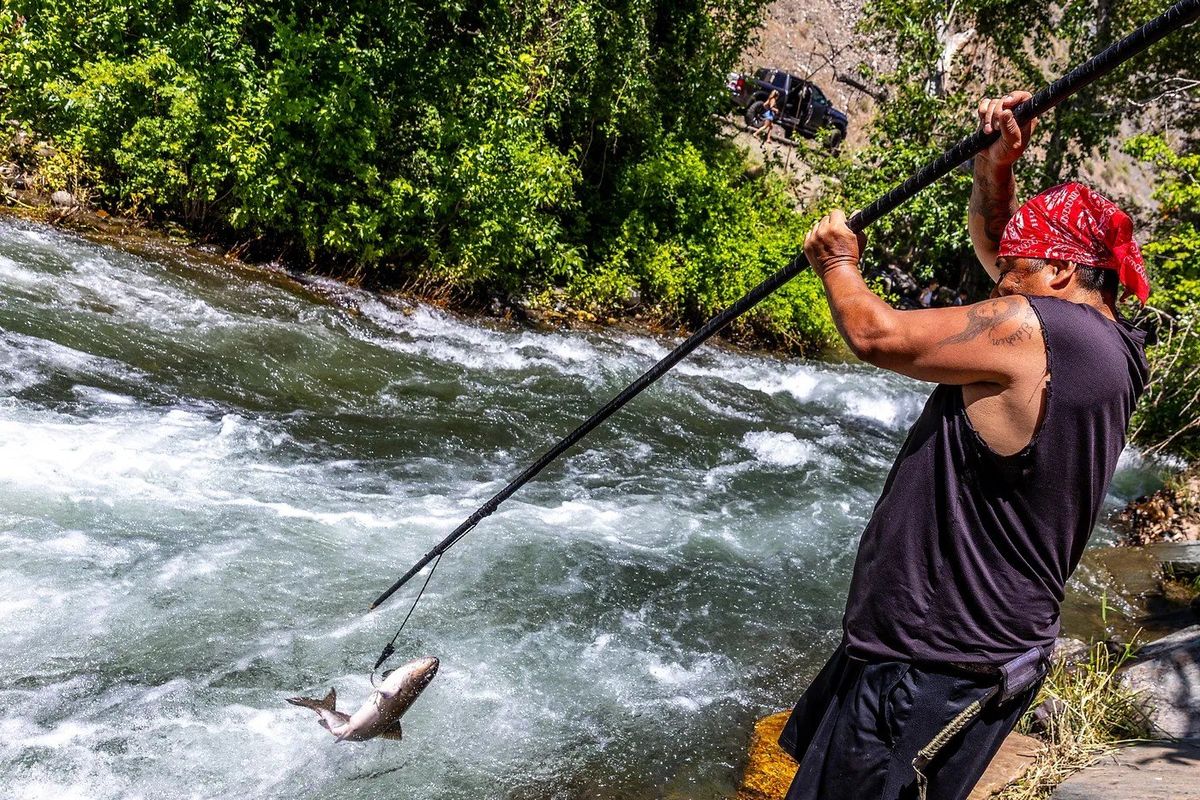
RAPID RIVER, Idaho – Virgil Holt Jr. reaches into the rushing water of Rapid River with a gaff pole and gently taps it along the rocky bottom as he draws it through a hole.
The traditional fishing tool is like an antenna of sorts, but one that is armed with a deadly barbed point.
With it, he can feel the nothingness of the frothy water and the hardness of the smooth rocks polished and shaped by the river. When he senses something between the two, the softer but powerful flesh of a spring chinook, Holt yanks the pole toward him. If he’s quick enough, the hook at the end of the pole will be buried into the fish.
Holt yanks and misses. He reaches back into whitewater, draws the gaff slowly toward him and then yanks with a lightning-like twitch.
The pole dances and bends as Holt lifts it with a spring chinook dangling from the gaff hook.
“Heck yeah,” he said.
Holt and other members of the Nez Perce Tribe are at the traditional fishing spot this month to catch spring chinook bound for the Rapid River Hatchery. Most of them are using dip nets, another traditional method used to catch spring chinook.
The nets are effective and catch fish without marring the flesh. But Holt likes to gaff as well. He calls it a dying art form that he aims to keep alive.
“There’s only, like five or six of us out of the hundreds of fishermen that do it,” he said. “It takes patience. You’re going around the rocks and you’re feeling. As soon as you feel that soft, you gotta be split-second (fast),” he says.
Jeff Scott likens it to fishing with his finger. The fish are deep, just off the bottom. The gaff probes blindly through the water.
“As soon as you touch that fish – that’s when you got do just a little pull and it hooks them,” he said.
Holt learned from his dad, the late Virgil Holt Sr., who died last fall. But as he was growing up, he also watched Scott.
“Besides my dad, I modeled my gaffing game after his,” Holt said.
Scott is 67 and still an active gaffer. He said the gear is lighter than a dip net and easier on his body.
“I caught my first salmon when I was 8 and I got really good by the time I was 10 and I’ve been that way ever since.”
His grandfather, Lyman Scott, brought him to Rapid River in 1962 when he was just 5 years old. That is before the hatchery was built and the river was straightened.
“We came here for fall chinook and Dolly Vardens. We didn’t come here for salmon, or not these salmon.”
He continued to fish there with his dad, Wilfred Scott, who, along with Virgil Holt Sr., participated in the confrontation at Rapid River between tribal members and the state of Idaho that reinforced the tribe’s right to fish on its own terms and under its own regulations. In a series of standoffs that started in the late 1970s and culminated in 1980, the state attempted to stop Nez Perce from fishing. Returns were low and the state wanted to ensure enough fish reached the hatchery for spawning.
The Nez Perce rejected harvest as a reason for lower returns and instead blamed Snake and Columbia river dams. They had reserved their rights to fish, hunt and gather in “usual and accustomed” places in the Treaty of 1855 and again in the Treaty of 1863 when the tribe ceded millions of acres of land to the federal government.
Dozens of Nez Perce fishers were arrested and cited by the state. A judge dismissed the cases. Now it is settled practice and law that tribes like the Nez Perce manage their own seasons and states manage sport fishing. Harvest is split evenly between the two groups.
Holt said gaffing can be more effective in high flows that make dip netting more difficult. He can also probe areas where dip nets won’t fit.
He’s working with younger anglers to pass on the tradition.
“They want to learn bad. They always see me packing fish and nobody else is,” he said.
Scott has passed gaffing on to his sons and to theirs as well.
“I got some grandsons that are pretty good,” he said.
Dip netters also probe through the water looking for chinook. But the process is a little different. They target holes and resting spots where the chinook pause while advancing upriver, and sweep the nets through it, feeling for fish.
Fletcher Penney wades into the rushing water and steadies himself. He reaches out with the net at the end of a 20-foot pole and sweeps it downstream, dipping through the hole where he thinks fish are holding.
When he feels a fish in the net, he rotates it upward in his hands and pulls it in hand-over-hand.
“You just bounce your pole off the rocks as you go down the river,” he says, pointing at a hole in front of a big rock. “You scoop right in there, and boom. You just got to feel where they are laying. Spend time on the river and you’ll catch fish.”
Holt sometimes attaches a GoPro camera to his gaffing and dip netting poles to capture underwater view. His videos are available on his Instagram page @virgilholtjr.