
Months after terror attack, New Orleans cautiously celebrates Mardi Gras
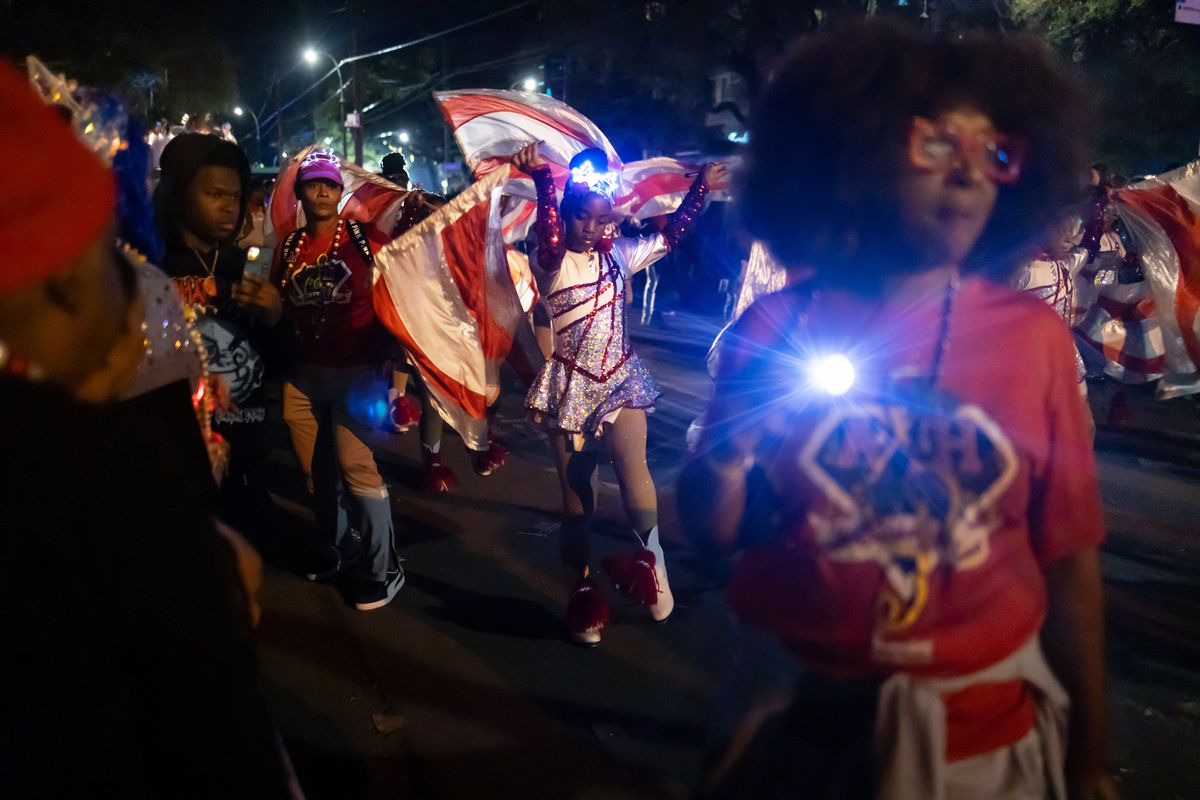
NEW ORLEANS – Almost everyone has their perfect spot to take in the full majesty of Mardi Gras parades here, from the brightly lit floats from which riders toss bounties of colorful beads to the precision of the marching bands whose booming bass drums serve as the heartbeat of the city’s cherished Carnival tradition.
For Tiana Johnson, that place has always been on the Uptown route, along St. Charles Avenue near the Interstate 90 bridge, where revelers have been known to bring their own sound systems to do amateur parade announcing, and impromptu dance parties frequently erupt in the street between parade floats.
“People who haven’t been here for this just don’t get it. … It’s magic,” she said.
But this year, Johnson, a New Orleans-area native, did not know what to expect during Mardi Gras. Only two months ago, a driver raced a rented Ford F-150 truck down several crowded blocks of Bourbon Street in the city’s French Quarter, intentionally ramming dozens of pedestrians. The New Year’s Day terrorist attack left 14 people dead and deeply rattled a city known for its easygoing, life-of-the-party spirit.
New Orleans Mayor LaToya Cantrell requested and was quickly granted additional state and federal security assistance ahead of the Super Bowl, which the city hosted on Feb. 9, and for the century-old celebration of Mardi Gras. The final two weeks of the annual pre-Lent celebration, underway now in a crescendo featuring the biggest parades and estimated crowds of several hundred thousand people, was elevated from its usual Special Event Assessment Rating 2 to SEAR 1, a Department of Homeland Security designation given to “significant events with national and/or international importance that request extensive federal interagency support.”
For the Super Bowl, that meant some of the strictest security measures ever seen in the city – including rooftop sniper teams, steel vehicle barricades, and bans on large bags, packages and coolers in the French Quarter. But many here wondered what that designation of intense security would mean for Mardi Gras – a rolling, miles-long party of parades across the city, known as much for their pomp and revelry as they are for their informality and accessibility.
New Orleans officials have faced scathing criticism and multiple lawsuits in the aftermath of the Jan. 1 attack, with the city and its police department accused of ignoring warnings about security vulnerabilities and public safety risks in the French Quarter and around other major public events, including Mardi Gras. In recent weeks, rumors circulated about parades being intentionally shortened and rerouted to make them easier to guard, and the imposition of tougher security measures like those enacted during the Super Bowl, including a ban on coolers and other large items along the parade routes. While none of the longtime parade routes has been altered, there has been a significant change: a flood of law enforcement in highly visible positions during the festivities as a deterrent against any potential wrongdoing.
On Thursday, as Johnson arrived to wait for the Krewe of Muses, one of the season’s most anticipated parades, she was surprised to find that many of the things she loved about Mardi Gras remained mostly the same. Kids were tossing a football in the street, maneuvering around adults who were dancing to a soundtrack of Lil Wayne blaring from a nearby speaker system that had been wheeled in via wagon. There were open tents and tables packed with snacks on the neutral ground, a grassy area nestled between the north and south lanes of St. Charles Avenue where tracks run for one of the city’s famed streetcars.
“It feels normal, but then it isn’t,” Johnson said. As she spoke, her face, painted with purple, gold and silver glitter, was bathed in a blinking blue light from one of the many police cars parked along the neutral ground. They were flanked by officers from multiple city, state and federal law enforcement agencies – part of what city officials have described as an unprecedented deployment of security ahead of Fat Tuesday, the official end of the Mardi Gras season.
More than 1,300 city, county, state and federal officers have been deployed on the parade routes, including 600 New Orleans police officers. About 550 Louisiana National Guard members had come in to help as of Friday, while more than 200 Louisiana State Patrol officers have been positioned along the routes and in the French Quarter. Officials on Friday also began limiting large items and blocking vehicle traffic along several streets, including Bourbon.
Twenty-five state agencies around Louisiana have deployed more than 200 other officers, while an unspecified number of federal agents along with bomb-sniffing dogs and plainclothes officers are also on the ground in the run-up to Tuesday. Those familiar with Mardi Gras planning say the law enforcement presence on the parade routes is about two to three times that of past years and does not include additional private security officers that some of the larger krewes have retained to protect their celebrations.
During her traditional walk of the St. Charles parade route last week, the New Orleans police chief, Anne Kirkpatrick, cited the influx of law enforcement and called New Orleans “the safest city in America” right now.
But in a predominantly Black city, where residents of color have had a troubled relationship with NOPD and have been shaken by rumors of stepped up operations by Immigration and Customs Enforcement officers under President Donald Trump, Kirkpatrick and others have sought to soothe alarm over the security presence.
“You’re going to see SWAT teams. You’re going to see BearCats,” she said, referring to armored vehicles used by law enforcement. “You’re going to see those types of things. But please … don’t worry about that. They are your protectors.”
But she also cast those measures as something that should not dampen the Mardi Gras spirit: “Just have a good time, OK? Let us be the ones just taking care of you. Do not be disturbed by the presence. … We’re just here to make sure you know that you are safe and that you can also feel safe.”
Her Feb. 20 comments came days before footage was widely shared on social media of DHS officers driving their armored vehicle in one of the parades last weekend and appearing to blast the Vanilla Ice song “Ice Ice Baby.”
On Wednesday, the officers were positioned adjacent to a Mexican restaurant along St. Charles Avenue, as one stood atop the vehicle using binoculars to monitor the crowd, including those who emerged from the restaurant onto the parade route. It was a more stringent posture than that taken by New Orleans police and other local agents who were standing alongside and actively engaging with many paradegoers and participants, swaying to the music and even occasionally catching parade throws.
Many adjacent streets leading to the Uptown parade route were blocked by police or military vehicles or wooden barricades. Last week, New Orleans officials installed a weaving “serpentine” maze of large water-filled barriers for several miles limiting the speed of cars traveling on the opposite side of St. Charles Avenue. Some residents who have been forced to navigate the barriers during days when the parades aren’t running have described it as a real-life game of Mario Kart, but Kirkpatrick has said it’s a deterrent. “That will slow anyone down who thinks they are going to use a vehicle as a weapon,” Kirkpatrick said, alluding to the Jan. 1 attack.
A few feet away, the neutral ground was lined with dozens of heavy concrete barricades, aimed at blocking any vehicle from trying to drive into the parade route, a first-time addition. But the barricades have also served as impromptu seating for paradegoers; dozens were sitting on or standing atop them as they sought to catch beads and other parade throws.
While law enforcement officials have not barred people from bringing coolers onto the parade route, they have said they will enforce a ban on grills – a new rule that was approved last summer by the New Orleans City Council as part of several guidelines to make the route safer and more accessible.
So far no one has appeared to be violating the rules, but many wondered if that would remain the case leading into Tuesday, when families and other large groups are known to arrive in the predawn hours to grab their spots along the St. Charles parade route to grill and cook for the day as parades roll by.
“It’s a part of the culture here,” said Latrice James, whose family had sometimes arrived as early as 3 a.m. to stake out a spot for Zulu, a historic Black parade that rolls first thing Tuesday and is one of the most anticipated events of Mardi Gras. “You cook, you eat, you watch the parade go by. That’s Mardi Gras,” she said as she stood along the packed sidewalks Friday waiting for the Krewe of Hermes to kick off the final weekend of parades.
When pressed on what her family might do this year, James gave a coy smile and declined to say. But she guessed that some might try to block spaces on adjacent streets to smoke their chicken without getting in trouble, or find a place in a nearby parking lot. And if others were cooking on the route without getting a ticket, some adjustments could be made on the fly.
“Gotta have a grill with wheels,” she said.