
A small Montana town has thrived on federal jobs. Now come Trump’s cuts.
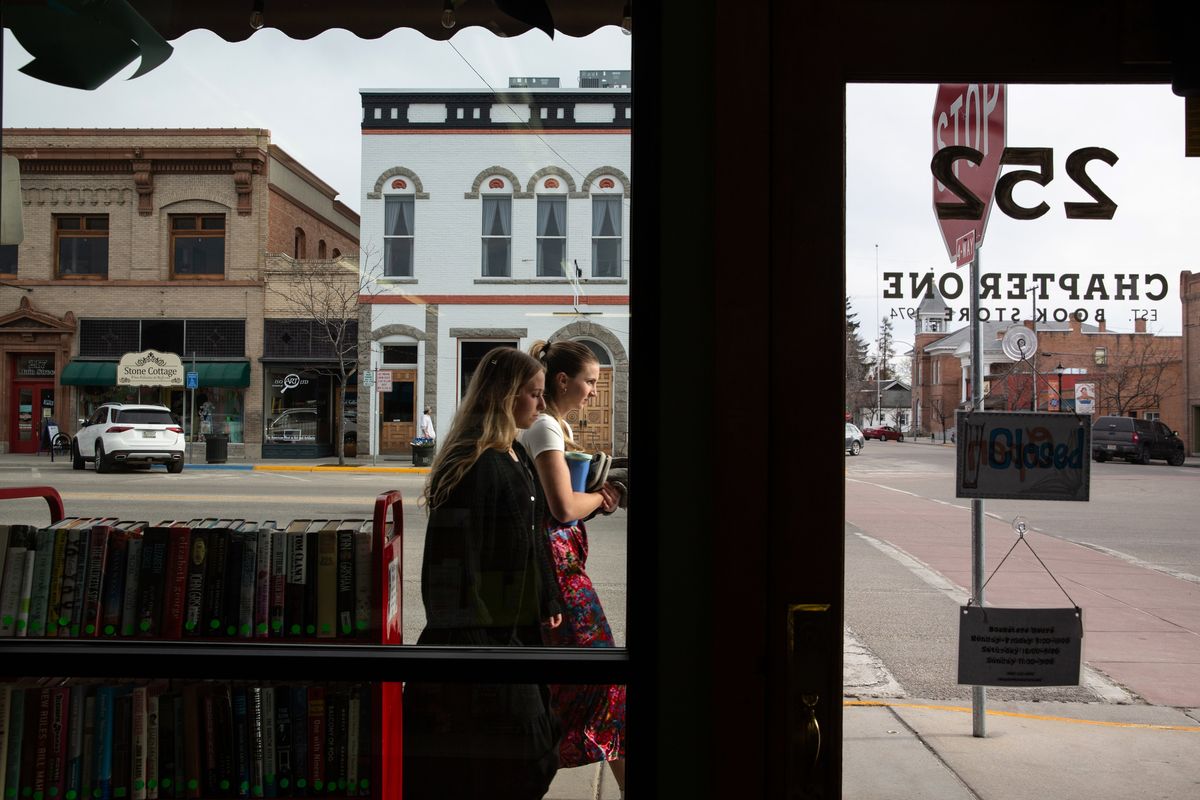
HAMILTON, Mont. – In an era of rural decline, this town of 5,000 touts art galleries and upscale cafes. Its Main Street, with a homegrown department store still going strong after 75 years, remains a draw not just for locals but for the tourists who come to explore the surrounding mountain wilderness.
But many people worry that the future is at risk. Hamilton has depended for decades on what seemed a reliable economic foundation – the federal government, which employs hundreds at a world-renowned scientific laboratory and in the Bitterroot National Forest. Now staff and funding cuts at both are shaking this pocket of deep-red Montana, prompting its leaders to warn the Trump administration of “dangerous safety and economic consequences” and sending citizens into the streets to protest.
As one saying here goes, locals either have a Ph.D. or a GED. It’s wry recognition of the outsize role of federal employment in an area where most alternatives pay little despite a median home price of about $600,000. Hamilton leaders fear researchers at Rocky Mountain Laboratories and forest managers who lose their jobs are likely to leave, taking their salaries, families, firefighting skills and community contributions with them.
“They are participating in the local economy. They’re volunteers for our nonprofits, for our schools. They’re very engaged citizens,” said Robin Pruitt, the city council president. “We know that our community would be devastated to lose these community members.”
The dynamic has made Hamilton a prime example of the ripple effects of the administration’s efforts to drastically shrink the government. The consequences of pink slips always reach beyond the individual employees fired. Yet they feel magnified in a town this size.
“This is the small business, main street American economic impact,” said Mary Casper, who watched with alarm as the labs canceled bookings for visiting researchers at her motel in downtown Hamilton.
The scope of the firings and buyouts is unclear because the White House has not made numbers public. At the labs, a scientist who is keeping a tally counts at least 25 of 573 people gone, most of them support staff. Fourteen more are expected to leave or be terminated by June, according to the scientist, who talked on the condition of anonymity because workers are not permitted to speak publicly.
At the national forest, some 30 to 40 of 208 employees have been fired or have left through various incentive programs, said Melissa Pingree, a Bitterroot employee who’s on the executive council of the local federal workers union.
A spokesperson for the Department of Agriculture, which includes the forest service, said via email that staffing numbers continue to be finalized; operational firefighters were not offered voluntary retirement and deferred resignation, according to the service. The National Institutes of Health did not respond to a request for comment about staff cuts at the labs.
This spring, the city council moved a listening session on the cuts from city hall to the middle school, a larger venue to accommodate more than 200 attendees. Though Hamilton leans more blue than the broader river valley, the council had seen its share of ideological battles – a proposed rainbow-painted crosswalk sparked a “holy war” a few years ago, Pruitt recounted – and was unsure how heated the meeting would get.
All comments were on one side: Protect federal jobs.
The council responded by passing a resolution opposing the cuts and pleading, in letters to NIH and the Agriculture Department, to consider its perspective. “We’re just about as low on the government pecking order as it comes, but we had to do something,” said Pruitt, whose position is nonpartisan.
But this is Trump country, and Ravalli County’s three Republican commissioners, who represent a jurisdiction where 69% of voters backed the president, see the situation differently. At a recent meeting, dozens of residents urged them to press Montana’s congressional delegation to challenge the staff reductions. “Some of the people making cuts could not tell the difference between a deer and an elk,” a former lab worker said.
“There’s some reason for concerns,” commissioner Greg Chilcott responded, “but at the same time, we’re 37 trillion dollars in debt as a nation. … Something has to be done.”
His comments were booed.
Like the rest of the lush Bitterroot Valley, Hamilton once thrived on timber. Those jobs dried up with the closure of sawmills, and few here expect even tariffs on Canadian lumber to revive the industry.
Luckily, the town had something else: Rocky Mountain Laboratories. It began more than a century ago with scientists in sheds and tents researching Rocky Mountain spotted fever, a deadly tick-borne disease. And while a moat was dug around the facility in its early days, to assuage residents’ fears of tick escapes, the labs have long been a source of pride for many.
It has been at the forefront of infectious-disease research, producing a yellow fever vaccine during World War II, identifying the bacterium responsible for Lyme disease and contributing to immunizations for Ebola and COVID-19. Today its work draws scientists from around the globe. A 2023 University of Montana report found that the labs support 1,497 Montana jobs, $89 million in after-tax income for households and $232 million in annual business revenue.
Hamilton’s backdrop is the 1.6-million acre Bitterroot National Forest, a wonderland of hiking, hunting and fishing. Visitation and migration boomed during the pandemic and grew more when the smash television series “Yellowstone” started filming in the county.
The federal government accounts for 4% of jobs but 8% of wages in Ravalli – both numbers significantly higher than the statewide figures, according to Bryce Ward, an economist in Missoula.
The combination of solid salaries in a charming town next to an outdoor playground makes this place a coveted assignment. Everyone in Hamilton knows someone who works at the labs or the forest. Some households have two federal salaries. Their children are on teams and in classrooms, where lab employees volunteer in an after-school science program.
Kara Bond landed a job last year as a forest archaeologist. She loved the work, and she loved Hamilton, where she rented an apartment that backed up to the Bitterroot River. She began to imagine staying for the long haul in what she calls “the quietest place I’ve ever lived.”
But she was still a probationary employee when the Trump administration fired thousands of workers in that category in mid-February. The email came in as Bond was at a chemotherapy session for breast cancer.
She gave up her apartment and moved to her home state for treatment, only to have a court ruling lead to her reinstatement. Now she’s working remotely and hoping she will still have the job and be able to return to Hamilton after she has surgery in May.
“Nobody knows who’s going to get RIFs,” she said, meaning reductions in-force or more layoffs.
Jeff Burrows, a county commissioner whose district includes the labs, said he feels for those losing jobs. He is also uneasy about the lack of transparency on how deep the cuts will be and how they’re being orchestrated by people in Washington.
He’s no drain-the-swamp guy; he thinks forest service employees have been crucial partners to the county. Still, Burrows said he understands the administration’s focus on slashing costs.
“I don’t think it’s going to devastate our economy from the proposal so far that I’ve seen,” he said in an interview.
Yet business owners are already feeling the cuts. Allegra printing has long worked with the forest service and the labs, producing signs and materials for presentations. That generated additional business from NIH divisions based elsewhere, said co-owner Michelle Mendenall, who estimated the federal purchases typically make up 10% of Allegra’s revenue.
The lab orders are gone for now, she said. At a community event, a lab employee told her his department had “just a couple of us left.”
“I’m 20-something years into these relationships,” Mendenall said. “You’ll start a project one week, and you’ll talk to them on Friday, and you email them on Monday, and they’re not there anymore.”
Casper and her husband bought the City Center Motel two years ago and spruced it up, confident it could become profitable and inject more money into downtown. Soon it was getting good reviews, and lab officials started booking rooms for their visitors.
Last year, two people from Africa stayed for three weeks. Nine people came from Europe to attend a four-day conference. In 2024, the motel logged $15,000 in reservations from the labs, about 10% of its total. By year’s end, the 2025 calendar already had $5,000 in lab bookings.
Weeks after the president’s inauguration, a travel freeze led to them all being canceled. Such losses “can make or break your year,” Casper said.
Inside the labs, supplies are low because much of the purchasing department has been let go. New experiments are on hold. So are maintenance contracts, meaning critical machines – mass spectrometers, electron microscopes – cannot be fixed if they fail, according to Kim Hasenkrug, a scientist emeritus who remains in close contact with lab employees.
“A lot of those experiments are time critical,” he said.
At the forest, beyond keeping toilets clean and maintaining trails, there are concerns about how to fulfill the administration’s greater focus on timber harvest and fire mitigation with a smaller staff.
“You need all the people that know this stuff,” said Mary Williams, a retired Bitterroot archaeologist who lives in Hamilton. “There’s so much that goes into managing the forest.”
Commissioner Burrows does not completely disagree. Ravalli is 73% federal land, and he said the forest service has struggled to stay on top of trail and road maintenance. In one of the nation’s highest-risk wildfire areas, Burrows and others are well aware the county relies on federal funding and workers to ensure its safety.
For now, he said, the commission is in wait-and-see mode, “trying to keep our roads paved and trying to keep public safety going.”
He does wonder where all this will end up.
“If you’re going to reduce the number of people, if you are going to reduce the cost, you are going to see a service reduction, and what are people going to tolerate?” he said. “Because it’s unrealistic, I think, to expect the same level of service with less folks on the ground.”