
Cool critters: Western meadowlark song the best of early spring
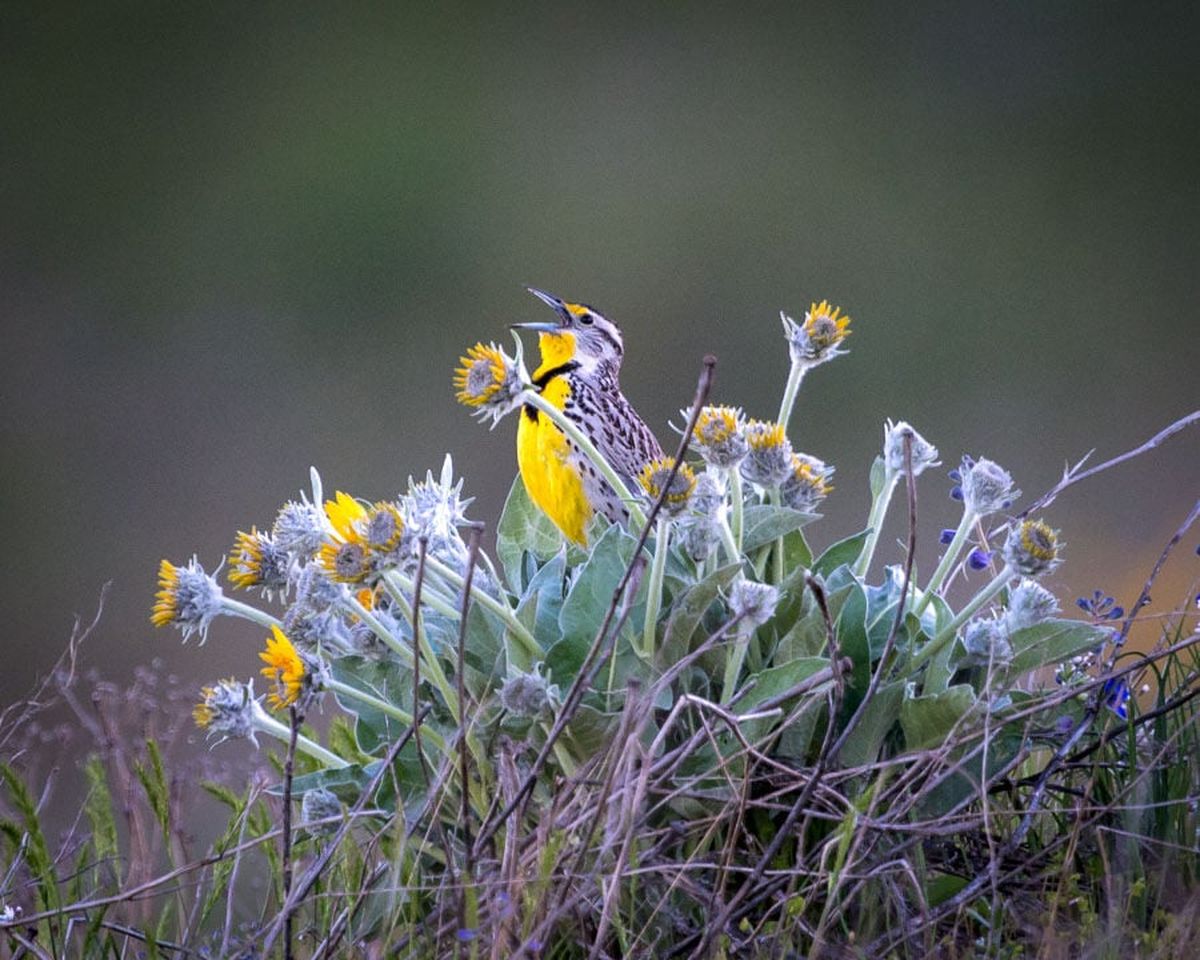
A striking bird that trills a beautiful song, the western meadowlark seems the ideal feathered friend to spotlight on Mother’s Day.
Not only does the bird flash a daffodil-yellow breast emblazoned with a jet-black V, it also sings a flutelike melody.
“Their song is marvelous,” said Lindall Haggin, a 55-year member of the Spokane Audubon Society, adding that the meadowlark is among the first migrating birds to arrive to the Inland Northwest each spring.
“Early spring is when their mating season begins,” Haggin said. “Often what we hear are the males singing to attract mates or mark their territory.”
Male meadowlarks belt out their most recognizable and melodious song during courtship. Perched atop fence posts, shrubs or other high points with their heads cocked back and beaks opened wide, they emit a cascade of high-pitched whistles followed by a lower-pitched jumble of warbles.
The notes ring out across fields, meadows, pastures and other open, naturally grassy areas where the birds breed throughout the West and parts of the Midwest, according to the National Audubon Society. In more urban areas, the birds are drawn to parks and roadsides with low-to-medium-height grasses where they forage mostly for insects, the Audubon website states. Only occasionally do they feed on cultivated land.
Recognizing the musical intricacy of the meadowlark song, famed jazz musician Dave Brubeck wrote a composition based on it. According to davebrubeck.com, Brubeck frequently heard western meadowlarks sing while growing up in Amador County, California. Later, he composed the piece, “Strange Meadow Lark,” which was released in 1959.
If you listen to the song off the legendary “Time Out” album, you’ll find that the pitch and pattern of Brubeck’s piano solo sound remarkably similar to the meadowlark’s primary song.
So, whether you live near the rural community of Roslyn or in the city of Spokane, you’re more likely to hear a meadowlark than see one. Often shrouded by grasses, this lovely, robin-sized bird is most visible when singing its heart out from elevated perches. Their nest is hard to spot as well, as the female builds a grass-lined depression in the ground and conceals it with surrounding vegetation.
Although the meadowlark is widespread and common in Washington state, “their numbers are generally good but going down,” Haggin said.
And not just in Washington.
Since 1966, the western meadowlark population has declined about 1% each year in all but two of the states it inhabits, “resulting in a cumulative decline of about 37%,” according to the Cornell Lab of Ornithology. That’s because native grasslands – the habitat that meadowlarks need for feeding and nesting – are disappearing, mostly due to suburban development and agricultural intensification, the agency states.
To head off the population decline, North Dakota, which named the meadowlark its official state bird in 1947, recently launched the “Meadowlark Initiative” to help recover meadowlarks and other avian grassland species.
If Theodore Roosevelt were alive today, he’d be thrilled. Our nation’s 26th president came to adore the western meadowlark while spending time at his ranch in the Dakota Badlands. Roosevelt, who championed the conservation movement during his presidency, called the meadowlark’s song “inexpressibly touching” in his 1885 book “Hunting Trips of a Ranchman.” The bird is “one of our sweetest, loudest songsters,” he wrote, “singing for hours in rich, bubbling tones.”
And talk about a coincidence. Roosevelt also helped promote a women-led campaign to launch a nationally recognized Mother’s Day on the second Sunday of each May.