
Orchard Prairie students tidy small cemetery, graves of prairie pioneers in historic school district
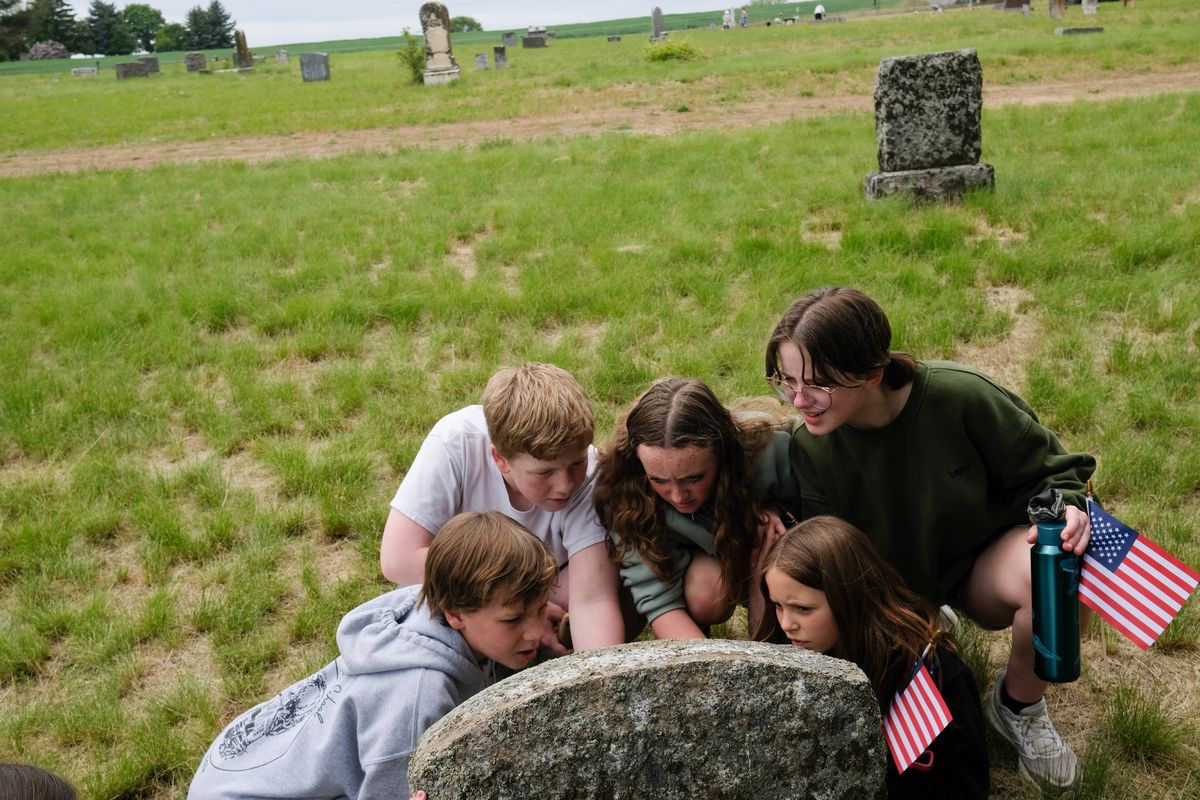
As she meandered the small Orchard Prairie Cemetery, Ann Jones was startled to see she recognized some of the last names engraved into the headstones.
They’re the same surnames of some of the kids with whom she’s worked as a paraeducator at the Orchard Prairie School District, which enrolls 79 kids on a secluded grassy hilltop about 20 minutes from downtown Spokane.
“It’s weird to walk around here and see some of the kids’ names,” Jones said.
Though geographically close to Spokane, the prairie has maintained its individuality with detailed recorded history from residents, the oldest operating schoolhouse in the state and a tiny cemetery where lay many of the area’s historical icons.
Each year, in observance of Memorial Day, about 40 students take the mile-plus trek from their two-school campus to the prairie’s acre-sized cemetery for a service project in honor of the veterans and prairie pioneers buried in the historic grounds.
“I like to think that this place is really honored for the entire community,” seventh-grader Maddy Weeks said. “I mean, the community loves this place; that’s why we clean it up all the time.”
Students trod the gravel roads lined with recently plowed farmland abuzz in cricket song as a pair of horses trotted to greet the parade and students proudly pointed at their own homes. On the journey, they followed roads bearing some of the same names they would see on the oldest headstones at the graveyard.
“They’re named after people that lived here,” explained August Czapla, in fifth grade, standing in the cemetery and pointing to stone markers. “Like there’s Palmer, and then there’s one over there – that’s Espe, and then there’s Sprague.”
On Thursday, the students poked around the cemetery, moving from headstone to headstone as they looked for references to military time served on the markers. They left a small American flag by each veteran’s headstone, with some serving as far back as the Civil War. Kids also cleared the occasional piece of litter; there’s not much, thanks to another group that cleaned the space a few weeks prior. They even propped up some headstones that had broken. On particularly overgrown headstones, students used a brush to carefully scrape lichen and moss from the markers.
“We want people to be able to read the graves,” August said.
“There’s no flowers on a lot of these graves, they’re so old,” Maddy said. “So, it’s good to be here to honor them.”
The yearly trip helps to put history into perspective for the young students. Cynda Weitz, who teaches fifth through seventh grade, can lead all the lessons she wants about war, but seeing the concrete effects on their small prairie community makes a war’s impact undeniable.
“We talk about wars; we talk about these things in history, at least in my class especially because they’re the older kids,” Weitz said. “But it’s hard for them to make a connection; people really died. They come here and they’re like, ‘Oh, people in our community; people that were family members of people we know are here, and they’re buried.’ ”
Placing a flag and dusting off the oldest headstones instills respect, Weitz said.
It’s a level of veneration for the dead that some don’t need to be taught. Some students have family buried at the cemetery, from recent relatives to ancestors they’ve never met.
Student Joh Lathrum pauses for a beat in front of a marker belonging to his two great grandparents. He and his cousin, who also attends Orchard Prairie, recently rode their bikes to the cemetery to place a bouquet of artificial flowers at the headstone. They died when he was much younger.
As the kids’ minds began to wrap around the years of local history under their feet, much of it centers around their school, built 1894 and the oldest operating schoolhouse in the state.
The people who built the school are buried in the cemetery, as are their children and grandchildren and so on, all learning in the same structure that younger students occupy today, Weitz said.
“They’re finding out all about the history of where their families came from, where this community came from,” Weitz said. “It’s not just some houses that popped up. This is a community, and has been a community for hundreds of years.”
“This person died five years after the school was built,” said one student, wiping debris from a headstone of someone who died in 1899.
“They definitely went to the old (schoolhouse) that was made in 1894,” another kid said in reference to another grave.
The local history is important to instill, Weitz said, especially in Orchard Prairie, which holds its heritage like a badge of honor, with residents cataloging ancestral and recent events in books that pull from documents from the time.
“They know that our school was built in 1894; they know that,” Weitz said. “But to see that these people came and built a community, and they’re now the beneficiaries of that community that’s been growing for hundreds of years, it’s cool for them to see.”
Reading the graves is one of the highlights of the field trip for many, who appraise every marker and engraved names, dates and epitaphs. They scour the cemetery for the earliest birth year, 1819; the youngest person buried, a 2-month-old; and the oldest grave, that of 14-year-old Eber Palmer who died in 1884.
The Palmers, one of the pioneering families, have a road on the prairie that shares their name. The Palmer patriarch, Oren Palmer, donated an acre of his property to become the community’s cemetery after his son, Eber, died. His was the first known pioneer death at Orchard Prairie, according to a prairie history book kept by the school’s administrative assistant Heather Roark. Roark’s parents live in the original Palmer homestead, she said, and the history isn’t lost on her.
As they take care to tidy headstones, the students know the space is important to their neighbors. It’s not only physical evidence of the pioneering history held so close, but to some a reassurance that they may have a site forever on the prairie.
“People up here will know that they have a resting place to be when they pass away,” fourth-grader Edan Anderson said. “And not some random place far, far, far, far away.”