
Dick Cheney in Spokane: What former VP – instrumental in the U.S. War on Terror – said about the conflict while visiting region
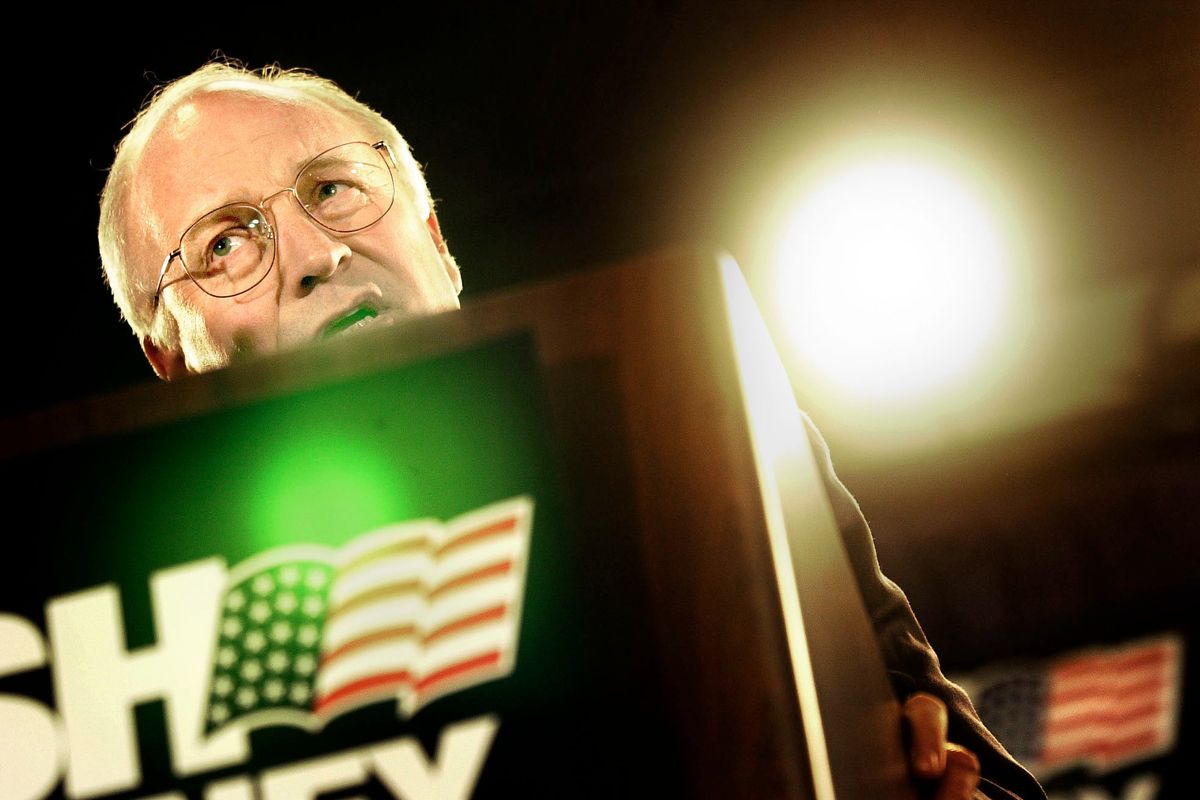
Former Vice President Dick Cheney died on Tuesday at the age of 84. A proponent of aggressive U.S. foreign policy, the former Wyoming congressman and defense secretary emphasized military power in three visits to Spokane and Coeur d’Alene.
As the running mate to George W. Bush, then governor of Texas, Cheney made a campaign stop in Spokane on Oct. 25, 2000, just a day after Democratic presidential candidate Al Gore spoke at Gonzaga University. In a stump speech at the WestCoast Grand, now the Centennial Hotel, Cheney promised change after eight years of the Clinton administration, where Gore served as vice president.
“I think the evidence is absolutely overwhelming that the state of the U.S. military is worse off today than it was eight years ago,” Cheney told a crowd of 500, according to a Spokesman-Review report at the time.
Cheney also weighed in on the fate of the four hydroelectric dams on the Lower Snake River, taking a shot at Gore for the Democrat’s silence on the issue the previous day.
“I’m an avid fisherman, but I don’t think breaching the Snake River dams makes sense,” he said.
Just below the story on Cheney’s visit on the front page of The Spokesman-Review was an update on the bombing two weeks earlier of the USS Cole by the terrorist group Al-Qaida, which killed 17 sailors while the U.S. Navy destroyer was being refueled in a harbor in Yemen. Less than a year after Bush and Cheney were sent to the White House in a historically close election – following a controversial Supreme Court ruling that halted a recount of decisive votes in Florida – Al-Qaida struck again, this time on U.S. soil.
The attacks of Sept. 11, 2001, set in motion what the Bush-Cheney administration dubbed the war on terror, beginning with the invasion of Afghanistan, where the ruling Taliban had given Al-Qaida safe haven. In March 2003, the war expanded with the U.S.-led invasion of Iraq, which Cheney championed despite a lack of evidence that then-Iraqi President Saddam Hussein had weapons of mass destruction or ties to Al-Qaida, as the Bush administration claimed.
When Cheney returned to Spokane on April 17, 2006, he addressed airmen at Fairchild Air Force Base, emphasizing the need for the United States to stay the course and finish the job of “liberating” Iraq.
“The president and I want you to know how much we appreciate everything you do for the United States,” Cheney told the troops. “America believes in you.”
That was three years after Bush had delivered his now-infamous “Mission Accomplished” speech aboard an aircraft carrier off the California coast, and American troops didn’t withdraw from Iraq until the end of 2011. After the Islamic State took advantage of the power vacuum left by that withdrawal, U.S. forces returned to Iraq and about 2,500 remain in the country today, according to the Pentagon.
On Nov. 2, 2006, Cheney made a campaign stop at the Coeur d’Alene Airport to stump for Idaho Republicans, including House candidate Bill Sali and then-Rep. Butch Otter, who was running for governor. The vice president criticized Democrats for calling for an end to the Iraq War, calling the war on terror “a battle for the future of civilization” that was worth fighting.
“All these proposals have a common theme: They would have America leave Iraq before the job is done,” he said, as The Spokesman-Review reported. “If we left before the job was done, we would simply validate the al-Qaida strategy that if they kill enough Americans, they can change American policy.”
Orion Donovan Smith can be reached at (202) 853-2524 or at orionds@spokesman.com.