
Mariners wanted: Six-Figure salaries and months at sea
GALVESTON, Texas – The United States could soon need a lot more people like Nicole Caputo, who works as an officer on American cargo ships.
“It was either this or art school,” said Caputo, who has worked on 10 vessels since graduating from New York’s state maritime college in 2018. “I was younger, and I was like, ‘Oh, that sounds exciting,’ so I gave it a shot.”
There are few American mariners today because only a small proportion of international commercial shipping is done with vessels flying under the American flag, meaning they are registered in the United States, follow the Coast Guard’s regulations and employ American citizens. The jobs pay well but often require people to be away from home for months at a time.
Demand for civilian mariners could soon rise because President Donald Trump and a bipartisan group of legislators in Congress want to revitalize the American shipbuilding industry and counter China’s rise as a commercial shipping power. The United States made 38 large commercial vessels in the past decade, compared with more than 7,500 produced by Chinese shipyards, according to BRS Shipbrokers.
Legislators have drafted a bill that would provide subsidies for a fleet of new American vessels for international trade that would have to have U.S. officers and engineers. Roland Rexha, secretary-treasurer of the Marine Engineers’ Beneficial Association, a union for merchant marine officers, said the fleet would require thousands more American crew members.
Mariners can earn more than $100,000 and get as much as six months of paid leave a year. The pay was what initially attracted Caputo, 29, to working at sea. “I can afford to take care of myself and my family fairly well,” she said.
Even so, fewer new officers are entering the profession. There are only seven maritime academies in the United States – six state schools and the U.S. Merchant Marine Academy in Kings Point, New York. The federal academy is free to attend, but the state schools are not. The number of students graduating with Coast Guard qualifications to work on vessels has been falling, to 810 last year from 1,048 in 2017, according to data from the Maritime Administration, part of the Department of Transportation.
Rexha said shipping companies had made changes that were helping to attract and retain mariners, like improving food and providing internet connections at sea. “But they have to address wages,” he said.
The Military Sealift Command, a fleet of ships that supplies the U.S. Navy and is crewed by civilians, has struggled to employ mariners, even though it is offering high pay – an annual salary of more than $220,000 for a first officer along with a $71,000 signing bonus, according to its jobs page.
The fleet took vessels out of regular service last year because of a lack of civilian mariners.
The high salaries on American vessels are a draw, but working at sea for long periods – and being away from home and families – can be hard for mariners.
“You’re seeing different things – you meet all kinds of people” said Caputo, a second mate, the third-highest rank on a vessel. “But it’s also isolating, because you’re away from your people, your family, for three to four months at a clip.”
Cole Johnson, an engineer who graduated from the Merchant Marine Academy in Kings Point, said that he was excited for a career as an engineer but that he often wondered how he might meet someone and start a family.
“I knew it was going to be tough with this job,” Johnson, 24, said.
One possibility, he said, is to eventually switch from long hauls at sea to a maritime job that does not require being away for long periods. But the pay, he said, is likely to not be as high, and he would have less time off.
Nathan Weymouth, most recently a chief engineer on a tramper, a ship that does not operate on a fixed route, said he had been home for five Christmases during his 22 years as a mariner.
Weymouth, 46, added that, while six months of paid shore leave might appear generous, mariners worked such long days at sea that they put in far more than half a year’s work while on vessels. He said that he worked more than 12 hours a day and that some shipping companies did not provide enough well-trained people to run vessels.
“You get off the ship, and you’re so burned out,” he said.
Still, Weymouth said he had earned enough to buy 84 acres in North Carolina on which he was planning to start a tree farm. He felt somewhat optimistic about the future of the profession, he said, because his union, the Marine Engineers’ Beneficial Association, was “holding companies accountable and advocating for improved wages.”
Students at the maritime academies learn to be either deck officers, who command, navigate and steer vessels, or engineers, who oversee the functioning of a ship’s engines and equipment.
Several shipping companies were on the lookout for hires at a career fair last month for mariners at Texas A&M Maritime Academy in Galveston, one of the six state academies.
Fairwater, one of the shipping businesses at the fair, recruits as many as 70 new mariners a year, said Jordan McDonald, a senior director at the company. He said Fairwater, which transports petroleum products and chemicals on a fleet of 42 ships, was able to find a sufficient number of recruits.
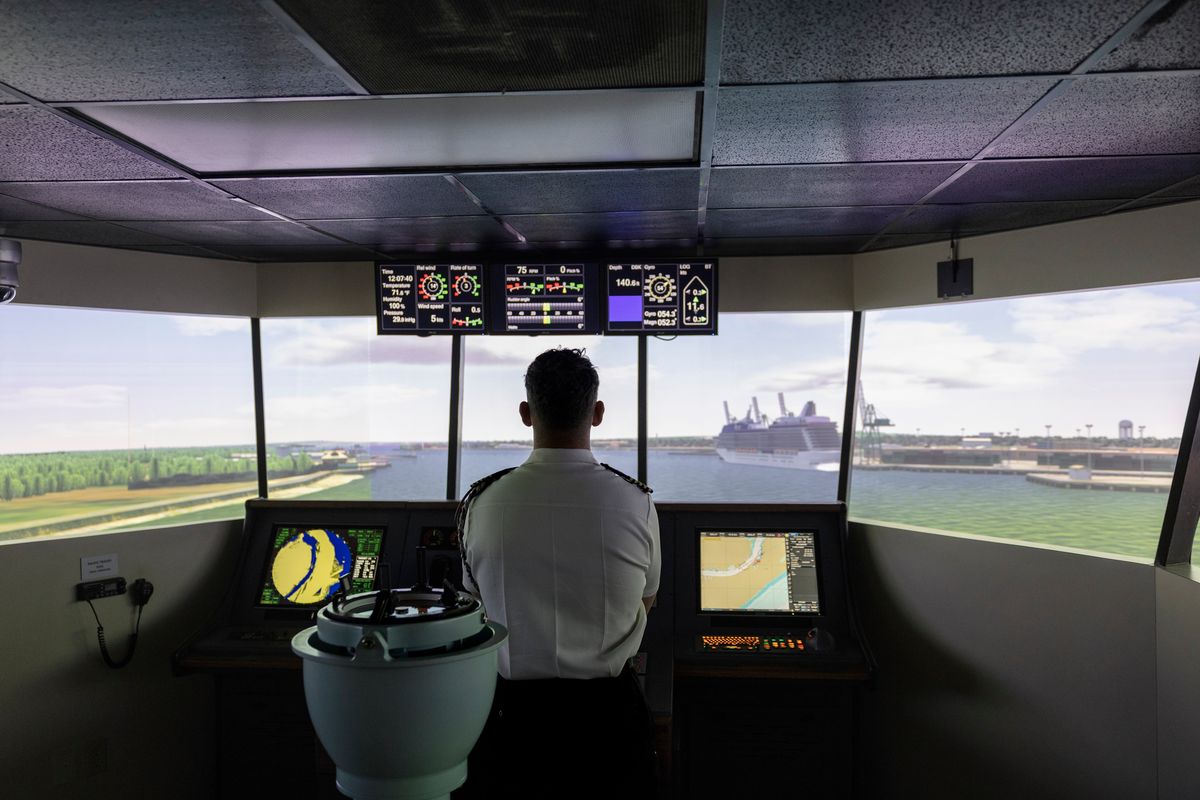
Aidan Ussery, a student at Texas A&M’s academy, said he had “absolutely loved” the 100 days he spent on a tanker in the Gulf of Mexico as part of his training. “Most people don’t know what this career is,” Ussery, 21, said while standing in a ship simulator. “Once I explain it, they’re like: ‘Oh, my gosh, that’s so cool. You’re going to make how much?’ ”
He said that he was thinking of joining the Military Sealift Command and that he expected to earn around $120,000.
Commercial shipping has also struggled to attract women and people from underrepresented groups. From 2013 to 2022, just 13% of the students at maritime academies were women, and 2% were Black, according to a report last year from the Maritime Administration.
Allegations of sexual assault have also plagued the industry. A student from the federal maritime academy, Hope Hicks, said she was raped in 2019 while working on a ship operated by Maersk, a large shipping company based in Denmark. Maersk settled a lawsuit brought by Hicks in 2022 for an undisclosed sum. That same year, Congress passed legislation that sought to require shipping companies to do more to prevent sexual assault.
Christine Dunn, a lawyer who represented Hicks, said that the law had provided important safeguards but that it had to be consistently enforced.
Hope Germanakos, a graduate of the Merchant Marine Academy and now working on a Chevron vessel, said the company had regular trainings aimed at preventing sexual assault on ships. Since working on vessels, she has been treated as an equal, Germanakos, 25, said.
“My opinion always seems to be valued,” she said.
For there to be an upswing in demand for mariners, Trump and Congress have to succeed with their efforts to revive American shipping.
But there have already been setbacks.
In his recent trade truce with China, Trump suspended for a year fees that were recently imposed on Chinese commercial ships that dock in the United States. The bill in Congress relies on the fees to subsidize the new fleet made up of American vessels crewed with Americans.
The bill also intends to bolster the maritime academies and study whether more are needed.
Col. Michael Fossum, a former astronaut who is now superintendent of Texas A&M’s academy, said his institution was ready to respond.
“If they build them, we will provide the crews,” he said.
This article originally appeared in The New York Times.