
As tiny village moves forward in west Spokane, neighbors concerned for ‘another Second and Division’; supporters say protections are in place

The city of Spokane will help fund the operations for the 30 tiny homes planned just west of the Government Way and Sunset Highway intersection.
The New Roots Village will be a referral-only community as part of the region’s effort to house people. It will feature three shower-equipped bathrooms and two community buildings. Each unit is between 70 and 96 square feet and is equipped with heating and air conditioning.
“The idea is, let’s figure out how we can really do this well in our community and show that it’s a part of the continuum of homeless services that we need if we really want to address homelessness in meaningful and sustainable ways,” Waters Meet President Zeke Smith said.
Waters Meet, previously Empire Health Foundation, is the owner and developer of the plot, 3004 W. Eighth Avenue. Waters Meet purchased the materials for the homes for $700,000 earlier this year using state funds. As soon as city permitting goes through, the homes will go up on the land, and temporary residents should be able to move in by January if all goes as planned.
The city council approved a one-year contract Nov. 10 with Community, Advocacy and Treatment, formerly called Compassionate Addiction Treatment, to operate the village when it is complete.
“If we get approved to operate the tiny home village,” Community, Advocacy and Treatment Spokane Interim Director Sandy Munck said at the council meeting before the vote, “we will bring more than just 30 pallet homes. We will bring 30 opportunities for healing, stability and belonging.”
The contract is for $975,000, or around $32,500 per bed, by Councilman Jonathan Bingle’s calculation at the council meeting.
Council President Betsy Wilkerson said that compared to the $180 per day, or $65,700 per year, it costs to care for a single adult in an adult family home, the village is “considerably less than what others are paying through state services.”
West Hills Neighborhood Council President Robert Thompson said that the local community is concerned by how quickly the village has seemed to come together after they learned of the plans in the summer. There could be positives to the units being in the area, he said, but “it just didn’t feel like the intention for the character of the neighborhood was necessarily there.”
Waters Meet has held meetings with the neighborhood, but Thompson said community members have been left feeling frustrated at a lack of answers about how the change will affect them.
“It’s great that we’re seeing development, but this feels like development that’s taking away from the potential for what that corner could be,” he said.
The New Roots village is not the only facility in its immediate vicinity catering to people who are homeless or otherwise vulnerable populations. A new gas station is slated to open in the area this year as well.
“The idea that we’ll have a gas station, which most likely will sell alcohol at least in some capacity, directly next to a sober living facility, directly next to this really experimental tiny home village, and then also having that 48-unit Catholic Charities project …” Thompson said, referring to the new St. Agnes Family Haven, “leaves us with a lot of questions and a lot of concerns about what that corner is going to look like come next year.”
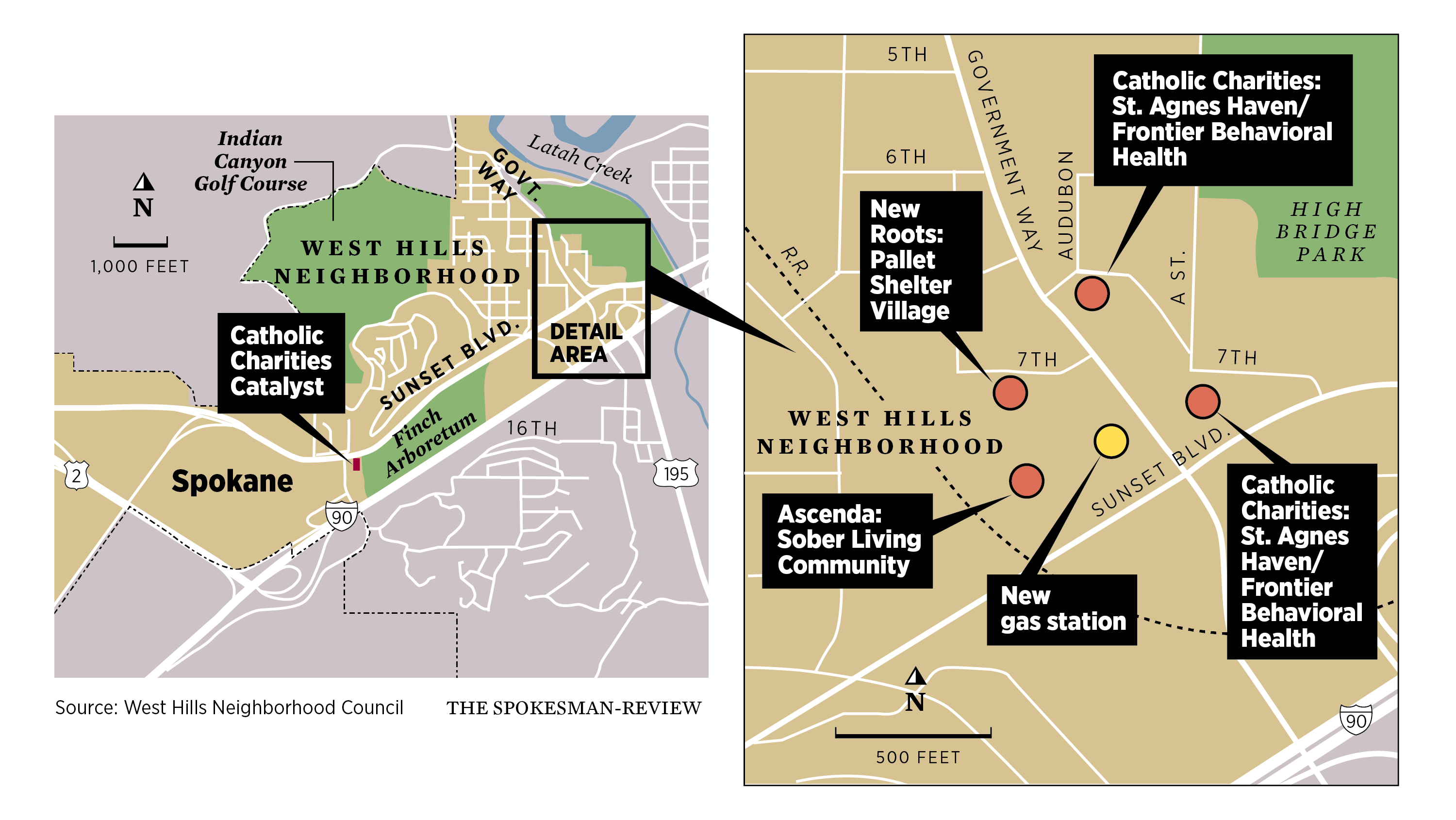
Karen Lindholdt is the chair of a subgroup of the West Hills council created specifically to address the New Roots Village Tiny Home Project. While many neighbors are “eager to get the unhoused shelter,” Lindholdt argues that the addition of more transitional housing in the area is a violation of city code stating that city -owned or funded transitional housing should be evenly dispersed through Spokane’s neighborhoods.
The New Roots village is not owned by the city and it is not one of the eight official city shelters scattered throughout Spokane. About $400,000 of the $975,000 in funding toward the new operator is from the city, making the village qualify as a city-funded service and therefore subject to the law. The remaining $575,000 is from the state commerce department’s Encampment Resolution Program.
Comparing the transitional housing to the other housing in the area is like comparing apples and oranges, Smith said.
“There aren’t actually any shelters in the West Hills. This won’t be a shelter,” he said. “You may not know it as neighbors that you have group homes and other kind of living environments that are transitional and permanent. So I don’t actually think there is the concentration that they’re describing.”
The village is not meant to be a permanent installation, rather, it is a pilot site to see if the tiny-home model will work in Spokane. Smith estimates that the homes will be moved to other locations after around five years. The West Hills location is ideal for testing the housing due to its proximity to downtown and a bus stop.
Spokane Mayor Lisa Brown also challenged the sentiment that West Hills is “overburdened” with specialized housing for homeless and at-risk people. The goal of the scatter system is, after all, to minimize negative impacts.
“I think the question isn’t, ‘How many facilities are there?’ ” Brown said. “The question is, ‘What are the real impacts on the neighborhood,’ and if there are impacts – that’s the whole point of the city’s good neighbor agreements, to have a process for people to make those known and to make sure that the operators of the facilities have to address the impacts.”
Ultimately though, Lindholdt said the neighborhood’s concern is that Sunset Highway and Government Way will become another Second and Division, unable to attract or maintain businesses.
“Frankly, I think anyone who has eyes and lives in Spokane cannot dispute what has happened to business owners there at Second and Division. They’ve shut down,” she said. “They cannot, because of the heavy, heavy congregation of both individuals who live there and the hanger-ons that may come to prey upon them and sell drugs. … It’s caused businesses to shut down.”
Multiple public commenters at the Nov. 10 council meeting agreed with the West Hills Neighborhood Council, echoing concerns for neighborhood safety and substance abuse.
Though he can understand why neighbors are afraid, Smith said that he doesn’t “think the fears are founded in reality.”
“We know that when a village like this is effectively stood up … you actually see a reduction in crime that can happen in the area,” Smith said. “I think the other factor that’s important to call out is part of what I think is driving people’s fear is what they understood, or what they perceived through the media, of Camp Hope.”
Camp Hope, Smith said, was unstructured, without a city sponsored operator, leading to high concentrations of vulnerable individuals and litter in the area. “None of those things are true” about New Roots.
“There will be a level of security there. There will be a level of agreements that are made between the residents and the service provider and each other about how they want to live and move into better, healthier living along the way,” he said. “We know how to actually run it in an effective way.”
Bingle and Councilman Michael Cathcart were the only two council members to vote against the contract.
“I have great sympathy for the folks of West Hills who have come down, and I think there’s been a lot added to that one neighborhood,” Bingle said after hearing public testimony. “I think what ends up happening is the more affordable pieces of land are not on the South Hill.”
Moving forward with building the village was not up for consideration at the meeting. Council members for the district, Paul Dillon and Shelby Lambdin, voted in favor of contracting with Community, Advocacy and Treatment Spokane.
“Certainly I think this will be providing a good option for those who are looking for those wraparound services, trying to exit homelessness,” Dillon said. “The question before us so often for council has been, where do people go? Where do people go? And this is helping address that by increasing our infrastructure and capacity.”
Munck said that as the workers from Community, Advocacy and Treatment Spokane “also hear and understand the concerns of the West Hills Neighborhood. That is why, if we get this opportunity, we are committed to being a good neighbor.”
This report has been updated to reflect that the city did not contribute to the purchasing of the New Roots Village land, the project is waiting on city permits, and the spelling of Sandy Munck’s name.