
Stage review: Stellar cast and music on stage for ‘Moulin Rouge’
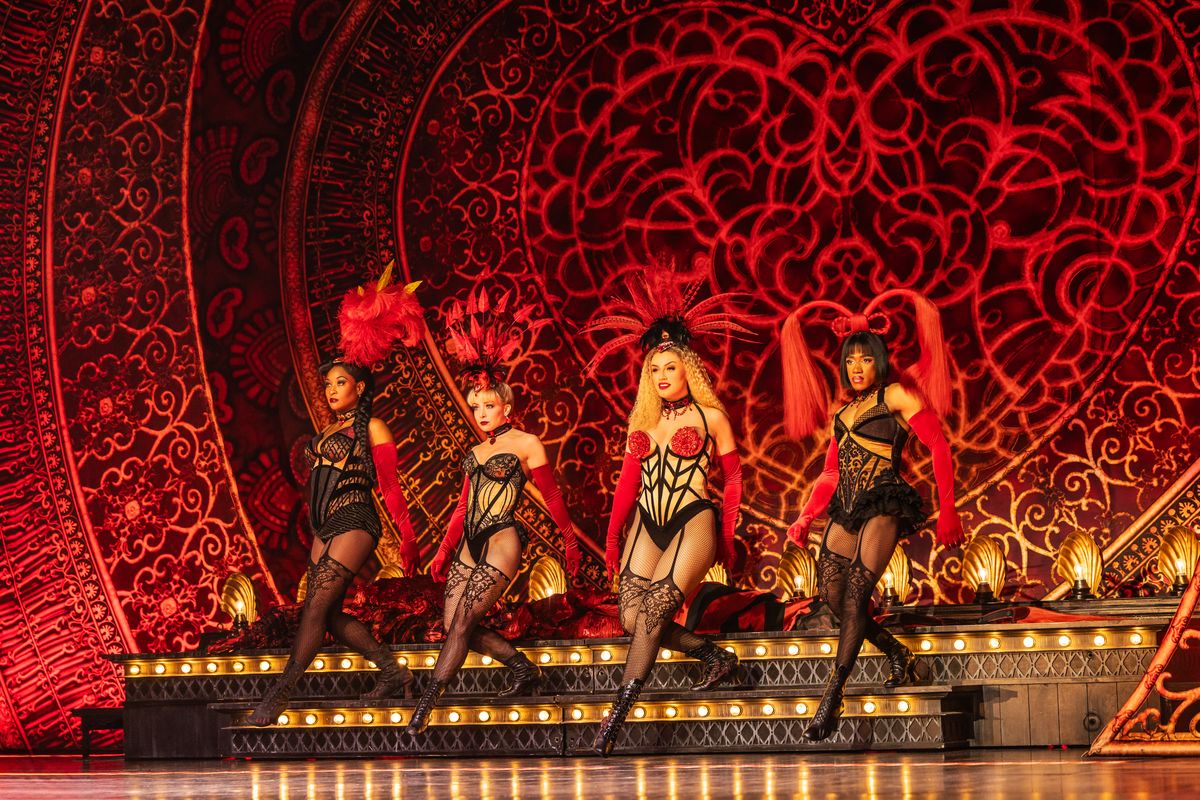
“No matter your sin, no matter your desire, you are welcome here … Moulin Rouge is a state of mind, where all your dreams come true.”
With those words, plus the cancan and a little confetti, Harold Zidler (Bobby Daye) welcomes the audience to the glitziest club in Paris.
The set and costumes sparkle so brilliantly, it is impossible to tell that the theater is actually on its last leg. But to solve that problem, Zidler has invited the Duke of Monroth (Andrew Brewer) to see the show, promising the star of the Moulin Rouge, Satine (Arianna Rosario), to him.
At the same time, Henri de Toulouse-Lautrec (Jahi Kearse) tells his new friend and fellow Bohemian Christian (John Cardoza), freshly in Paris from Lima, Ohio, that he will capture Satine’s heart.
It is then that Christian speaks directly to the audience, telling us this is a story about love. We are then swept to the streets of Montmartre where Christian meets Toulouse-Lautrec and Santiago the Argentinean (played Wednesday by Jordan Vasquez), who are struggling to write a song.
Christian chimes in with the perfect lyrics (“The hills are alive with the sound of music.”), and the trio quickly become friends. Toulouse-Lautrec and Santiago bring Christian to the Moulin Rouge, where we meet the storied Satine.
In her big number, Satine dazzles the crowd quite literally between her bejeweled costume and medley of songs like “Diamonds Are Forever,” “Diamonds Are a Girl’s Best Friend,” “Material Girl,” “Single Ladies (Put a Ring on It)” and “Diamonds.”
After the show, Satine mistakes Christian for the Duke (new Spokanite Brewer, who nailed the Duke’s icy, heartless stare) and invites him to her dressing room. Satine thinks she is meant to seduce him, while Christian thinks he is meant to audition a song for her.
After some funny double entendres, the pair begin to fall for each other. Cardoza and Rosario were especially cute while singing “Your Song” together.
Toulouse-Lautrec, Santiago and Zidler burst into Satine’s dressing room only seconds before the Duke, who is expecting to see Satine alone. The group manages to convince the Duke that they were auditioning a show for him with the hopes that he would invest in the show and save the club.
The group quickly begins rehearsals for the new show, but the love triangle between Satine, Christian and the Duke complicates things, with the Duke putting the club, and the lives of the performers who call it home, at risk.
As Satine, the star of the Moulin Rouge, Rosario really is the star of “Moulin Rouge.” There is a gorgeous warmth to her voice that makes her sound so real and grounded when she sings, and she managed to work the audience at the Moulin Rouge as well as she worked the real audience.
One of my favorite Satine moments though was when she was on her own, singing “Firework” to herself in the mirror. It was a sweet, vulnerable moment that gave audiences a look at Satine’s offstage life.
As her partner through it all, Cardoza was perfect as Christian, a songwriter who arrived in Paris with little more than a dream. It was fun watching him blabber about his Ohio accent, so nervous was he to meet Satine.
Cardoza had an incredible transformation in the second act, fueled by heartbreak and glowing green absinthe. In one of my favorite moments of the show, he became more disheveled as his performance of “Crazy” and “Rolling in the Deep” went on and seemed to be truly distraught by the end of the number.
On the opposite end of the spectrum, another favorite scene was far more low-key, when Toulouse-Lautrec told Christian of Satine’s history growing up on the streets. There is an incredible clarity to Kearse’s voice, even as he hits the deepest notes.
Kearse and Vasquez brought a lot of humor to the show as the artsy bohemians, especially in the first act before the stress of opening the show got to them.
Vasquez and Elyse Niederee, who played dancer Nini on Wednesday, set the second act off on a high note, with a saucy medley danced to “Bad Romance” and “Tainted Love,” among other things.
Along with the stunning sets, designed by Derek McLane, and costumes, designed by Catherine Zuber – seriously, “Moulin Rouge” might be the most beautiful show I’ve ever seen – I was most impressed by how the show manages to fit popular songs from so many different genres, and varied dance styles to match, into the show.
“Moulin Rouge” is a jukebox musical, but the songs are woven into the story in such a way that it does not feel like it. Audience members chuckled at some of the songs in recognition, not because they seemed out of place.
The biggest possible round of applause goes to the stellar cast, which also includes Danny Burgos, Kaitlin Mesh, Jerica Exum, Amara Berhan, Rodney Thompson, Renee Marie Titus, Jeremy Gaston, Gabriella Burke, Runako Campbell, Rhys Carr, Darius Crenshaw, Mateus Barbosa Da Silva, Nicolas de la Vega, Jordan Fife Hunt, Nathan Fister, Logan Gray Saad, Collin Heyward, Charizma Lawrence, Katie Lombardo, Meghan Manning, Amanda Mitchell, Luke Monday, Kenneth Michael Murray, Luke Rands, Maia Schechter, Adéa Michelle Sessoms, Jeff Sullivan, Carmella Taitt and Jerald Vincent, for managing to perform to what must feel like a playlist stuck on shuffle.
The applause extends, of course, to the band – conductor Wendy Feaver, associate conductor/keyboard Flint Hawes, drummer Brett Beiersdorfer, reed musician Rajiv Halim, trumpeter Adam Roebuck, guitarists Francesca Castro and Joe Parker, bassist Marcus Vann, violin/viola Chuck Bontrager, cellist Kelsee Vandervall, and electronic music designers Taylor J. Williams, Dana Haynes and Ethan Deppe, with music preparation services by Emily Grisham, for playing hit after hit after hit.
For all its glitz and glam, “Moulin Rouge” also illustrates the dark side of the rich and famous. The Duke sees no problem using his money to control people, and unfortunately many of those people see no other option but to obey.
Ultimately, the bohemian ideals Christian, Toulouse-Lautrec and Santiago sing about – truth, beauty, freedom and love – lift up what the Duke tried to keep down and speaks to the heart and passion that inspires performers to keep getting on stage night after night.