
The number of fluent Spokane Salish speakers has more than doubled after the first graduation of a pilot adult immersion program: ‘This is historic’
WELLPINIT, Wash. – Felicia Pichette was overjoyed the first time her grandson told her “no.”
It wasn’t what he said, but how he said it: in Spokane Salish, the endangered Indigenous language of the Spokane tribe.
Pichette, a tribal member and student of the language, offered to carry a large root-digging stick for the toddler, but he stubbornly refused to let it go. Pichette speaks to her grandkids in the native tongue with the hopes that something will rub off on them. Evidently, it did.
“That right there, that little moment was like, ‘They do hear me,’ ” Pichette said.
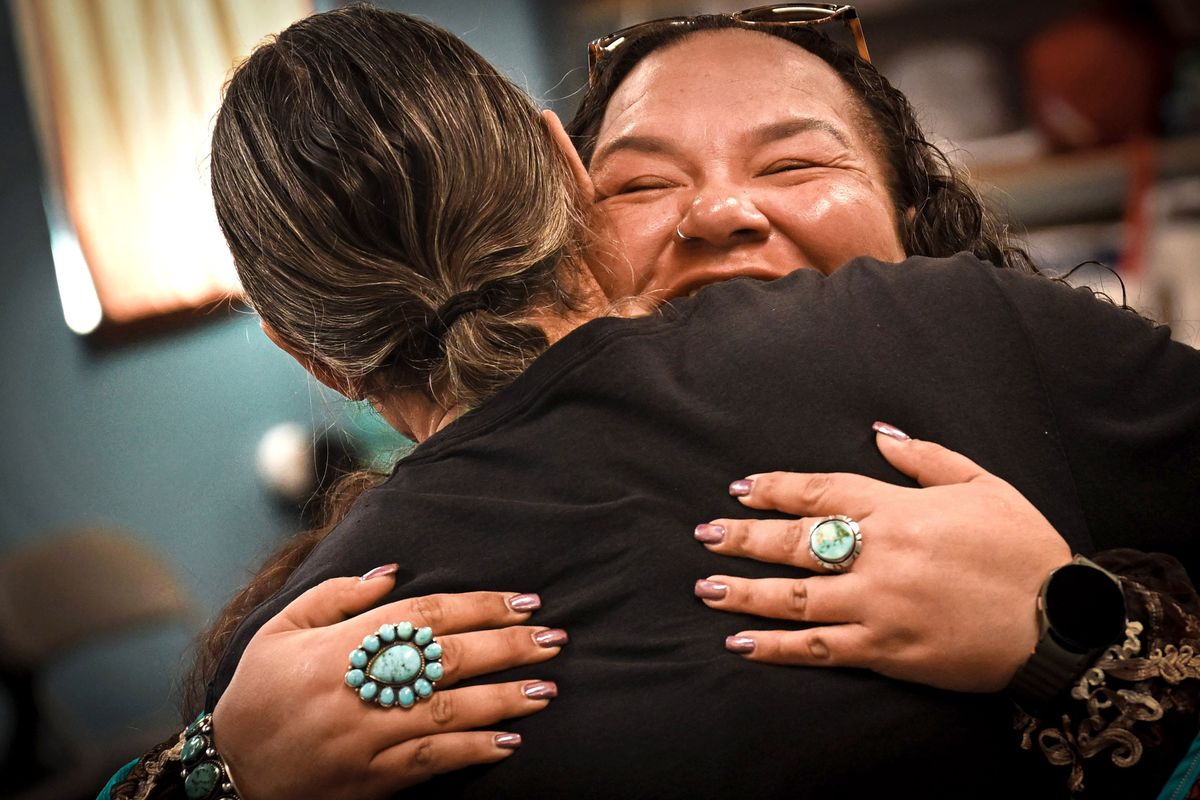
Pichette is one in the first cohort of adults in a Spokane tribe -sponsored Salish language -immersion program who graduated on Tuesday in a tear- and laughter-filled ceremony in Wellpinit, Washington. After two years in the immersion program, the nine graduates are at varying levels of “conversationally fluent,” joining the handful of fluent speakers, mostly elders.
“There was a time when you could hear the language,” said teacher and founder Barry “Sulustu” Moses. “There were still pockets of it all over this reservation. And as time went on, that diminished. And with each passing year, it went down and it went down and it went down, and now you go, and you almost don’t hear it.”
Two years ago, Sulustu, whose English name is Barry Moses, launched the classes for 17 adults in the Spokane tribe with some familiarity with the language. Students spent 40 hours each week in class, doing cultural excursions and community outreach to reclaim the language, all while being paid by the Spokane Tribe for their efforts.
“When an Indigenous language is lost, it is lost, absolutely gone, vanished, and there’s no place you can go to retrieve it, other than perhaps the archives,” Sulustu said at the graduation. “It’s on a page in a file cabinet, but it’s not alive anymore.”
Determined to ensure that isn’t the case, the nine graduates are on a course to preserve the language by spreading it into their families and communities until it’s as common as it once was.
It’s music to the ears of Spokane Tribal Elder Orten Ford, Salish name člukwtšnma. Her name means, “She walks a long way without pain,” after her great-grandmother who was known to drag herself by her arms when her legs went out.
Ford is one of the few fluent speakers, a regular at classes eager to converse in her native tongue with more than just her cat. She was raised in Salish by her grandmother in a time when you couldn’t go far on the reservation without hearing the language. It saddened her to watch it fade in her lifetime as her grandmother’s generation “fell asleep in death,” she said.
“You go to the store and you go to the post office, nobody there knows how to speak,” she said. “But now, to walk in that door and come in here, it’s like stepping back in time, because these guys are all speaking.”
Hearing students swap Salish back and forth at the graduation, giving attendees a taste of immersion, brought many to tears.
Attendee Clyde Abrahamson, father of graduate Dionne Abrahamson and son-in-law to Ford, rose to address the room of 20-some people, tears welling in his eyes before he spoke.
“I miss my dad,” he said, describing his father who was a fluent Salish speaker.
“This is historic,” he said of the graduates, calling them the next fluent elders tasked with spreading Salish.
Language preservation has long been among the highest priorities of the Spokane tribal government. The tribal council approved $2 million in funding for the first two years of this pilot. After its success, Sulustu said they’re planning to continue funding for the graduates to learn more, six of the nine planning to stay with the program, with a chance they’ll bring in more learners.
“I’m proud of the hotels we’ve built. I’m proud of the land that we’ve got back. I’m proud of so many things that the tribe has done, and then I’ve got to be a part of while I’ve been in this space,” said Tribal Council Secretary Monica Tonasket. “But the most proud that I am is of this adult immersion class.”
Pichette, who has studied the language for 15 years and is both a student and lead coordinator of the program, said learning her ancestral language is critical to preserve the lessons and oral traditions passed down from her elders.
“People back then said the truth, and their word meant exactly what they said,” she said.
She sees Ford as a grandmother figure, sharing her knowledge with the class. Ford shares Salish stories of her own grandmother tending her football-field-sized garden, fables to impart lessons, and scolding students whenever necessary. Working with Ford, she is reminded of her own grandmother and all the elders who fought an uphill battle to preserve Salish.
“In all the work that we see in the archives, our elders put that out there for us; they wanted the future to know, to learn it, to be able to understand it,” Pichette said. “So here we are as their prayer. We have a group to learn in trying to understand it.”
In turn, Ford beams, knowing there’s a motivated group of learners to care for the language for generations.
“These guys are fluent. It’s good to hear, and pretty soon, maybe we’ll hear it from their kids,” Ford said. “These are the Nšiʔšiʔcín, our new elders. ‘Nšiʔšiʔcín’ means the caretakers of our language and of our stories of the Salish people.”