
The Navy turns 250 today. Here’s what you need to know about the military branch’s beginnings.
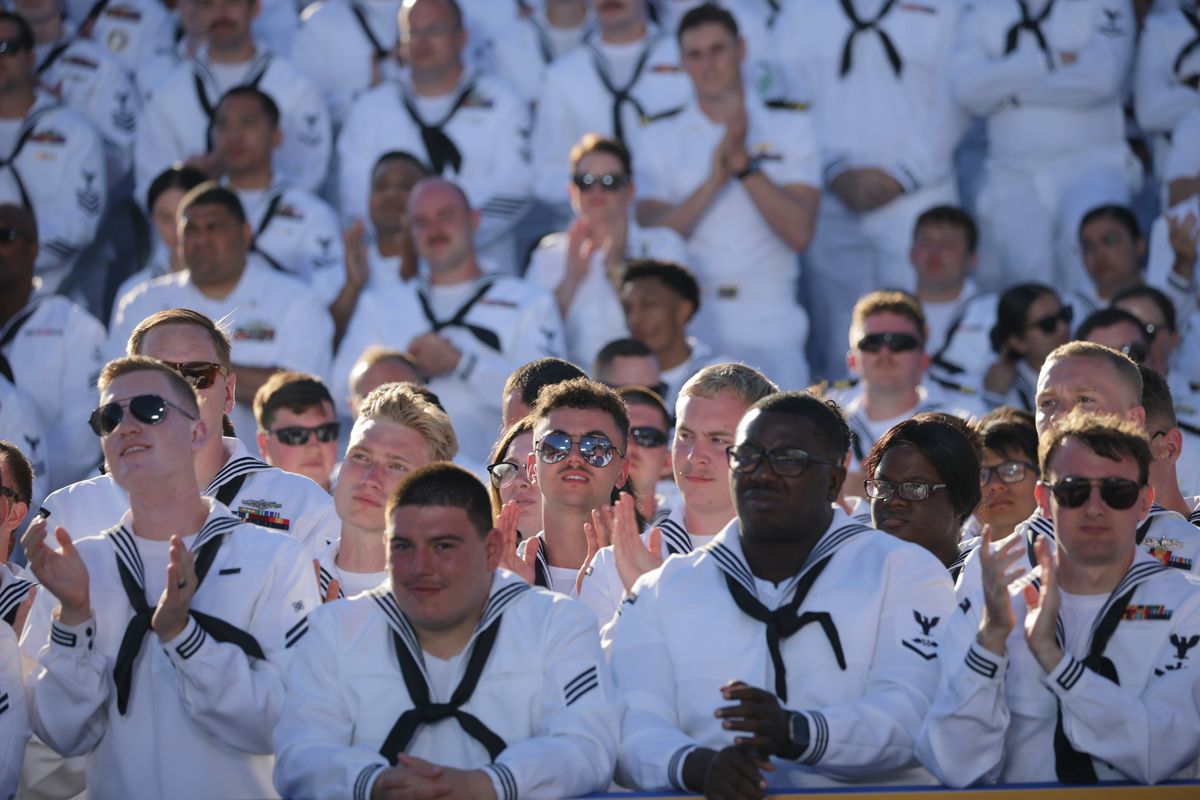
Oct. 13, 2025 , is a milestone for sailors past and present as the U.S. Navy celebrates its 250th birthday. From battling British ships in the Caribbean, fighting pirates off the Barbary Coast to stopping the Japanese at Midway, the Navy has been an important element in U.S. foreign policy.
“When word of a crisis breaks out in Washington, it’s no accident that the first question that comes to everyone’s lips is ‘Where’s the nearest carrier,’ ” President Bill Clinton said while visiting the USS Theodore Roosevelt in March 1993.
Revolutionary War
On Oct. 13, 1775, the Second Continental Congress called for the formation of the Continental Navy. Soon after, two privateers were pressed into service, and, in December of that year, the Congress called for the construction of an additional 13 frigates to be built.
The problem was the Continental Navy was being stood up to fight against the world’s most formidable force on the high seas, the Royal Navy. The continentals were outclassed, outgunned and beaten back in almost every engagement. Successes were few and far between. Privateers, issued letters of marque, fared better, with more than 2,000 British merchants seized during the war.
During the American Revolution, there was one commander who stood out among the rest: John Paul Jones, who is regarded as the father of the American Navy. With the 43-gun frigate Bonhomme Richard under his command, he led a Franco-American squadron against a convoy of merchant ships and its escorts at the Battle of Flamborough Head in September 1779.
During the battle, Bonhomme Richard suffered under the withering fire of HMS Serapis, and its captain asked if the Americans were ready to surrender; John Paul Jones replied, “I have not yet begun to fight.”
Following the American victory in the Revolutionary War, the fledgling country couldn’t afford its Navy, but the economy relied on tariffs on imported goods. In 1790, the Treasury secretary, Alexander Hamilton, formed the Revenue-Marine, the forerunner of the Coast Guard, to protect American shipping against piracy on the high seas.
Four years later, the U.S. passed a naval act which commissioned the new country’s first six frigates. Of the six, one of them is still in service: the USS Constitution. Launched in 1797 in Philadelphia, “Old Ironsides” is the oldest commissioned wooden frigate still in service. It is homeported in Boston.
Annapolis
While it had its share of outstanding leaders, including Commodore Matthew Perry, David Porter and Stephen Decatur, there was a problem with Navy leadership as a whole. They had nowhere to train new officers. While the government had established a military academy at West Point, the Navy did not have a similar school.
In 1845, George Bancroft, the secretary of the Navy, worked without congressional approval to establish a school at an old fort, Fort Severn, in Annapolis, Maryland, and a council of officers, including Perry, developed the school curriculum. In 1851 Congress designated the school the U.S. Naval Academy.
Ironclads, torpedoes and submarines
In April 1861, the Civil War broke out, and as American Army officers gave up their ranks to serve with the Confederates, so did a number of naval officers.
To prevent their capture, the U.S. Navy set fire to its shipping at the Norfolk Naval Yard in Virginia. One of the scuttled ships was USS Merrimack. The Confederates rebuilt her with armor plating on her hull, christening her CSS Virginia.
A year later CSS Virginia fought another ironclad, USS Monitor, at the Battle of Hampton Roads, the first clash between ironclads. The battle ended in a draw, but both sides saw the potential of these revolutionary designs.
There were two other revolutionary designs to come out of the war. The first was an explosive charge that was fixed upon the end of a spar. The idea was to ram an enemy vessel, fixing the charge to the ship’s hull, and then the attacker would back away. The explosive was attached to a trigger cord that was activated once the attacking ship moved a certain distance. That’s the technical explanation of what it was, but if you’re looking for the short answer, the Confederates developed the first naval torpedo.
The second design was a fish torpedo boat developed by Horace Lawson Hunley that would run partially submerged and be armed with a single spar torpedo. Hunley’s ship was pressed into service by the Confederates and christened the CSS H.L. Hunley. In 1864, the Hunley engaged the USS Housatonic with its spar torpedo and sunk it, revolutionizing naval warfare with the advent of the submarine.
The Hunley, which had actually sunk and been recovered twice before, killing everyone aboard in each sinking, including Hunley himself in the second sinking, sank again after destroying Housatonic.
Modernization and the new Navy
In the aftermath of the Civil War the U.S. Navy languished, its budget slashed for nearly two decades. Ships fell into disrepair, and by the early 1880s the Navy had approximately 150 ships, only a third were serviceable, and most were aged holdovers from the Civil War.
Starting in 1883, the Navy, authorized by Congress, funded a modest modernization program that included a handful of protected cruisers and the country’s first battleships, USS Texas and its more famous sister ship, USS Maine.
In 1890, Navy Capt. Alfred Thayer Mahan wrote “The Influence of Sea Power upon History, 1660-1783,” which had a tremendous impact upon navies around the world. In the United States, the country saw its Navy as being a necessity in projecting power in the Pacific, to Hawaii and in the Caribbean. A naval act approved by Congress that year kicked the fleet’s modernization into gear. A more modern torpedo was developed over time in Europe, and the American Navy ordered development of a series of torpedo boats, the forerunner of the destroyer.
‘You may fire when ready, Gridley’
In 1898, tensions were escalating between the Spanish and Americans, fueled by fabricated newspaper reports of Spanish atrocities in their colonies. The Maine, sent to Havana following riots in Cuba, blew up in Havana Harbor. A board of inquiry concluded the ship was hit by a sea mine at the time; years later research found it was an internal explosion.
The assistant secretary of the Navy, Theodore Roosevelt, quietly ordered the repositioning of squadrons around the globe. When war broke out, those squadrons were ready to engage the Spanish fleet.
While the Battle of Midway and the Battle of Leyte Gulf are widely remembered as lopsided victories for the U.S. Navy during World War II, their first such victory came courtesy of Commodore George Dewey, commander of the Asiatic Squadron. He had sortied his force from Hong Kong and on May 1, 1898, attacked the Spanish in Manila Bay. From the deck of his flagship he gave the ship’s captain, Charles Gridley his order: “You may fire when ready, Gridley.”
When it was over, the Asiatic Squadron had sunk seven Spanish protected and unprotected cruisers, a gunboat and a transport ship. One American sailor died of a heart attack during the battle.
For reference, Commodore Dewey’s flagship is still afloat. The USS Olympia, named after Washington state’s capital city, is a museum ship in Philadelphia.
The Spokane Trophy
About 300 miles away from the nearest large body of water sits Spokane. A few years after the end of the Spanish-American War, the city’s Chamber of Commerce, along with some Spanish-American War veterans, wanted to commission a silver trophy to honor sailors from Spokane and present it to the Navy as an annual trophy for the top ship in the fleet in gunnery.
The design of the trophy included depictions of President Roosevelt, Spokane Falls, Chief Garry of the Spokane Tribe, Mount Spokane and a replica of the monument to Ensign John Monaghan.
It cost an estimated $1,500 for a local jeweler to build the trophy using 400 ounces of silver; it’s worth nearly $4 million today.
The trophy was first presented to the USS Tennessee in 1908, and every year following the top ship in the fleet was presented the Spokane Trophy until it was retired in 1941.
Among the recipients during that period were USS Arizona and USS West Virginia; the last one to receive the award before its retirement was a New Mexico-class battleship named after the 43rd state, USS Idaho.
The trophy was brought out of museum status in 1984 and moved to the Pacific Fleet headquarters in San Diego. To this day the top ship in the Pacific Fleet is the annual recipient of the coveted award.
Billy Mitchell, air power and the aircraft carrier
World War I found the U.S. Navy on convoy duty once the U.S. entered the war, guarding convoys bound for Europe. After the war, navies were limited by the Washington Naval Conference and the London Naval Treaty, but that didn’t stop technological advancements, including newer submarines and the development of a new type of ship, the aircraft carrier.
At the end of World War I, many admirals and key naval leaders saw the future of the Navy remained firmly in the hands of its battleships. Col. Billy Mitchell helped change the discussion.
A longtime proponent of airpower, he hypothesized airplanes could sink ships. A series of highly restricted and controversial tests were held involving aircraft bombing ships which helped prove the point. Battleships were not invulnerable.
The Navy had commissioned its first carrier, the Langley, in 1920, and because of the limitations of the Washington Naval Conference, converted its plans to build Lexington-class battlecruisers into Lexington-class carriers.
When the Japanese attacked Pearl Harbor on Dec. 7, 1941, the U.S. Navy had just seven fleet carriers: Lexington, Saratoga, Yorktown, Enterprise, Wasp, Ranger and Hornet. Four of the seven were sunk in 1942. By the time the war ended four years later, the Navy had commissioned 26 new carriers and 78 smaller escort carriers, along with hundreds of other ships ranging from battleships and cruisers to destroyers and cargo ships.
Korea, Vietnam and the modern Navy
In 1947, the Departments of War and Department of the Navy were unified into one command, the Department of Defense. As part of the sweeping move to unify the military, the Army Air Corps became its own branch, the U.S. Air Force. There was a big catch at the time: funding. President Harry Truman sought to fund his domestic agenda by cutting defense spending, and the Navy and Marine Corps were going to bear the brunt of the cuts.
Bombers were seen as the way to deliver atomic bombs to protect the United States, and the Navy wanted to not be left out. The Revolt of the Admirals called into question priorities in defense spending, civilian oversight of the fledgling Defense Department, and prioritization of bombers over the Navy.
The argument went Truman’s way in the end but a few short years later the North Koreans invaded the South and the argument shifted back the Navy’s way with the need to have the ships it needed to do things like, for instance, the amphibious invasion at Inchon, or pulling Marine and Army units out of the Chosin Reservoir, or using carrier air power or naval gunnery to shell targets inland.
By the time of the Vietnam War, the U.S. Navy was being used to launch air strikes from the Tonkin Gulf and patrol inland waterways using small riverine patrol boats. Again, the force was dated, with some ships in service from World War II.
Efforts were made to modernize the fleet from the 1970s into the ’80s, with newer ships replacing those World War II veterans, and time and again, when crises raged in the Persian Gulf, the Caribbean or the Mediterranean, the Navy was given orders to make best possible speed to that trouble spot. On Sept. 11, the USS Enterprise was steaming around the horn of South Africa when word came down about the attacks. The commander of the battle group turned his task force around and headed for the Indian Ocean. The Enterprise’s aircraft were among the first to strike into Afghanistan.
The Pacific Northwest
Throughout its history, the Pacific Northwest has been represented among the fleet.
The USS Oregon was one of the first battleships in the fleet and saw action during the Spanish-American War. One armored cruiser and two battleships were named after the state of Washington, the last one a North Carolina-class fast battleship that served throughout World War II mostly in the Pacific. A steam sloop, a motor boat and two battleships carried the name Idaho, including one that served through World War II.
Today, the states of the Pacific Northwest are still represented in the fleet as Virginia-class attack submarines. The USS Washington was commissioned in 2017, the USS Oregon in May 2022, and the USS Idaho is expected to be commissioned next spring.