
Together Spokane: Rebuilt elementary school, new park and expanded sports facilities among plans for Shadle Park High School boundary in schools, parks $440 million tax proposal
Once again, voters are being asked what should be done with the former Joe Albi Stadium. Instead of an advisory vote, this time it’s through a $240 million parks levy and $200 million school bond.
The two tax asks are separate ballot measures but part of a joint campaign dubbed Together Spokane to improve area schools, parks, sports facilities and myriad other projects.
The campaign promises to touch every corner of the city in small and large ways, including a few major projects slated within the boundaries of Shadle Park High School, which accounts for the northwestern part of the city.
A significant part of Together Spokane’s pitch to voters is growing sports facilities across the city, and one of the more ambitious components of this is the proposed expansion of the Dwight Merkel Sports Complex in northwest Spokane.
Named after the late champion of youth sports Dwight Merkel, the $11 million facility was funded by a park improvement bond approved in 2007 and opened in 2010 with six full-size grass soccer fields, two synthetic fields, five softball diamonds, a BMX track, skate park and more. Its facilities could grow significantly with the passage of the levy and bond on ballots this November.
If voters approve both the parks levy to maintain and operate the site and the school bond to build the expansion, an additional six rectangular fields would be constructed on the site of the former Joe Albi Stadium, bringing the total to 14. At least three of the new fields would be all-weather, extending the useful season of the complex.
For some, another vote over the future of the Joe Albi site will dredge up bad memories. In a 2018 advisory vote, residents supported building a new stadium at the Joe Albi location, but school officials rejected the recommendation in favor of building what is now known as the ONE Spokane Stadium downtown.
School officials have long argued that the change was a sign of smart government carefully stewarding tax dollars, citing a commitment that came to light after the vote from the United Soccer League to invest $2 million in a downtown stadium.
Seven years later, that “bait and switch” still leaves some voters hesitant, one reader wrote in an August email.
But Together Spokane supporters believe this year’s bond and levy package could still offer the site a future facilitating youth sports.
“When we decided to build the stadium downtown, part of that discussion was, well, what should happen to the Joe Albi land?” Spokane Public Schools Superintendent Adam Swinyard said in an April interview.
The answer they landed on is the Dwight Merkel Sports Complex extension.
Together Spokane proponents believe the concentrated facilities at the sports complex would attract regional tournaments to the area, emphasizing the potential savings for parents who currently have to travel elsewhere in the state for their child’s competitions.
For some skeptics of tax increases, the upgraded sports facilities and the impact they could have on local youth are an enticing selling point.
James Plaster, who has a child attending the nearby Shadle Park High School, doesn’t discount the burden taxpayers are feeling already, let alone the possibility of an increase. He said he didn’t recall but believes he voted against the failed 2023 school bond, and he’s wary now about the size of the Together Spokane proposal.
But his son also plays tennis at Shadle.
“It’s hard to practice sports unless you’re paying for a private club in the winter,” Plaster said. “I just think for youth in the community, there needs to be anything available to them.”
Public indoor tennis facilities may well be in the cards.
The ongoing “war” between tennis and pickleball, as Swinyard puts it, could present an opportunity for Shadle Park High School, with the Pacific Northwest arm of the United States Tennis Association offering to help pay for a new indoor tennis facility to be built around Shadle’s tennis courts – if the Together Spokane package is approved by voters.
There are 22 indoor courts in Spokane with more than 44,000 active players, U.S. Tennis Association Pacific Northwest CEO Matthew Warren said in a July interview.
“We are the second-fastest growing region in the country when it comes to tennis,” Warren said. “Which puts more pressure on the current ecosystem and the lack of infrastructure that we have.”
The groups are proposing the construction of two indoor courts next to the park’s established eight outdoor tennis courts, as well as a “bubble” over the complex to protect it from weather and keep the complex open year-round.
The USTA would fund the design and construction of the bubble. The funds from the Together Spokane tax package would fund the rest of the project, including parking spots and designing an entryway.
The plan also involves providing in-school physical education classes, training and equipment for gym teachers, as well as after-school tennis programs.
The tennis facilities would also be open to the general public during school hours.
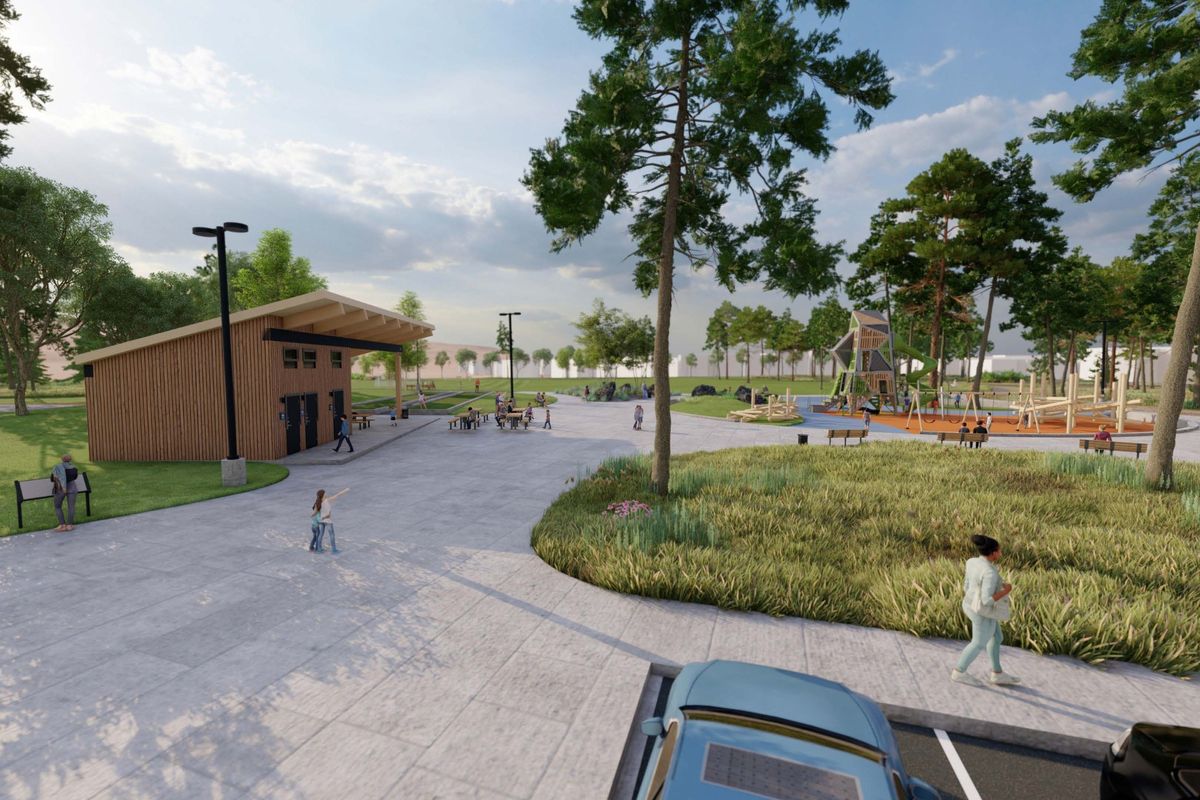
Spokane parks has also pledged to build three new parks if the levy is approved this November, hoping to expand the areas of the city where any resident can walk to a neighborhood park in 10 minutes or less. The very tip of northwest Spokane would be the beneficiary of one of them.
On a 30-acre stretch of dry prairie and pine trees at the northeast corner of North Indian Trail Road and West Bedford Avenue, butting up against city limits, there is already a sign posted proclaiming this is the “Future Home of Meadowglen Park.”
North Indian Trail is surrounded by natural lands, such as Riverside State Park to the west and St. George’s Trail to the northeast. But if residents near the Meadowglen site want to go somewhere with a playground or bathroom, Pacific Park is currently their closest option, roughly a 30-minute walk away.
Like with all of the new parks, a lot is left to the imagination, as parks officials have pledged to seek input from the community about what they want the park to look like. But proposed improvements include the standard playground, bathroom and off-street parking lot, as well as a “sport court,” multipurpose turf field and various landscape improvements. Preliminary plans are for a little under half of the land to be developed into a park, while the remainder would remain as natural land.
“It is envisioned that this project will consciously limit the amount of turfgrass and include large portions of ‘meadow landscape,’” Together Spokane states on its website. “Should funding permit, neighborhood dog park and/or splash pad may also be included.”
Both Pacific and Meadowglen parks would also benefit from increased security and maintenance, and likely extended access to their respective bathrooms if the parks levy were to pass, as would every park in the city.
And for those more concerned about academic facilities than athletic ones, Madison Elementary, the oldest school building on the north side of town, is one of two schools slated to be razed and replaced with bond funding.
Staff said the current structure, built in 1949, has problems with heating and cooling. There’s no air conditioning to address warmer months, and cold air leaks through the energy-inefficient windows, making heating a struggle in the winter, said principal Heather Holter. The school’s roof leaks during rain or snow, pouring water into classrooms, where ceiling tiles have been known to fall off, too.
The new Madison would be more of a “community center” with a school inside of it, Swinyard said.
Attached to the two-story school facility would be an indoor field house with five sport courts, operated by the city parks department for the public to use throughout the day. Another section of the building would serve as the northern Boys and Girls club.
“We’ve redesigned Madison to be a Boys and Girls club, an elementary school, a five-court field house, an event center so large groups could access that space,” Swinyard said at a recent town hall event at Shadle.
The Pacific Northwest Qualifier volleyball tournament would pay for the sport court flooring in exchange for use of the space during their tournaments held two weekends out of the year.
Each entity would chip in on the endeavor, Spokane Hoopfest intending to contribute $1 million to the field house and Boys and Girls Club of Spokane County planning to pitch in funds from the sale of their building on Providence Avenue, CEO Wendy Drum said in a February interview.
Swinyard and Jones imagine the space bordering Franklin Park to accommodate both youth and adult sports; Jones noting a wait list for the parks department’s adult volleyball league 130 teams deep. Franklin could get new lighting for more after-dark play.
“A part of this great relationship with Madison Elementary and the adjacency to Franklin Park … is making that the youth and adult sports complex headquarters within the city of Spokane,” Jones said, “almost like a Dwight Merkel lite to provide that access to adult and youth sports.”