
Together Spokane: Replacing the oldest school in the city, boosting field space among plans for Ferris High boundary in schools, parks $440 million tax proposal
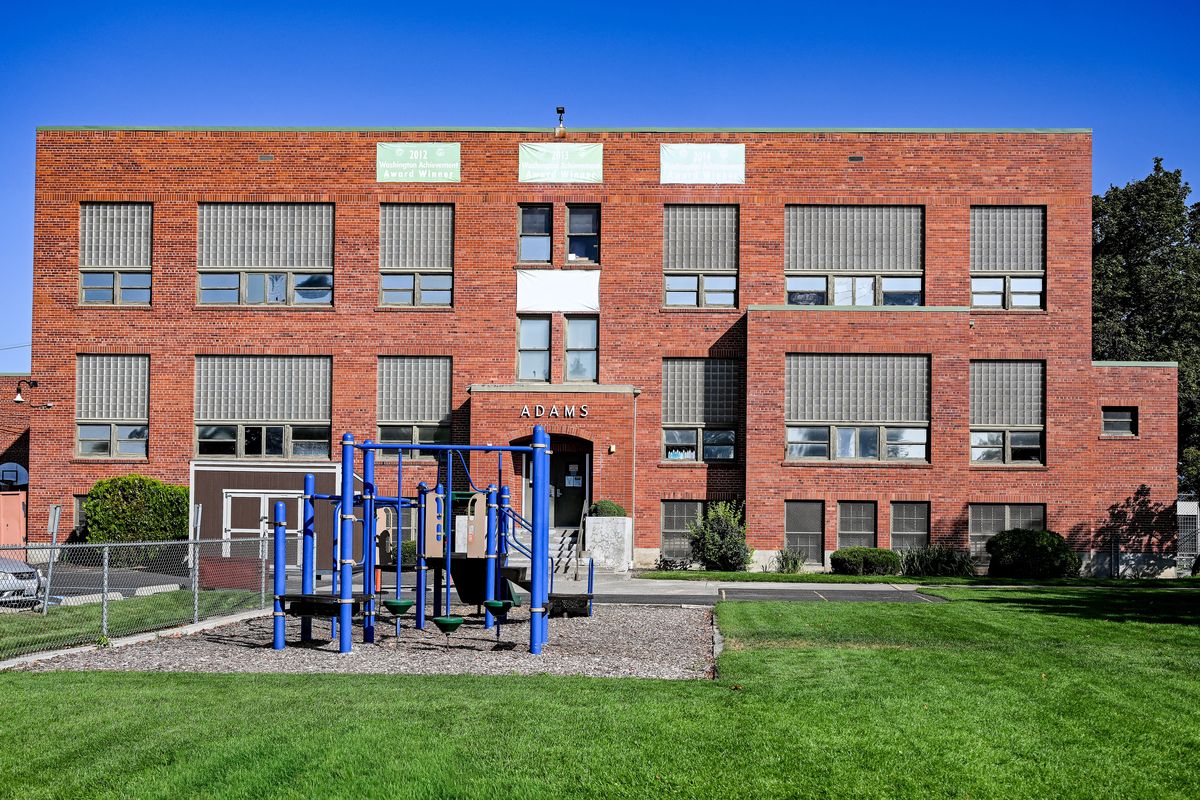
Among the 200-plus projects that would be addressed in Spokane Public Schools’ $200 million bond and city parks’ $240 million levy is the replacement of the city’s second oldest public school still in use.
Built in 1910, Adams Elementary on the upper South Hill is laden with historic charm: It has classic red brick exterior, original wood floors in the school’s oldest sections and black-and-white photos of serious-looking school children hung on the walls.
But the 116-year-old school’s lifespan is up, district officials said. It is inefficient to heat and cool, not up to code on accessibility standards and not conducive to modern-day school functions.
If 60% of voters approve of the property tax increase, the school would be razed and replaced, which would be cheaper than constant repairs or modernization, school Superintendent Adam Swinyard said.
“Adams is a circumstance in which, really, from a cost perspective, it needs to be a full rebuild,” Swinyard said when announcing the bond proposal in February.
The Adams replacement is one of around 200 projects the school district seeks to fund through the property tax measure in conjunction with the City Parks Department, which has a $240 million tax levy on ballots at the same time. The two are separate ballot items, but if they both pass schools and parks would partner to accomplish more projects.
Together Spokane, the name of the dual campaign, promises to touch every corner of the city in small and large ways, including a few major projects slated for schools within the boundaries of Ferris High School, which accounts for the southeastern part of the city.
Ferris’ student boundary on the north is the railroad track along Trent Avenue, where it neighbors Rogers’ boundaries. Lewis and Clark shares a border with Ferris to its west, running up the South Hill in a jagged line that includes part of East Central in its bounds, also enveloping Lincoln Heights and Southgate neighborhoods.
The current Adams structure, built 1909, had additions constructed on either side in 1917 and 1948. It’s not the original schoolhouse. That was a wooden two-room structure built in 1902, according to school district archives. Originally called “Garden Park School,” it was its own school district meant to teach kids outside of the then-city limits. Spokane Public Schools absorbed the school in 1909 when they replaced the wooden building with a brick, six-room schoolhouse now part of the current structure. Newspaper and county records show that was built in 1910.
It was renamed Adams Elementary, though not in honor of either of the presidents. School district research indicate it was named after Charles Adams, who owned property near the school.
Staff inquired about getting the structure on the Spokane Register of Historic Places, but it didn’t meet the preservation offices’ standards since it has been updated over its 116-year-old life, school spokesperson Ryan Lancaster said.
Staff have made do with the space they have, knocking down walls here and there to fit classrooms and offices into old coat closets, adding a bathroom for basement access and fencing in the iron fire escape to prevent kids from climbing up during recesses.
Lacking a ramp or elevator, the building doesn’t meet Americans with Disabilities Act standards. Kids living within Adams’ boundaries who need such accommodations for mobility reasons, if they use a wheelchair or crutches for example, are expected to transfer to another elementary school.
In its place would be a larger facility meant to serve as more than a school. There would be classroom space for school kids, plus a new Boys and Girls Club facility built into the school to offer on-site childcare outside of school hours. It’s a much -needed space on the South Hill, Swinyard said.
“There are not a lot of places for kids to go,” Swinyard said at a recent town hall event. “If you go to Target on the weekend, you will find an ad hoc youth center with lots of teenagers running around Target. I witnessed it myself this weekend; it’s quite astonishing.”
The Boys and Girls Club is one of the handful of outside entities that plans to chip in on the cost of the project if the bond passes. The organization has committed the proceeds of a building on Providence Avenue they intend to sell, CEO Wendy Drum said in a February interview. It was an old Catholic school where the organization first settled 25 years ago.
Replacing Adams would be a top priority for the district, early in the project timeline should the bond pass. The district paid for site plans with the 2018 bond, so the project is “shovel-ready,” Swinyard said. Construction could start as soon as winter break, during which Adams kids would take up the space at the former Jefferson Elementary at 37th Avenue and Grand Boulevard for a temporary school.
While the entire city would benefit from the addition of 15 all-weather fields across the school district, special attention would be paid to the Ferris Sports Complex at Ferris High School, which includes three all-weather rectangular fields and one baseball field.
The Spokane Youth Sports Association recently announced it would abandon its long-stalled proposal to build a sports complex on the Glenrose Prairie, and would instead invest up to $5 million for the development of the Ferris Sports Complex if the Together Spokane tax asks are approved this November. SYSA would receive priority to use fields when not in use by school district students.
“This is a great opportunity for us in the community,” said Ben Walker, CEO of SYSA. “The south side desperately needs new field space, and we like the collaborative nature of the plan. So again, if the bond and levy pass, we’re in and want to invest in this project.”
Chase Middle School also would be a target under the bond. The district plans to knock down a wall dividing the cafeteria and library for a more open concept design akin to the spaces in the district’s collection of newly built middle schools.
In Sacajawea and Flett Middle Schools, for example, the cafeteria, or “nutritional commons,” bleeds into the library, or “learning commons” where books are on display and easily accessible to a student wandering the school outside of class.
“It’s not the library in the past, where they’re sacred spaces where everybody needs to be quiet and cloistered,” Lancaster said.
The school’s ’90s-era carpet would also be replaced with a buffed concrete.
The school bond and parks levy will be on November ballots, which need to be dropped in an official ballot box or mailed by Election Day, Nov. 4.
Reporter Emry Dinman contributed to this story.