
Northwest Museum of Arts and Culture exhibit looks into life, legacy of Davenport Hotel and the families behind it
The Northwest Museum of Arts and Culture’s recently closed exhibition, “Fire: Rebirth and Resilience,” examined the devastating effects of fires throughout the state’s history.
The Malden and Pine City fires, the Gray Fire near Medical Lake, and, of course, the Great Spokane Fire in 1889, which effectively destroyed the city’s downtown.
Many photos and burnt artifacts in the exhibition showed devastation, but there were others that showed signs of life, signs of rebuilding and, as the exhibit’s name suggests, signs of resilience.
A lasting sign of that resilience is the Davenport Hotel.
Louis Davenport arrived in Spokane in spring 1889 with plans to work in his uncle’s restaurant. After the Great Fire, Davenport opened a small restaurant of his own. As the restaurant became more popular, Davenport expanded into a building situated on the corner of Post Street and Sprague Avenue.
A second expansion found Davenport purchasing an adjoining building in 1904 and hiring architect Kirtland Cutter to connect the two spaces.
A decade later, a group of business owners wanted to create a place that would draw in visitors and host events. The group looked at the success Davenport had with his restaurant and asked him to lead the project, with Cutter as architect. The opulent Davenport Hotel opened in 1914.
After 70 years of elegance, and numerous owners, the hotel closed in 1985. In 2000, it saw new life after Walt and Karen Worthy purchased and restored the hotel, including its hand-painted frescoes, ornate woodwork, European-inspired marble and gold leaf around the lobby hearth.
The Davenport Hotel has been once again wowing guests and locals alike ever since.
The name Davenport has been practically synonymous with Spokane for more than a century, and that legacy, of the man and the hotel, is explored in “The Davenport Legacy,” which opened Saturday and runs through spring 2026 at the MAC.
Curator of History Ellen Postlewait was not at the MAC at the time, but she knows the museum hosted a small exhibit about the Davenport around the time the Worthys finished renovating the hotel. That exhibit featured photos of countless events held at the hotel over the years, many taken by Charles Libby.
“I read a wonderful quote where (the Worthys) referred to it as Spokane’s living room, where the fire was always lit, because that was one of the things with that big fireplace,” she said. “Anyone was welcome from any walk of life to experience this transformative, luxurious space. It was supposed to be accessible to everybody.”
Twenty years after the renovations, Postlewait said the museum found itself in a position to highlight the Davenport and more recent projects at the hotel as well as put a few pieces from the renovations from the museum’s collection on display. They also had the opportunity to produce a catalog with lead author Lawrence Kreisman, an architectural historian who was interested in the work Cutter and Davenport produced in Spokane.
“Elegance and Ambition: Louis Davenport, Kirtland Cutter and Spokane at the Turn of the 20th Century” will be released as a companion to the exhibit.
The phoenix rising from the ashes of the Great Fire, as Postlewait put it, it was lucky that the museum was able to highlight the Davenport after the “Fire: Rebirth and Resilience” exhibit.
“It’s really serendipitous that it worked out this way, but also it feels like a good time to talk about it a little bit more,” she said
Each gallery highlights one aspect of the Davenport legacy overall. “Elegance and Ambition” focuses more on Davenport’s home life (he and his family lived for some time in an apartment above the restaurant) and his relationship with Cutter.
Postlewait said that gallery gave her the chance to pull out decorative art pieces Davenport’s son Louis Jr. donated to the museum in the 1980s.
Another gallery focuses on the museum’s collection of hotel-related photos and artifacts, many of which have come from members of the community over the years. The hotel has loaned a “fabulously heavy” barber shop chair from the original hotel, and there is also a menu from Davenport’s first restaurant on view.
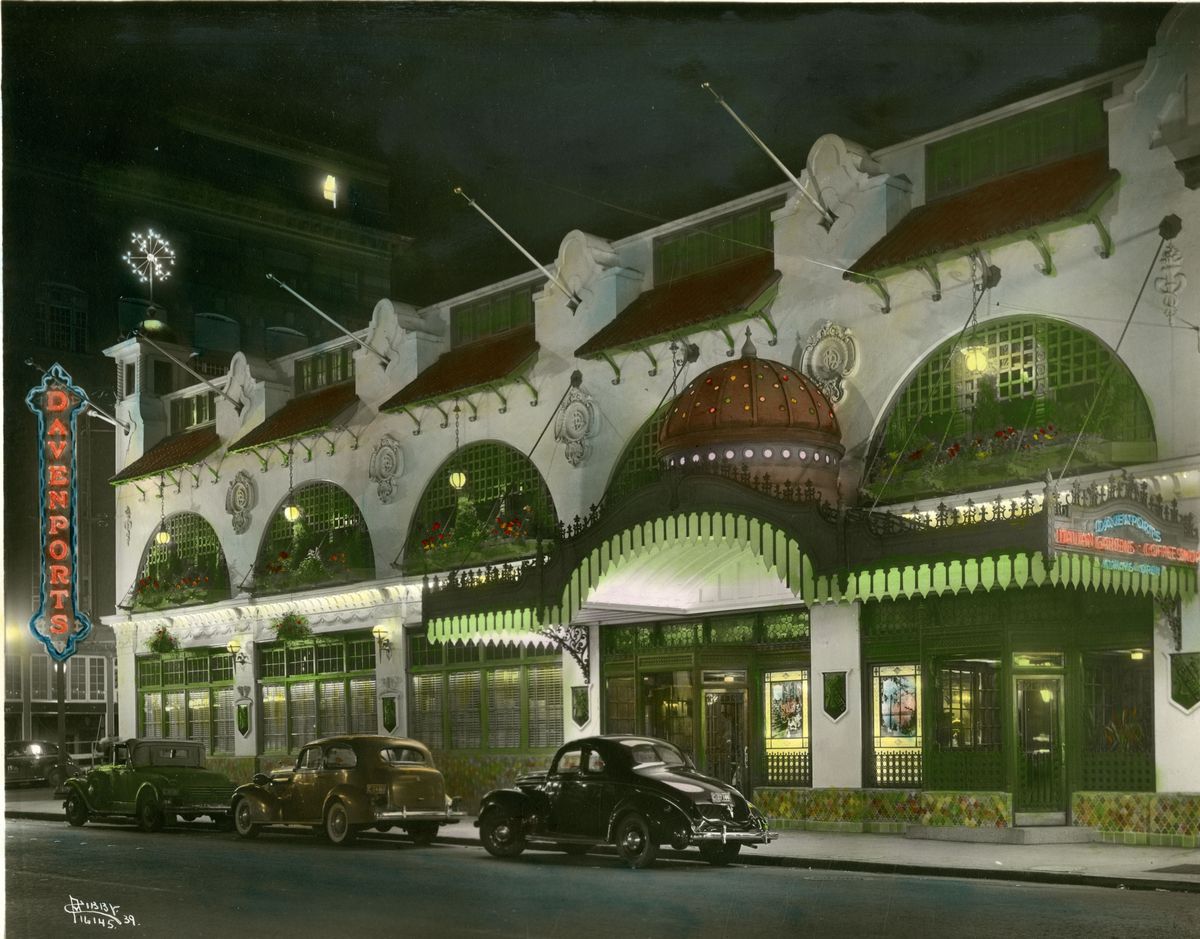
Photos show the variety of events hosted at the Davenport as well as spaces like the Italian Gardens restaurant and businesses that used to call the Davenport home.
“When they built the Davenport, it was meant to be almost a city in and of itself,” Postelwait said. “On that block, they had room for outside businesses to come in. They had their own Davenport businesses. You had all of the guest rooms, and then there were conference spaces and ballrooms. It was really meant to be the space where, whether you were a visitor or a Spokanite, you could stay downtown basically in that block and never leave unless you really wanted to.”
The Davenport collection of hotels has grown to include several locations across downtown Spokane, but the original is still the crown jewel. Though many might think they’re familiar with the hotel, Postelwait encourages people to try looking at the Davenport in a new way. Grab some coffee, she suggests, then wander through the hotel and take a closer look at the details and care that went into the building that started as a restaurant and grew into a regal gathering space for one and all.
“I can’t deny I’ve taken the Davenport a little for granted,” she said. “ ‘It’s a cool thing that’s always there.’ It was fun to really look back and dig in a little bit more on the history and all those cool tales about it that make it so special.”