
Spokane County couple saves tiny owl trapped in a sewer pipe. Here’s how to protect raptors on your property
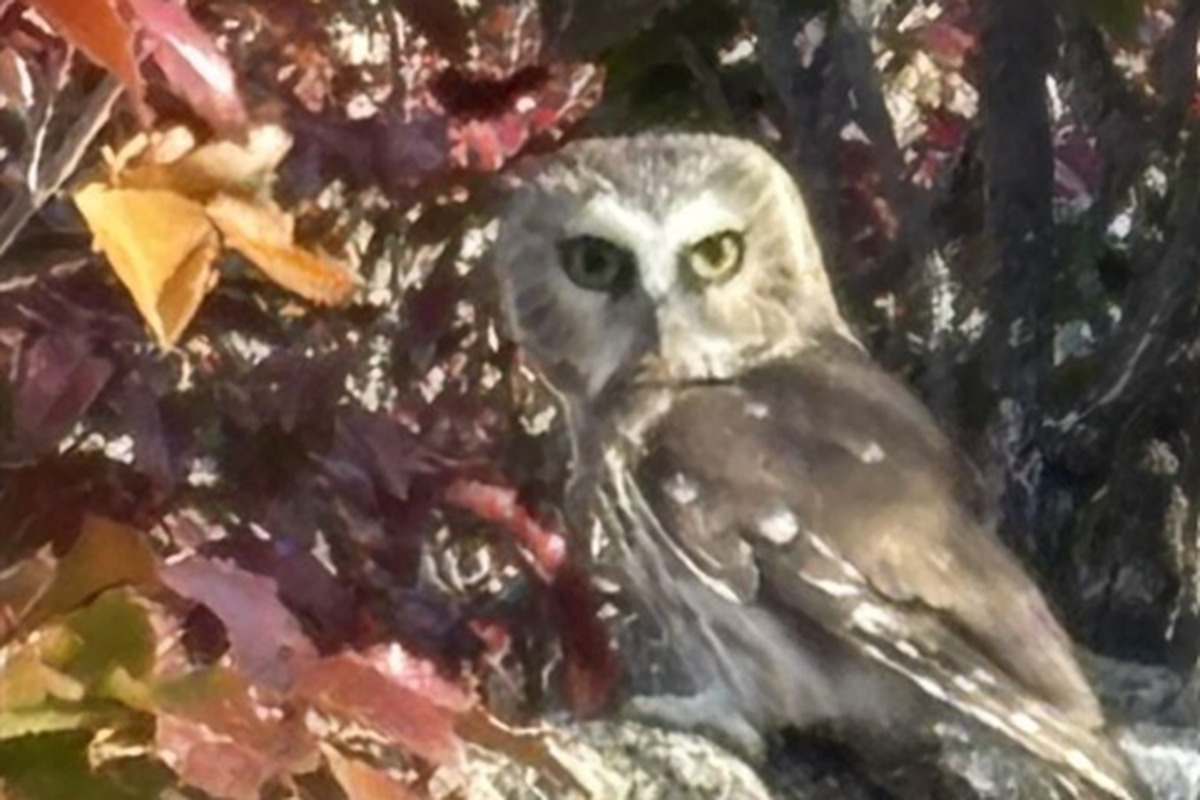
Inside a concrete septic-system pipe jutting from the ground, two big, yellow eyes gazed upward, surrounded by a circle of blackness. With Halloween right around the corner, could it be Pennywise, the sewer-dwelling evil clown from the Stephen King novel “It?”
No. It was obvious to the man walking his dog 50 miles northwest of Spokane last week that the forward-facing eyes belonged to a trapped owl – likely a small one. Too deep inside to be reached, the man contacted the Spokane Audubon Society’s Save-a-Bird program using a dedicated email address on the organization’s website. The time was 9:30 a.m.
By 11 a.m., Save-a-Bird volunteer team members Bea and Jim Harrison were driving in from their home east of Cheney to Fort Spokane, the site of a former U.S. Army post and later, a Native American boarding school. On this historic property, now run by the National Park Service with a visitor center and museum, the bird was stuck inside a narrow vertical pipe. The couple had no way to know how long the owl had been there, only that it would die if they couldn’t extract it.
Life-long birders, the Harrisons knew about the danger posed by open-topped vertical pipes. Birds – some of them cavity nesters and others looking for a safe place to rest or escape bad weather – enter the pipes and then can’t get out. Younger and less coordinated birds will land atop a pipe to roost and then fall in.
“An open pipe sticking vertically out of the ground can become a death trap,” Bea Harrison explained.
The threat is so widespread that the U.S. Fish and Wildlife Service launched a “Death by Pipe” public awareness campaign to encourage people to close, screen or cap open vertical pipes, or remove them when no longer used.
“Trapped in a small space with no food or water, the bird struggles until it slowly dies of stress, starvation, or dehydration,” the Wildlife Service states on its webpage, adding that the cycle of death continues when another bird comes along and gets trapped in the same pipe.
Once the Harrisons arrived at Fort Spokane, they parked their car and walked to the abandoned concrete pipe. Peering inside, a pair of bright yellow eyes glowed back at them from 5 feet deep.
Jim Harrison had assembled a makeshift catch pole by attaching a loop of rope to the end of a fishing rod. He hoped to slip the rope around the owl’s body and safely pull it up, but each time he tried, “the owl would turn, thrash and grab the rope with its talons,” Bea Harrison recalled. “It absolutely would not go along with our plan.”
So the couple moved to Plan B.
After retrieving a hardwood stick from a tree, they lowered it into the pipe and placed it at an angle. Within a minute or two, they saw a distinctive feathery-white “Y” between the bird’s eyes. Then they saw its entire face. Almost methodically, the owl was climbing up the stick.
If the small raptor appeared injured or severely dehydrated, the Harrisons planned to transport it to a licensed wildlife rehabilitator.
But a transport wouldn’t be necessary. This little owl had a trick up its sleeve.
Climbing up the stick, the bird was about a foot away from the pipe’s opening. Ever so slowly, the Harrisons began pulling the stick out.
“Suddenly, the owl took off and flew behind us,” said Bea Harrison, recalling that instead of it hightailing out of the area, it landed on a nearby ledge . Then, using those yellow-marble eyes, “he just looked at us,” she recalled. “For several minutes, it stared at us and we stared back.”
Roughly the height of a russet potato topped with an oversized head, the rescued subject was greeting-card cute.
It was a northern saw-whet owl, and even though it’s a common, year-round resident of the Pacific Northwest, few people are lucky enough to see them, according to field biologist Hayley Madden of the Owl Research Institute in Charlo, Montana. The owl’s small size and camouflaging colors help keep it out of sight, as does its tendency to roost deep within dense trees such as Douglas firs, junipers and spruce, she explained.
“I can’t guess how many times I’ve walked past one perched in a tree without spotting it,” Madden said.
But thanks to the saw-whet owl’s bright yellow eyes, this one was spotted and rescued.
As for getting the pipe covered to prevent another bird from getting trapped inside, Spokane Audubon board member Mike Borysewicz said he has been unable to reach the National Park Service, presumably due to federal shutdowns and staff cuts.