
The Spokane region quietly reached an air quality milestone this summer decades in the making
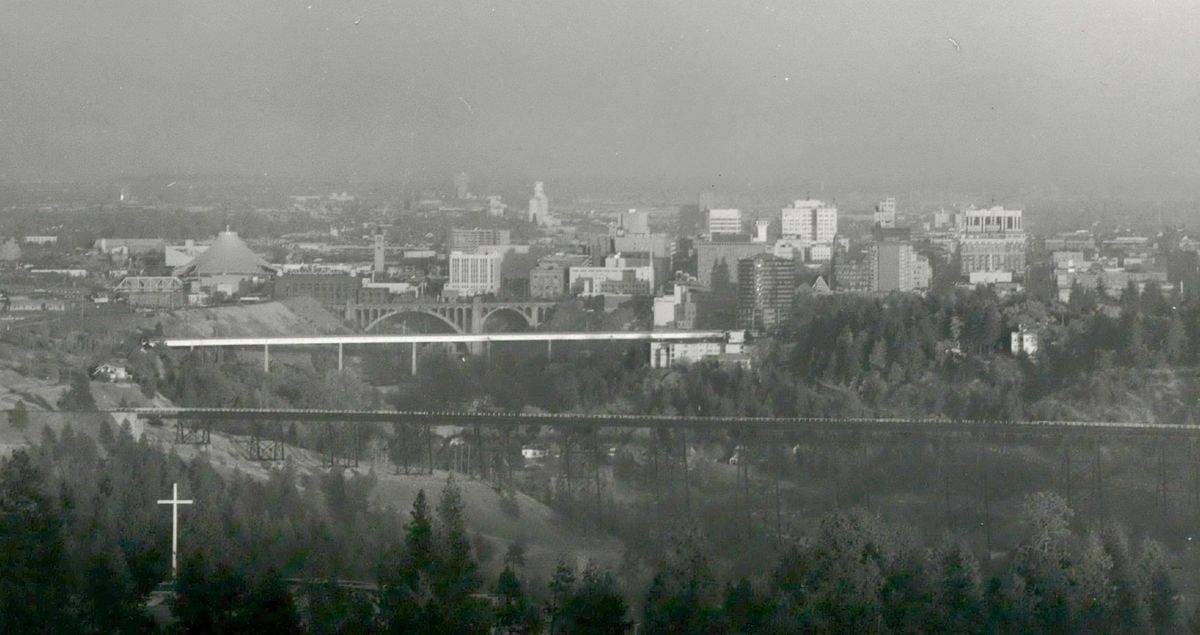
Smog, and lots of it, blanketed Spokane for years.
The industrial engines that drove the Inland Northwest’s growth in the 1900s spewed soot and smoke across the region, and as the region grew, so did the pollution problem. Additional residents meant more vehicles spewing exhaust, more coal and wood -burning stoves emitting smoke and dirt kicked up on busy, unpaved roads.
One could hardly tell nowadays. Transplants to the Inland Northwest may not even realize how industrialized the downtown core once was, or the historic ties to timber, manufacturing and mining.
The Spokane Regional Clean Air Agency announced Wednesday that, for the first time in decades, the region is no longer under probationary federal watch for carbon monoxide and particulate pollution. It’s a success story decades in the making, said agency spokesperson Lisa Woodard.
“If you’re a newcomer to Spokane, or fairly new, you may not appreciate from where we’ve come,” Woodard said. “And sometimes it’s hard to really appreciate what you have if you don’t look back and see.”
By the 1990s, Spokane was listed by the Environmental Protection Agency, alongside Los Angeles, among a handful of cities considered to have the worst carbon monoxide and particulate pollution in the country. Spokane had repeatedly flunked air-quality standards for carbon monoxide and particulates, leading to its designation as a “serious non-attainment area.”
The label led to a lot of fear among local leaders worried about the region’s reputation, and how business and tourism may be affected, Woodard said.
“So it was a lot of education and working with business communities, making presentations throughout the community about ‘What does this really mean?’ ” Woodard recalled. “It means that it puts us on a timeline and provides funding so that we can address the issues that are causing poor air quality, and that we can move forward as a community.”
Spokane reached compliance in August 2005, due largely to the work done by the regional air quality monitors and enforcers, the Spokane Regional Clean Air Agency. Established in 1969, the agency, once called the Spokane County Air Pollution Control Authority, is responsible for the leg work of the state’s 1967 Clean Air Act, and its federal counterpart of the same name.
Executive Director April Westby, who stepped into the role a year ago, began her career with the agency at the ground level. It’s rewarding work, she said, and the impacts of it can be seen in the attitudes and behaviors of the region’s residents. As an example, she pointed to the perennial wildfire season discussions around the Air Quality Index and where the region falls on a given day.
It’s a testament to the agency’s work, and the goals of the region’s newer residents, she said.
“The younger generation, I think, is a lot more concerned and a lot more interested in learning about our environment, our air and what they can do to lessen their impact,” Westby said.
August 2025 marked the end of a required 20-year maintenance period for reaching attainment, marking a significant improvement to the air quality of more than three decades ago. The agency is now no longer required to submit plans to the EPA for addressing rampant carbon monoxide and particulate matter 10 micrometers in diameter or smaller, sources of which include dust kicked up by agriculture, wood heating and outdoor burning.
Spokane hasn’t exceeded federal limits for either since the 1990s, and concentrations of carbon monoxide are so minute that the agency stopped monitoring for it in 2016. Woodard said the dramatic decrease over the last few decades is due to improved techniques and technology for transportation and agriculture, as well as impactful changes in the behaviors of local residents.
The introduction of more fuel -efficient cars and oxygenated fuels to power them went a long ways in throttling the carbon monoxide hanging over Spokane, while improvements to farming practices led to less soil erosion and particulates in the air. Other key changes include the agency’s work with regional public work departments to use cleaner traction sand in the winter, or replacing outdated wood stoves.
“A lot of the programs that we put forth in our maintenance plan are programs that still continue,” Woodard said. “They’re programs that got us into attainment to begin with.”
Through the late 1980s and most of the ’90s, air -quality experts monitored only particulates 10 micrometers or smaller in size with available equipment. In 1997, a new standard for smaller particles, 2.5 micrometers in diameter or smaller, was established.
The smaller particles, of which wildfires are the primary local source, are the more pressing pollutive matter affecting Spokane in this day and age, Westby said. The fine particles are more hazardous to human health than their larger counterparts, capable of penetrating deep into one’s lungs and causing significant damage to the respiratory system.
Wildfire smoke has resulted in unhealthy air quality in the region almost every year since 2012, with an annual average of 51/2 days where the AQI was over 100, according to the agency. Last summer was the first since 2016 not to have a day over the federal limits for fine particle pollution in the past eight years.
Spokane is still considered within compliance of the fine particulate standards, as the EPA excludes spikes caused by natural disasters like wildfires and dust storms, Woodard said.
“We still do have good or moderate days of air quality 95% of the year,” Westby said. “So you know, we really do, most of the time, have really great air here.”
Wildfire smoke may be the new concern, but Woodard stressed it’s important the community take note, celebrate and continue with the decades of work it took to make the region a healthier place to live. Residents can learn more about current air quality, the ongoing efforts to replace outdated stoves, asbestos abatement and the bevy of other programs managed by the agency on its website, SpokaneCleanAir.org.
“We think it’s a good message to say, ‘Hey, we’ve worked together as a business community, as our citizens, our elected officials, to achieve great things in our community, to improve our air quality,’ ” Woodard said. “And that means healthier, longer lives.”