
East Valley School District seeks $220 million bond for replacement of middle, high school
In February, East Valley School District voters are poised to encounter a ballot item they haven’t seen in more than a decade.
The school district is sending a $220 million bond proposal to February ballots, seeking to raze and replace the existing East Valley High School and Middle School. The current buildings, respectively 63- and 56-years-old, have reached the point where they would be as expensive to repair and modernize than to replace, Superintendent Brian Talbott said.
“The massive needs have just compounded over time, and we’ve been very supported by capital levies: We’ve been able to put new roofs on, update some systems like HVAC and lighting and roofs,” Talbott said. “But we haven’t been able to really address the needs that we have, which is construction.”
If passed, the bond would tax property owners at an estimated yearly rate of $1.96 per $1,000 in assessed property value over its 21-year life. Because an existing 74 cents per thousand tax levy from the school district is expiring in January, property owners will see their bills increase by an estimated $1.23 per thousand under the bond, if passed.
The district has been unsuccessful in passing bonds since 1996, and the seven attempts since then each failed to reach the 60% voter-support necessary to pass.
In those three decades, the district has been using short-term capital levies to finance smaller projects in the district, like replacing a HVAC unit from 1975 and “patchwork” repairs to aging facilities.
“We’re in triage mode, we’re fixing the worst of the worst of the worst,” Assistant Superintendent Neale Rasmussen said.
East Valley High School was last modernized in 1989 and the district added a classroom in 1997. The middle school had an office modernization in 1998 and the addition of a gym and music room in 1994.
Awaiting election results and collaboration with the community, Talbott said the district hasn’t drafted any renderings of what their new spaces could look like, but he does have one factor in mind.
The district would design the new middle school with a handful of additional classrooms to accommodate sixth-graders, who’ve in years past been at elementary schools.
As primary schools swell in enrollment, boosting the roughly 250 sixth-graders to middle school would free up space in elementary schools and align East Valley with what appears to be the status quo, Talbott said.
“We’re one of the few that’s left. So it’s just time,” Talbott said. “Our teachers, I think, want that. I think it’s common enough elsewhere that parents are surprised that we haven’t yet.”
If the bond doesn’t pass, sixth-graders would stay in elementary schools. The transition wouldn’t begin until new facilities are built, which still would be years away.
A drive past East Valley Middle School and High School might not clue passersby into the reality that’s evident inside.
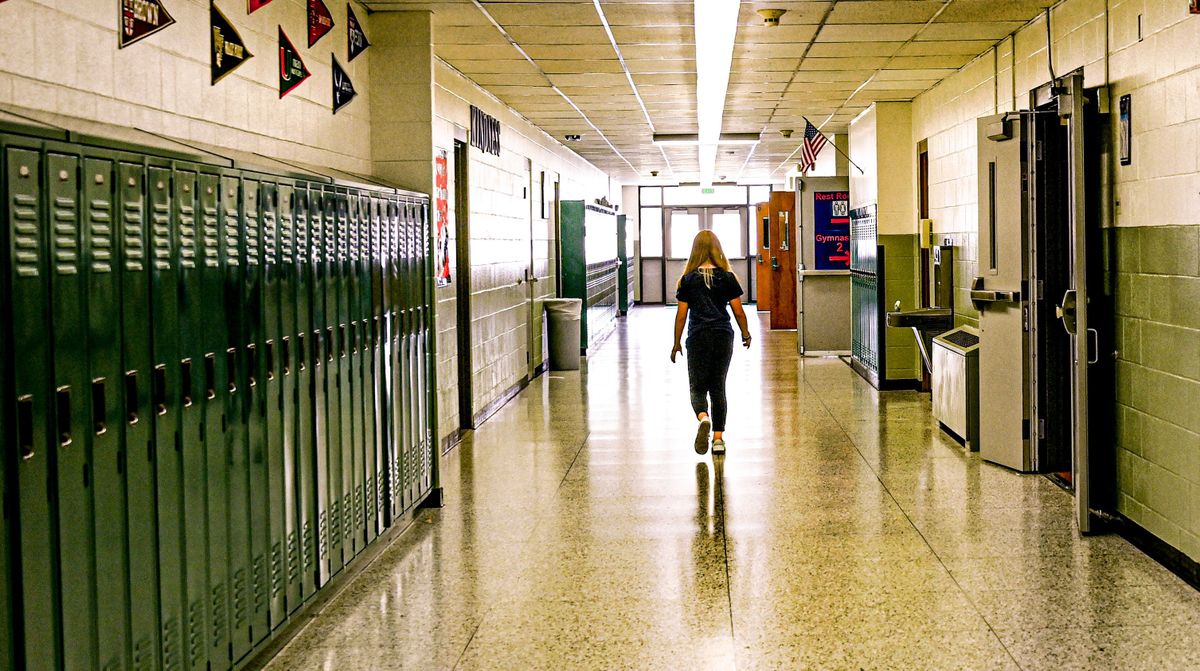
A meander through the high school is punctuated by the creaking floors and taped-together carpets in each hallway. Using the emergency eye-wash station in the upstairs science labs carries the risk of leaking water into classrooms downstairs, something that happened last school year, East Valley High School Principal Ryan Arnold said. Tiles on the outside walls are prone to falling off as they age, exposing wall insulation underneath. All the tile will need to be replaced eventually, Rasmussen said, an expensive project with or without the bond.
“It’s custom,” Arnold jokes about the quirks in his 63-year-old school.
The school isn’t exactly built for the modern era of education, Talbott said, pointing to the culinary arts program that learns in an old home economics classroom. It has stoves and sinks and counter space, but it’s more designed with home cooking in mind rather than the aspiring-chefs taking commercial cooking classes.
The school doesn’t have a performance space suitable for arts like drama or music, only a small stage with a few rows of seating that prohibit the school from putting on a play or musical.
“How do you help kids imagine, how do you help them strive?” Talbott said, standing on the small stage.
Choir and band concerts are hosted in the school’s cafeteria or gym, always packed with beaming parents, Arnold said.
The main gym in the school is noticeably hotter than other areas of the school. Talbott said the school’s aging HVAC system can’t muster the power to cool both administrators’ offices and the gym, so students have physical education class in a balmy, windowless gym in the basement.
While Talbott wants a new school to boost offerings to students, the state of the facilities is his chief concern. Signs of age can be found in every corner of the schools and constant patchwork repairs may not be worth the expense for a school that will need to be replaced eventually, Talbott said.
“Our maintenance and custodial crew and the folks who take care of our buildings have done yeoman’s work,” Talbott said. “They’ve just surpassed and eventually we have to do something.”