
Artist Sarah Barnett aims for ‘tensions,’ ‘apprehension’ in medical-inspired paintings, on display at Chase Gallery
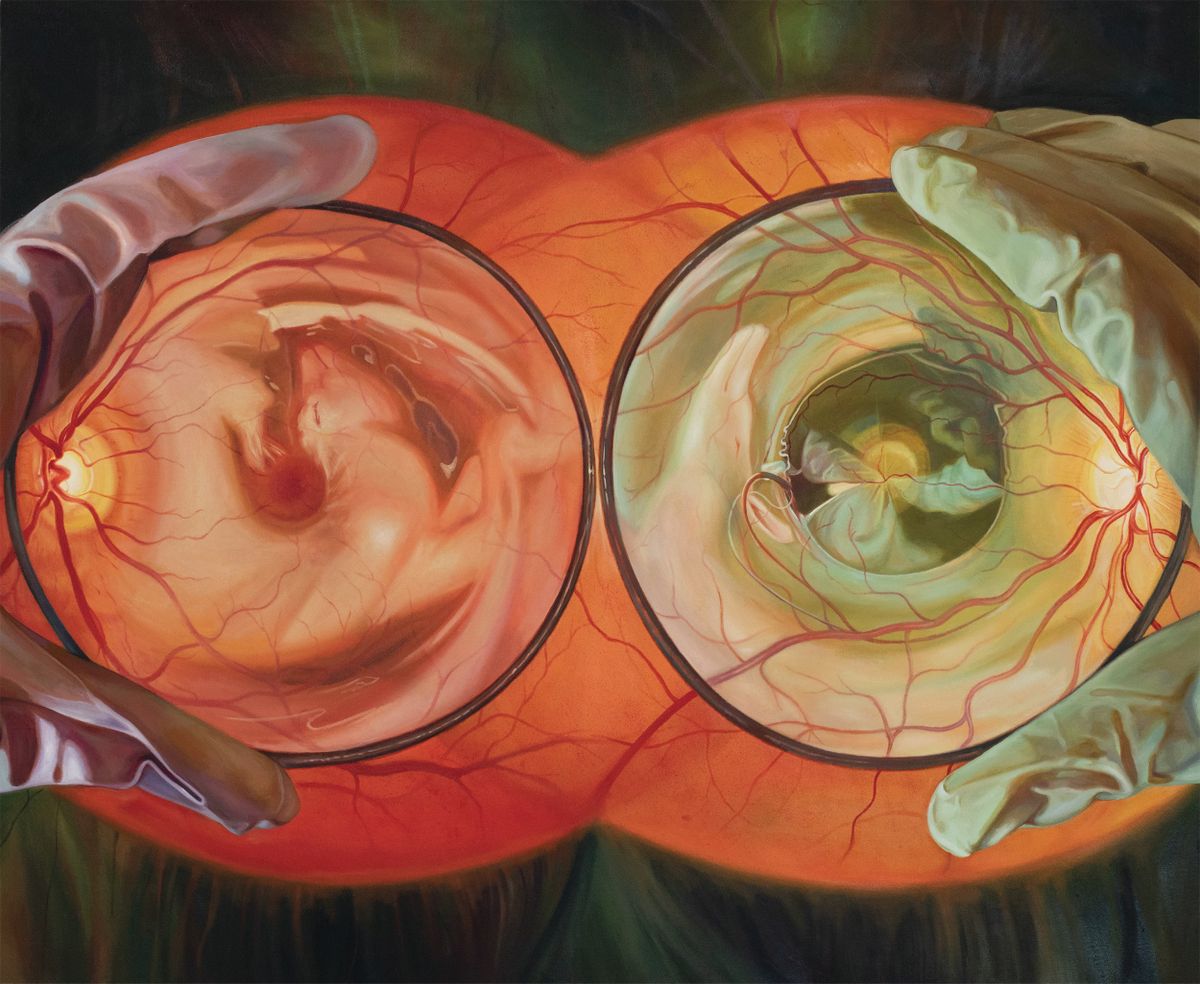
As a young artist, Sarah Barnett was interested in the details of everyday objects but also of the world around her.
With several doctors and nurses in her family, Barnett was fascinated with the human body. She recalls paging through a medical textbook at 4 or 5 years old and being engrossed with the body and human development in the womb.
When she later learned about anatomy in an artistic context via a college figure drawing course and saw the overlapping of art and science, something clicked, and what was once just a hobby became her main focus.
Barnett received her Bachelor of Fine Arts from the University of North Texas. At a professor’s suggestion, she then attended the 2018 Summer Undergraduate Residency Program at the New York Academy of Art.
“That’s where I really fell in love with the craft,” she said. “We learned how to draw, how to paint, how to sculpt basic anatomy. It wasn’t very long. It was a two-month long course, but I learned so much in that time frame.”
Barnett’s time in New York inspired her to pursue a master’s degree. While working on her Master of Fine Arts at Washington State University, where she now works as an adjunct instructor, Barnett began incorporating images of medical devices into her work.
This addition played into her love of science fiction, literature and film while also exploring our relationship to technology.
“Our relationship to technology we use on a daily basis, but also to the technology we use to extend our lives and improve our lives, and where the line is between that and then also becoming a dangerous thing for us,” she said.
This combination of human and technology, “organic and the synthetic,” as she writes in her exhibition statement, is the center of Barnett’s solo show “Simula,” which opens Friday and runs through Oct. 30 at the Chase Gallery.
The show features 21 works, some of which have never been exhibited before. The oldest paintings were finished in 2022 while others were finished just a week before the exhibit’s opening.
“I’m honestly making work more intuitively, so most of the work I make is within the same vein of ideas or interests,” she said. “That makes it easier for me to put works together in shows. They are all in the same bigger body of work.”
Barnett sees her works as still lifes or photo collages which she has recreated through paint, so there’s an incredible realism to her pieces, like the wrinkles in the latex gloves worn by an otherwise unseen figure in “In Vivo” or the strands of hair that fall over the hands of a woman covering her face in “Foreign Body (I).”
But there is also something, to call back to her sci-fi inspiration, very “Twilight Zone” about her work. In “Manikin Supine,” for example, we see a person with a large opening in their chest being intubated.
In the foreground, a CPR manikin lies on the table receiving the same level of attention. The manikin is in sharp focus while the person is fuzzy, almost like they are a painting within the painting. It seems then that the manikin, not the person with the gaping chest wound, is the one the viewer is meant to care about.
And in “Latent Permutations,” a collection of glass tubes are cobbled together at the front of the painting while a series of faces, which appear to be displayed on a screen of some kind, stare back at the viewer.
Are they friend or foe? Is the viewer trapped behind the glass tubes or presenting them to the faces on the screen?
In yet another painting, “Aerial Arterial,” a close up view of an open heart surgery is covered in the center by an image of people crossing a road as seen via CCTV. Barnett said this painting perhaps encompasses the idea of the show, the connection of muscle and mechanical, the best.
“My hope for it is to get a gut response from viewers, because it is a bit graphic, but not overly so,” she said.
Barnett feels as if the intersection between the human body and technology will always be a core interest that motivates her creative pursuits, but she does want to expand on the idea. She is very interested in science, space and the brain, so she can see herself exploring those ideas in future works.
She also has had a cast of characters and stories that have stuck with her since childhood that she’d like to bring to her work via visual worldbuilding.
Though she doesn’t want her work, no matter the subject matter, to be overly fear-inducing, she does consider herself to be fear-driven as a creative person. She “struggles with feeling OK with the way things are going in the world,” and that struggle is reflected in her work.
“I want my work to be evoking a sense of definitely tension and definitely apprehension but I don’t want it to be overly like ‘This is bad. This is scary,’ ” she said. “I want it to be a little bit hopeful as well, because I am hopeful. All these tools and technology can definitely be saving lives and used for good, but at the same time, they’re equally capable of doing horrible things, and I like that tension in the middle. I want my work to fall right in the middle and be more neutral and ambiguous.”