
Seattle’s Free 2 Fly run club fills a gap for visually impaired runners
Once Ixchel Lemus-Bromley started running in 2020, she didn’t want to stop.
Dashing through paved paths around Lake Union and Cal Anderson Park, Lemus-Bromley felt powerful and independent. Eventually, she ended up running marathons in Chicago, New York and Philadelphia.
But by 2024, it became harder for Lemus-Bromley to see due to worsening symptoms of retinitis pigmentosa, a rare genetic eye disease that causes night and peripheral vision loss over time. She grew anxious about whether she could continue doing what had turned into her passion: While outside, would she go off the path, trip on a curb, bump into a tree or twist her ankle?
“It felt like that freedom I initially felt left,” Lemus-Bromley said.
She searched for ways to keep running. At an adaptive sports camp in Trinity, Texas, in October 2024, Lemus-Bromley learned how to run with the assistance of a guide, and met runners who were visually impaired or had physical disabilities. Upon returning to Seattle, Lemus-Bromley was set on creating a similar community.
In March, she launched Free 2 Fly, a Seattle-based run club serving visually impaired runners, in which each runner is paired with at least one guide. The group – which held its first meetup in May and has since grown to 75 members, including 15 visually impaired persons and 60 trained sighted guides – usually meets at 8 a.m. on Sundays at Gas Works Park (and a different location the first Sunday of each month), with plans to increase the frequency in the future. The club also coordinates transportation to accommodate members who live farther out.
Lemus-Bromley said the group fills an accessibility gap, since there aren’t enough resources for visually impaired runners in the city. Achilles International, a nonprofit supporting athletes with disabilities, has 28 chapters in 19 states, but no chapter exists in Washington. And local organizations – such as Seattle Adaptive Sports and specialized programs of Seattle Parks and Recreation – don’t cater to running specifically, Lemus-Bromley said.
United in Stride, a national organization that connects visually impaired runners with sighted guides, collaborated in March with Free 2 Fly and Foundation Fighting Blindness on a guide training and community resource event. Still, United in Stride was designed to be a “self-service platform,” or database, to help organizations like Free 2 Fly, rather than a group that hosts regular meetups, said Katharine Geramita, a United in Stride ambassador in Seattle.
It’s important that Free 2 Fly meets regularly because a huge barrier visually impaired people face is being able to run consistently, Lemus-Bromley said. Many running workout plans suggest running multiple times per week, but visually impaired people who rely on guides or don’t have access to a treadmill cannot easily follow that guideline.
“If you’re having to constantly reach out to people to guide you, it can just be overwhelming, and you can get a lot of no’s,” Lemus-Bromley said. “So building Free 2 Fly, and having guides available and coming willingly without needing the visually impaired folks to reach out themselves, provides them that network.”
“Movement is what keeps us healthy and safe”
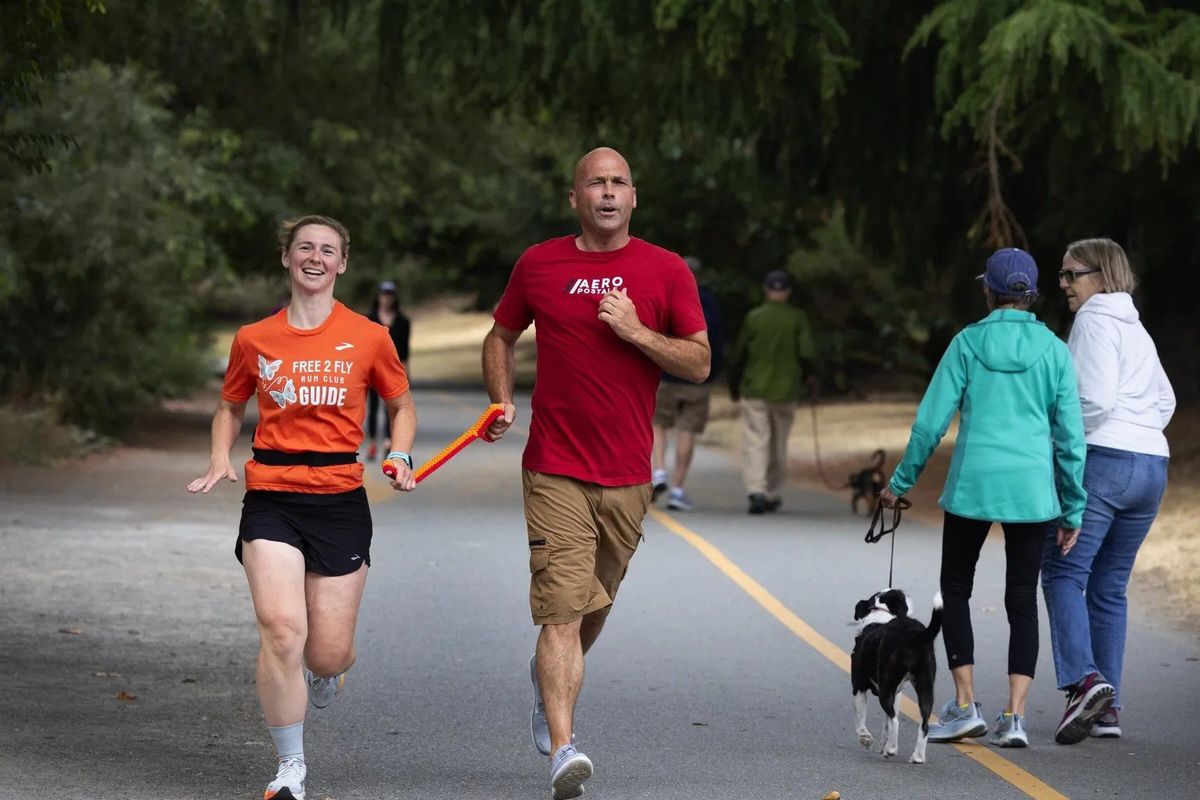
On a recent cool, cloudy Sunday morning, 28 people showed up for a Free 2 Fly meetup at Green Lake Park – the club’s largest gathering so far. Pairs of guides and visually impaired runners wore, respectively, orange shirts with the word “GUIDE,” and blue shirts with the word “BLIND” or “DEAFBLIND” on them, and linked their wrists with a crocheted tether. When running side by side, two white butterfly prints on the back of their shirts appeared to join together.
The meetup began after 8 a.m. with stretches – high knees, arm circles and lunges – before pairs went off to the park loop for a 40-minute run. Some walked and went halfway through the path and back, while others jogged or sprinted around the whole 2.8-mile lap.
In Free 2 Fly, Lemus-Bromley mainly conducts the trainings to become a guide, such as having volunteers run while blindfolded – supervised by other volunteer guides – to give an idea of the amount of trust and empathy that comes with the guiding process. Through this, volunteers also get an understanding of what phrases are helpful, such as repeatable, one-word commands when navigating obstacles. Lemus-Bromley also emphasizes that “blindness is a spectrum” and that each visually impaired person’s needs are different.
Guides and runners get partnered up according to goals and experience. Guides check in with their assigned runner on their preferences and what they hope to get out of a specific run, such as pace or distance. As much as possible, each visually impaired person runs with one primary guide – who is tethered to the runner – and one secondary guide, who runs to the side or in front of the runner. A secondary guide’s responsibilities can include setting the pace and paving the path ahead by alerting other people that a visually impaired runner is coming through.
At 9 a.m., the group at Green Lake Park reconvened to share the highlights of their morning. They celebrated completing a terrain outside of their usual meetup spot, a member’s longest continuous run and another’s running at their fastest pace.
Before Free 2 Fly, Lemus-Bromley said she often felt misunderstood while running on a path or with other run clubs around Seattle.
Experiencing light sensitivity and a lack of depth perception, Lemus-Bromley compared her eyesight to looking through small binoculars with fuzzy spots on them; in 2020 and years prior, these “binoculars” were much larger and clearer. Now, her field of vision has narrowed.
Bikers would yell at Lemus-Bromley if she didn’t position herself far enough on the side of the trail. In running groups she joined, Lemus-Bromley said she couldn’t keep up with the other runners because she’s more wary about injuring herself. While members were supportive when she told them about her vision, they didn’t know how best to help her, she said.
Because her impairment wasn’t obvious to others, “nobody on the path knew that I had a visual impairment, and so people treated me like I was a nuisance,” Lemus-Bromley said.
In January, Lemus-Bromley finished the Houston Marathon – her first guided marathon. In previous marathons, Lemus-Bromley would follow people on the course who were running a similar pace, but when that person altered pace, she would have to find another person to run behind; if she couldn’t find someone to follow, she didn’t feel comfortable speeding up. Through being guided, she learned that she could run her fastest even when she didn’t train at her best.
“Running with a guide totally gives you that safe bubble,” said Lemus-Bromley, who hopes to do more guide training with other groups to make their runs more inclusive. “It makes other people slow down. It makes people be aware, and you just feel like you have that support system right with you.”
Jessie Lorenz, one of Free 2 Fly’s first four members, has been blind since birth. A Paralympic gold medalist in goalball, she’s been running for decades, having finished one full marathon and six half marathons. When Lorenz ran her first one, she held onto a shoelace connecting her with the person guiding her.
These days, she runs with an actual tether and helps fellow visually impaired members who are navigating vision loss later in life.
Through the run club, Lorenz said she doesn’t have to feel “small or in the back of the pack.” Rather, she can focus on improving her endurance and speed, without having to explain herself.
“The running and the movement is so important, because it counterbalances all those messages and thoughts about blind people – that we need to sit still to be safe,” Lorenz said. “And actually, movement is what keeps us healthy and safe.”
“We’re running as one unit”
At the Free 2 Fly meetup at Green Lake Park, Alec Yeaney stood in the center of a field to lead the morning stretches. Yeaney has long been involved in the low-vision community, largely driven by his father’s vision loss from central areolar choroidal dystrophy, a rare genetic eye disease that also passed onto him and his siblings, though Yeaney said he hasn’t experienced vision loss yet.
For Yeaney, the run club allows sighted and visually impaired individuals to interact with each other on a personal level. When Yeaney guides a runner, he feels “we’re running as one unit.” Being responsible for their sight, Yeaney pays attention to every root, crevice and turn. As he calls out overhead branches and people passing by, he becomes more intentional with each step he takes.
“People (during) our highlights at the club will talk about, ‘This is the first time I’ve been outside running in 20 years.’ ‘I’ve never run before.’ ‘I haven’t walked or ran off my treadmill in multiple decades,’” Yeaney said. “That’s something that people say almost weekly, which is just incredible.”
When Rick Roy joined Free 2 Fly in May, he started out as a secondary guide. Now a primary guide, Roy said he’s enjoyed “helping others find their feet on the ground.” For the past two months, Roy has paired up with Young Choi, who is totally blind, and developed a close friendship with him. They first met while on a hike in Redmond with Free 2 Fly, where Choi held onto Roy’s hand as they walked through a trail. At Green Lake Park, they strolled and bonded over movies and music.
“I have fun just meeting these people. … The guiding part is like they are seeing through my eyes, but I find that it’s pretty (much) the other way around,” Roy said, adding that he’s been able to learn how his visually impaired partner perceives the world.
Choi said the run club helps him get up in the morning and exercise through means other than indoor walking machines. Before, he wouldn’t have considered running outside as an option.
With the club, Choi said, “I feel free.”