
Udderly Perfect: One family’s tradition of displaying dairy cows returns to the Spokane Fair
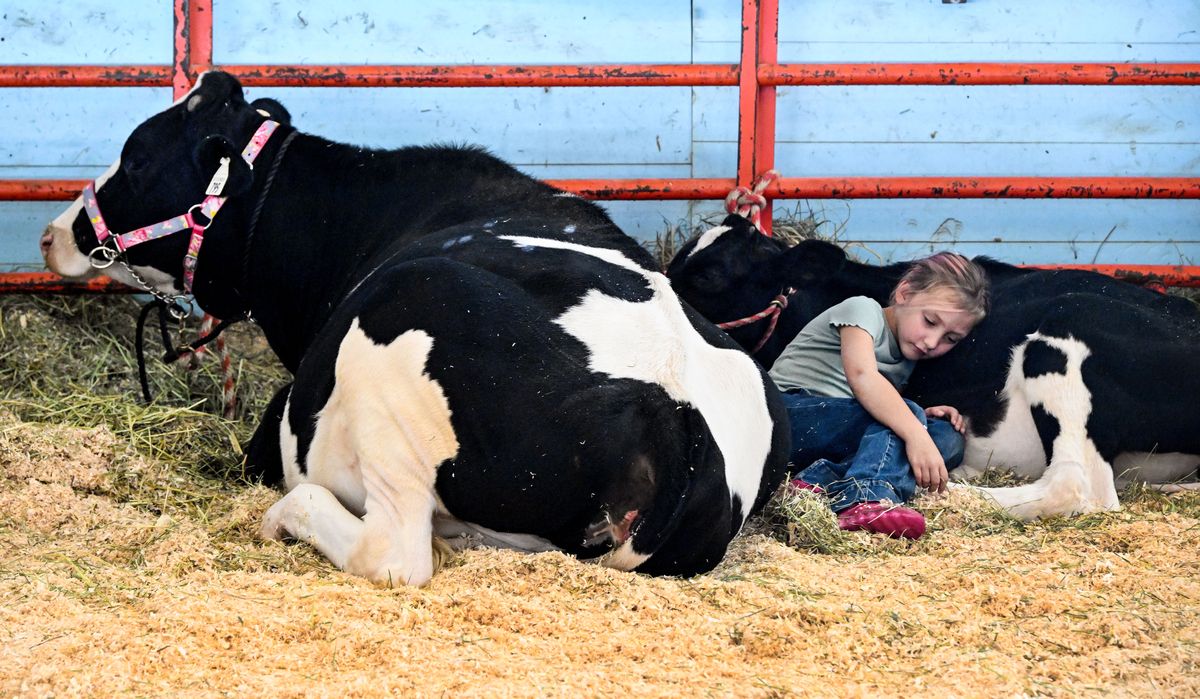
It might be called the beef barn, but if you wander over to the fixture at the Spokane County Interstate Fair this year, you’ll probably see two kids taking care of six dairy cows.
Dakota Cummins, 7, and her brother, Jayce Cummins, 10, are the fourth generation of the Cummins family to show dairy cows at the fair.
If you want to pet one of their cows, you can, but it’s always polite to ask first.
Remember: don’t pet the cows on the head, because they might try to scratch you back with their head. If it’s a smaller dairy cow, like Midnight, the “toddler” of the bunch, it could be kind of cute. But if it’s a bigger dairy cow, like Eevee, who weighs around 1,800 pounds, it’s possible for a person to go soaring across the barn from a single head bump.
For their dad, Jacob Cummins, the fair is also about keeping tradition alive. The 35-year-old used to show dairy cows at the Spokane fair as a youth, but he stopped in 2007, and there haven’t been any at the annual event since 2015.
“The reason we got back into it is just because I wanted my kids to have the same life that I did,” Jacob Cummins said.
This year was the siblings’ first at the Spokane County Interstate Fair, but Jayce said he’s won so many dairy cow shows in Yakima, Cusick and Colville that he can’t even keep track of all his blue first-place ribbons.
But at the Spokane Fair this year, the siblings aren’t competing against other cows like they do at other fairs. Instead, they’re trying to educate the general population on where food and milk come from, and hopefully bring the dairy cow show back to the fair.
Jacob’s dad, James Cummins, 65, also used to bring dairy cows to the Spokane Fair with his dad starting in 1970, when he was just 10 years old. James Cummins showed dairy cows up until about 1999 and then took a break for a few years until his son picked up the mantle.
Now, it’s up to Dakota and Jayce to carry on the legacy.
The Cummins family has owned Whitepine Flats Farm in Elk since 1964. In 1997, a fire burned down their dairy cow barn. Without enough funds to rebuild the barn, the family had to get rid of around 110 dairy cows and invest instead in a small herd of about 20 beef cows.
They also farm hay and silage on the land they live on. Silage is fodder made from crops like grass or alfalfa that’s been preserved by fermentation. James Cummins said to think of hay as cabbage and silage as sauerkraut.
“When we dairy farmed, we farmed about 400 acres. Now Jacob and I farm 1,100 acres,” James said.
During the wintertime, the family custom feeds cattle, which means other farmers bring in their cows for them to feed. Jacob estimates he feeds about 300 head of cows that aren’t his during the coldest months of the year. About 90% of the hay and silage they grow is sold, while the other 10% goes towards feeding the 20 beef cows, six dairy cows, and all the other cows that aren’t theirs.
The Cummins family also sells locker beef and locker pork. They cut out the middle man and sell straight to the consumer.
“The consumer buys it live, and then we get it processed for them, and then they pay for it,” James said.
Jacob and James said their profit margin when it comes to growing hay and silage has been thin recently.
“The weather has been very dry the last four years,” James said. “The last good year we had on the farm was 2020. That was the highest production per acre we’ve had in history. Then in 2021, we had the lowest production per ton in history.”
James said that in 2019, it cost around $200 to produce a ton of hay that they could then turn around and sell for $350. Just six years later, he said it costs more like $400 for them to produce a ton of hay, and they still have to sell it at that same $350 price.
Because hay is at the end of the food chain, James said they can only charge what the market’s worth. They can’t pass their cost on like most businesses can, because no one wants to pay more for hay if they can help it.
All the money that Dakota and Jayce make from the fair goes directly into their own personal bank accounts. That’s how James’ dad had it set up for him, that’s how James did it for Jacob, and that’s how Jacob wanted to do it for his kids.
But if the kids want that money, they have to work for it.
Dakota and Jayce are in charge of feeding their six dairy cows every morning and night. They have to wash, train and make sure the animals behave.
From time to time, Jacob said he’ll step in and help with making the cows behave. After all, an 1,800-pound cow versus a 70-pound 10-year-old isn’t exactly the fairest of fights.
“To have the grandkids there and be part of our legacy at the fair,” James said, “It teaches them where food comes from, responsibility of money, the consequence of hard work, and the consequence if you don’t do it right.”
Rain, sleet or snow, Jayce has to feed his four cows: Daisy, Foxy, Eevee and Lucy, along with the family’s other cows and chickens. Dakota has to feed her two cows, Anna and Midnight.
While daily chores and maintenance of cows is just another day for the siblings, Jayce said he doubts most of his friends would be able to do what he does day in and day out.
For particularly windy and cold days, Jacob’s advice to his children is simple: “Bundle up, dude.”
Once the Spokane County Fair wraps up on Sunday, Jacob, Jayce, Dakota and their mom, Danae, have three days at the farm until they have to drive to Yakima for another fair, where they’ll be for 12 days. Jacob said the family will be at a fair for 22 of the 30 total days in the month of September. Meanwhile, James said he doesn’t mind spending some time managing the farm, far away from the fair.
Jayce and Dakota both go to Riverside Elementary School two days a week and spend the other three days a week getting homeschooled by their mom as part of the Independent Scholar Program.
While the siblings aren’t competing against anyone at the Spokane Fair, they will be at the Yakima Fair. During Jayce’s first year showing dairy cows, when he was just 6 years old, he swept the competition at Yakima, Colville and Cusick. He even has the first place ribbons to back it up. The next year, his winning streak was smeared, but it taught him a valuable lesson.
“Anybody can say they’re number one. It’s wonderful,” James said. “But how you act when you lose really builds your character in life.”
While the Spokane County Fair is simply about displaying the dairy cows, at any other fair, Dakota and Jayce are out to win, showing how clean their cows are, how put together they are and how well they can handle the animals.
Win or lose, there’s one truth that remains for the siblings.
“A lot of good things can happen in the world, and a lot of bad things can happen in the world,” James said, “But you still got to get up and feed cows every day.”