
Ten years later, Eastern Washington scientist reflects on LIGO discovery that proved Einstein right
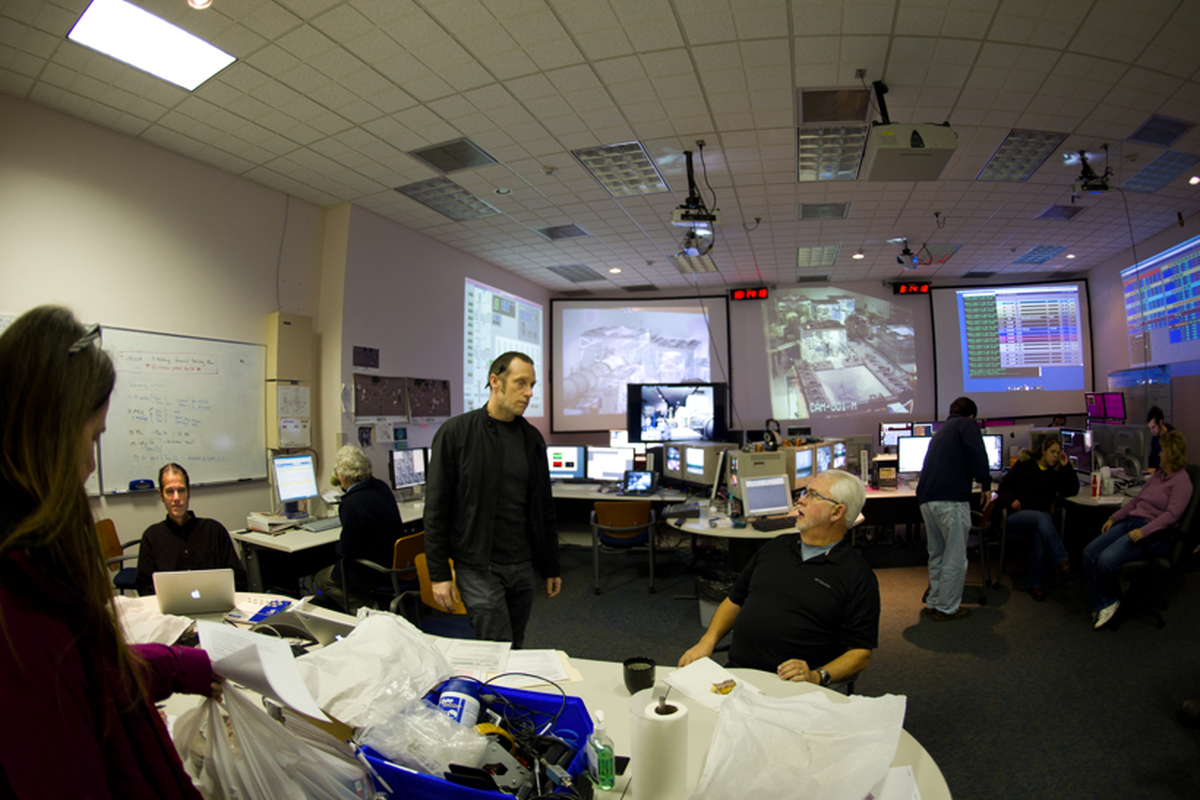
HANFORD – Ten years ago this weekend, a team of Eastern Washington astronomers changed the way scientists study the universe.
Space research has always relied on optical telescopes, radio astronomy and space-borne detectors to look at distant sources of light and decipher the cosmos.
But on Sept. 14, 2015, scientists made history with the first detection of a gravitational wave using specialized instruments stretched across the barren landscape of the Hanford Reservation, best known for its storied past as home to the nation’s secretive Manhattan Project, where nuclear scientists first manufactured plutonium.
They did it at the Hanford-based Laser Interferometer Gravitational-Wave Observatory by identifying and recording ripples in space created when two massive black holes explosively merged in a distant galaxy an estimated 1.3 billion years ago, with the wave taking that long to travel across the universe to reach Earth.
And that first detection of a wave wasn’t seen. More accurately, it was heard.
When Albert Einstein published his theory of general relativity in 1916, he stated that gravitational waves existed even though they had not been detected. But he also believed these waves would be virtually impossible to spot.
Those waves are created when massive objects like black holes or neutron stars – the collapsed cores of supergiant stars – disturb the space around them, resulting in a series of ripples, like when a rock is dropped in a pond.
Einstein didn’t think we’d have good enough tools to spot those ripples because they would reach Earth after traveling immense distances. In the second half of the 20th century amid giant leaps in technology, many scientists began to believe those distant, fast-traveling waves might be small in size, but they could be identified.
Their efforts toward this goal led to the construction of the LIGO observatory. The U.S. National Science Foundation paid for the project, and researchers from Caltech and the Massachusetts Institute of Technology managed it.
An identical LIGO facility was built 1,800 miles away in Louisiana. The dual installations are designed so that any gravitational wave detection at one site would be confirmed by the same signal at the other.
Both LIGO facilities use two 2.5-milelong tubes into which laser beams are directed toward mirrors at the far end, bouncing the beams back to the source. If a gravitational wave moves across and past LIGO, the distances inside the tubes will change slightly, and sensitive instruments will collect that information.
Think of LIGO as perhaps the largest antenna on the planet.
LIGO operated for a decade without detecting gravity waves. These early-year operations helped researchers tune the hardware and software systems to make them more accurate and sensitive.
A major technology upgrade followed, adding advanced optics, higher-energy lasers, more stable mirror pendulums and better noise reduction. This advanced LIGO was 10 times more sensitive, making it better able to detect waves occurring much farther away than before.
The upgraded LIGO lab was still in test mode during the summer of 2015, with its teams of scientists expecting to begin its first full observation run on Sept. 18. The interferometers were already collecting live data, and the lasers had been stabilized – a not-easy task since the detectors can routinely collect noise and seismic bumps from the environment. Strong winds, for example, or heavy ocean waves from as far away as Alaska sometimes disrupted the quality of laser measurements.
Then at 4:40 a.m. on Sept. 14, the LIGO instruments at Livingston, Louisiana, measured a signal. It was brief but distinct. Less than a hundredth of a second later, instruments at the Hanford LIGO recorded the same signal traveling at the speed of light.
At that moment, the most sensitive distance-measuring apparatus on the planet had just detected a spatial shift in the beam tubes measuring about one-thousandth the width of a proton.
No scientists at Livingston or Hanford were working on site at the controls that early in the morning. What had just occurred was another signal in the machine, still going through its testing and setup. It might have been a software glitch or a response to an electrical storm nearby.
Michael Landry was LIGO’s detection lead scientist at the time. His job involved tracking any signals that might be a gravitational wave, instead of “noise” or signals caused by seismic activity in the environment or glitches in the instruments.
At 5:30, Landry awoke to an email from two German postdoctoral students who had been using an automated tracking network to monitor data from the dual LIGO sites.
“I’m up in the morning and I saw this email,” he said. “The students in Germany are wondering: ‘It looks like two black holes.’ ”
The curious students had looked at the unusual data and had to ask if anyone could explain the source of the signal.
After discussions with scientists in the control room and calls to the detection lead in Louisiana, Landry started gathering logs and timelines. One of his first concerns was that the signal might have been a “blind injection” – a surprise test sent into LIGO by a staff scientist, to see how the operators responded and to keep the physicists on their toes.
Something like this had happened in 2010 with a similar signal. The team went through a careful checklist and determined that it looked good until they learned that Landry had himself inserted a bogus test signal.
But in 2015, Landry wasn’t allowed, under the LIGO injection rules, to directly ask if someone had inserted a fake signal. He was allowed to ask if LIGO was in a “blind injection phase” – meaning, was it possible that a false injection had happened?
The answer he got: No, LIGO was not in an injection phase.
“And immediately I got very cold. After I realized there was no injection, it felt like physical coldness. I became super calm,” Landry said.
Within a few hours, the teams at both sites had suspended operations and gathered all the data logs. Then followed a thorough review of the systems used to spot and identify signals or filter out interference or noise. They needed to prove that the detection was not a stray signal or a system glitch.
They also looked at and discounted the possibility that a hacker had caused the signal.
David Reitze, the executive director of the LIGO Laboratory, was at Caltech and had also spotted an email that morning about the possible detection.
“When I saw the plot of the data, which looked exactly like what we’d expect for a gravitational-wave signal from a pair of merging black holes, I was pretty sure we had something real,” Reitze said. “But we also knew it would take a lot of work to prove that the signal was from an astrophysical source.”
It would take months of screening and double-checking the signal and the integrity of the data before concluding that this was the first gravitational wave detection. A detailed research paper summarizing the event appeared in February 2016.
That first detection, named GW150914, matched the signal pattern physicists had predicted, based on the frequency and loudness two black holes would produce as they merged. The resulting 2015 merged black hole was estimated to be more than 60 times the mass of our sun.
The Sept. 14 black hole collision, when converted into a digital sound signal, became a “chirp” lasting about two-tenths of a second with a sweeping, rising tone. While gravitational waves are not sound waves, they can be converted to audible tones the way plucking a string makes a digital tone played through an amplifier.
The first wave signal originated within a large area in the Southern celestial hemisphere. Subsequent observations with additional detectors have allowed for more precise localization of later gravitational wave events.
Columbia University physicist Janna Levin has described the colliding black holes or merging neutron stars as musical mallets that bang nearby space like the skin of a drum. Then LIGO becomes the amplifier that transfers the physical gravitational waves into electronic sound waves.
Three U.S.-based scientists, Rainer Weiss, Kip Thorne and Barry Barish, would receive the 2017 Nobel Prize in physics for their work on LIGO.
The evolution of LIGO going forward will involve even more interferometer sensitivity and more reach – the ability to detect more events from far more distant galaxies and the ability to sense closer events more clearly or loudly.
It will have to do so without Weiss, who died this summer at the age of 92.
Since 2015, the two LIGO teams, in conjunction with overseas interferometers in Italy and Japan, have detected more than 200 gravitational wave events, with roughly another 100 more under review as potential cataclysmic gravitational events. Most are the mergers of binary black holes. A lesser number involve merging neutron stars, or the merger of black holes with a neutron star.
The U.S.-based LIGO sites now work in a network with interferometers in Italy (called Virgo) and Japan (KAGRA). Together they track cataclysmic events and can triangulate the sources of waves, sending real-time updates so other astronomers can use their own scopes and observation tools at the same time.
That tracking system was used in early 2017 to study in complex detail the crashing together of two neutron stars.
Starting in 2016, Landry became the head of LIGO Hanford Observatory, overseeing a staff of 60. Despite the LIGO history of successes, Landry still hears concerns at times from some who question the tax dollars spent and the benefit of gravitational wave research. For 2025, the operating budget for the two LIGO sites came to $47 million.
But there’s a push by the Trump Administration to cut LIGO’s budget to $29 million in 2026, which could eliminate either the site at Hanford or the one in Louisiana. If one was shut, it would affect to the ability of astrophysicists to triangulate where gravitational waves originated.
Reitze told the New York Times that the observatory could run on a diminished budget, but the cuts would be devastating and could unravel future findings and the advancement of our understanding of the universe.
Apart from advancing new technology – including breakthroughs in quantum engineering and developing cutting-edge measuring tools – Landry says LIGO’s mission helps scientists push against the limits of what we know about gravity, the creation of the universe and the fundamental forces at work.
Gravitational wave research is in its infancy, he said, with some of its major and transformative discoveries certain to arrive as the technology improves.
“When you turn on a brand-new type of detector, something sensitive to aspects of the universe that no one’s ever sensed before, that no one’s ever had the ability to see or interact with,” Landry said, “you’re going to find brand new things that you haven’t thought of before.”