
‘It’s your history’: State Constitution visits Spokane in first time leaving Olympia
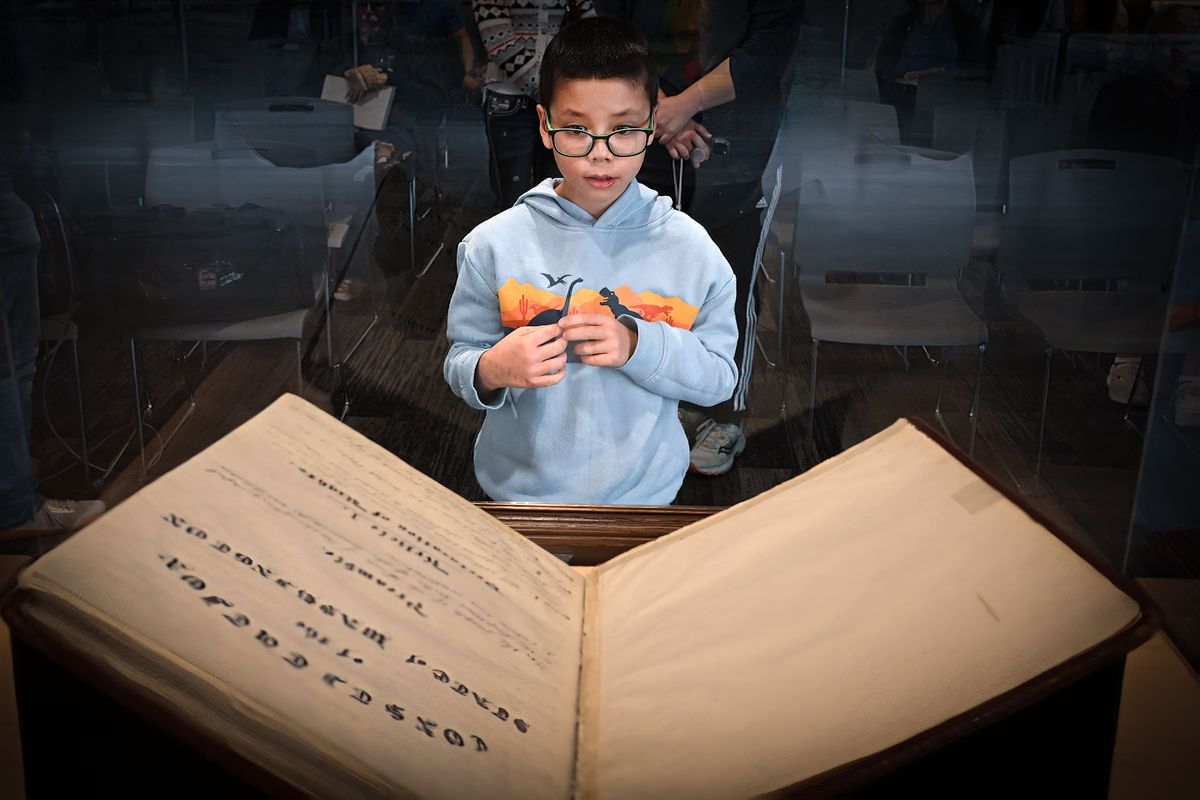
For its first trip out of Olympia since its 1889 ratification, the Washington state Constitution came to Spokane Monday afternoon.
In honor of Constitution Week, an annual event for recognizing the 1787 signing of the U.S. Constitution, the state’s leatherbound document featuring 78 handscribed vellum pages stood propped open under UV-shielding glass in the Spokane Central Library from 3 p.m. to 6 p.m.
“It’s like Mona Lisa. You know, I can view it online, sure, but wouldn’t it be awesome to actually see it in person?” Secretary of State Steve Hobbs said. “And it’s the same thing with the state constitution.”
No more than 50 people attended the 3 p.m. kickoff, and those who did show formed a line in front of the display, each taking turns looking over the preamble. Parents and grandparents stood and read during their turn, while teens took the once-in-a-lifetime opportunity to snap selfies with the state’s founding document.
Cheney residents Ali and Karl Doran stopped by the library on their way out to the Valley to see the constitution. The couple took the opportunity to show kids Anna, Jacob and Elizabeth “Lizzy” Doran – ages 8, 5 and 2 – how Washington became a state, though Anna only shrugged when a Spokesman-Review reporter asked how seeing the document in person was for her.
“It’s inspiring,” Ali Doran said. “It wasn’t protected for so long and now it – that it still made it this far is kind of amazing, for me.”
State Archivist Heather Hirotaka said in her opening talk that for most of Washington’s history, the secretary of state kept the constitution casually on a shelf in the basement of the old capital building.
Today, it is stored in a temperature- and humidity-controlled vault with locks for which even Hirotaka doesn’t have the codes. For the drive across the state, the book was held in a fireproof safe to protect it in the case of an accident. Washington State Police provided an escort for the whole journey, and an officer stood watch at the library Monday.
Completely mitigating all risks of traveling with the document took years, Hirotaka said. Having grown up partially in Yakima, she said it is important that Eastern Washington citizens get the chance to engage with archival documents.
“There are always conversations of ‘People in Olympia don’t care about the rest of the state,’ and that’s a narrative that we still hear today,” Hirotaka said. “And so for me, having lived in Eastern Washington, it’s really important that we connect with people in Eastern Washington and that we help people understand it’s not just the history of Western Washington, it’s the history of all of us, and how do we connect you to that in a way that is meaningful.”
While Anna, Jacob and Lizzy looked out the library’s window, overlooking the Spokane River, Karl Doran remembered an anecdote archivist Benjamin Helle shared about Washington becoming a state.
Washington inadvertently sent the approved constitution to President Benjamin Harrison without the signature of the governor at the time, Miles Moore, Helle said. During the delay, North Dakota, South Dakota and Montana were all admitted to the country, making Washington the 42nd state rather than the 39th.
“Most people probably wouldn’t mind if we were the 39th or 42nd. But it was, back in the day – and I don’t remember which paper it was, but they really lambasted the governor at the time,” Helle said later. “They called him – probably a horrible reference at the time – an ‘ignoramus’ for not signing the document correctly.”
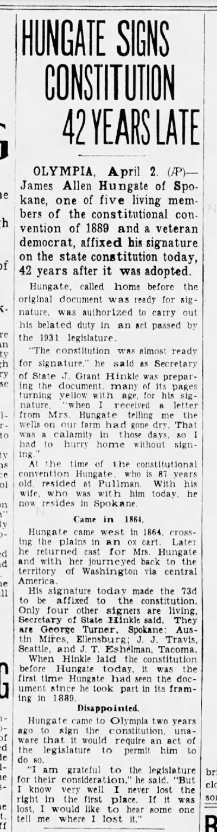
Signed by 75 male delegates, including farmers, lawyers, doctors, loggers and merchants, the state constitution banned monopolies and divided responsibility among elected officials rather than in a centralized government. Later, in 1931, one of the original delegates – James Hungate from Pullman – was granted special permission to sign the document 42 years after he had to leave Olympia early following telegram that his wells had run dry, Helle said.
Despite its long history, Helle said that there is still much to be learned about the state constitution. For example, on the inside cover the name “R. O. Wells” is signed. He may be a professor from the Skagit County area, Helle said, but who he is remains officially unknown.
“We’re always kind of encountering these kind of little mysteries,” Helle said. “So who put the binders on? Who was the scribe that transcribed all of this? There’s so many things that we are asked about, or look to find out, these little stories.”
Hirotaka and Hobbs both said they hope to bring more archival documents out of Olympia with which the public can engage. The archive building in Olympia is “essentially falling apart,” though, Hirotaka said, and she urges the public to ask legislators to support the archives.
“We safeguard these records and we take really good care of them,” she said. “But at some point, we will need some assistance from the legislature to step in and help us fund a new building and work with us on that, because it’s not just our history, it’s your history; and that matters.”