
Live glassblowing demonstration at the MAC gives museumgoers firsthand look at how glass art is made
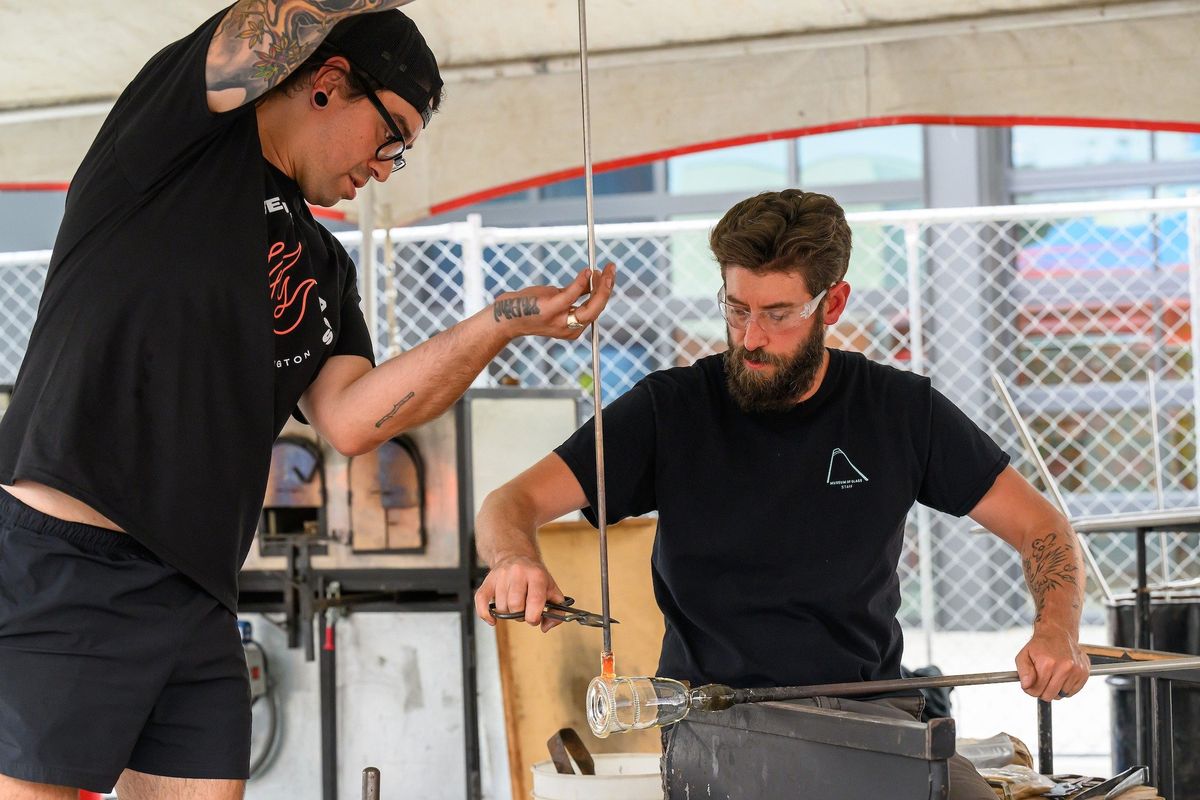
According to Tim Butler, marketing and communications director for the Museum of Glass, the Pacific Northwest has three major cultural exports: coffee, tech and glass.
Thanks to institutions like the Pilchuck Glass School in Stanwood and the Museum of Glass in Tacoma and artists like Dale Chihuly and Preston Singletary, glass work has become a popular art form throughout the region, one that’s revered beyond the Pacific Northwest.
Singletary’s “Raven and the Box of Daylight” is on view at the Northwest Museum of Arts and Culture through Jan. 4. Giving museum visitors insight into how a glassblower like Singletary works, the Museum of Glass Mobile Hot Shop will bring two artists and an emcee to the MAC on Saturday for the Art of Glassblowing, a live glassblowing demonstration.
The Hot Shop has been a major feature of the museum since its opening in 2002. At the shop, Butler said the museum’s team of glassblowers, which he likens to a house band, work on various projects. Every year, around 45 to 50 visiting artists, or guest musicians, visit the museum to work with the team.
Butler said museum employees are often asked how a piece in an exhibit is made, and the Hot Shop provides context plus an added wow factor from seeing glassblowers work in person. The museum also offers classes for those interested in trying glassblowing themselves.
“It’s that three-pronged approach,” Butler said. “See the artwork, see how it’s made, and maybe try your hand at it yourself. I definitely think that it has helped people become more invested in the artform, because they can see it happen in real time.”
Taking the show on the road is the Mobile Hot Shop, which features space for two artists to work on location. For 15 years, the Mobile Hot Shop has traveled around the region to art festivals, community centers and universities. The hot shop has also made its way to events in California and Canada.
“It’s usually a huge hit, because especially where we are in our neck of the woods, glassblowing and glassmaking is pretty prevalent, but we find when we bring the Mobile Hot Shop to these other locations, it’s often something that a lot of people haven’t seen before,” Butler said.
The hot shop, with about a 30-foot-by-30-foot footprint, features several furnaces Butler said are a little bigger than a pizza oven. The clear glass the artists use sits in those furnaces, “as if it’s molten honey,” Butler said.
Artists will stick rods into the furnace and collect the glass, a process called a gather. Then, the artists will form the glass into a ball and shape it from there.
The artists will use other furnaces for reheating the glass as needed, making sure they’re controlling the temperature as they work.
“The colder it gets, the harder it gets,” Butler said. “The warmer it is, the more it can be manipulated. When it’s getting close to being taken off the pipe, they have to cool it down very strategically, so that it’s all the same temperature all throughout the piece, so that there aren’t any cracks.”
The idea for the Mobile Hot Shop came from the museum’s mission to bring glassblowing to as many people as possible and show folks what the art form is capable of.
It also stemmed from the misconception that you need a space as large as the museum’s hot shop, which is housed in a massive cone-shaped part of the building, for a glassblowing studio.
Some artists, Butler said, work out of their garage or a small studio.
“Really, it can be done by just moving the furnaces and moving the equipment,” he said. “It’s really wherever you can set it up.”
On Saturday, emcee Mackenzie Hough, who also emcees at the museum, will be on hand to explain the work glass artists Alex Cain and Conor McClellan are doing.
Cain is part of the museum’s hot shop team, and McClellan has worked with the Mobile Hot Shop for several years.
During the demonstration, Cain and McClellan will show audiences exactly what the medium is capable of. They’ll show how far one can stretch hot glass and will demonstrate several glassblowing techniques through the creation of, Butler imagines, cups or vases.
“That’s another thing about glass is that a lot of it is functional,” he said. “One of the things that I think a lot of glass blowers pride themselves on is being able to make these functional items beautiful and pieces of fine art in themselves.”
Another special thing about glassblowing is that it is a relatively young artform, with many glassblowing greats, like Singletary, not only still alive and working but also local. At the Museum of Glass, for instance, it’s possible to see a piece by an artist in an exhibit, then see them working in the Hot Shop.
While Singletary’s work is highlighted at the MAC, Butler is excited for the Mobile Hot Shop to bring even more attention to the artform in the Inland Northwest.
“It’s really exciting to be part of it, especially the more touch points like this that we can get across the state with other like-minded arts institutions, the better,” Butler said.