
Slackwater sailing: Lewis-Clark Sailing Association to celebrate milestones
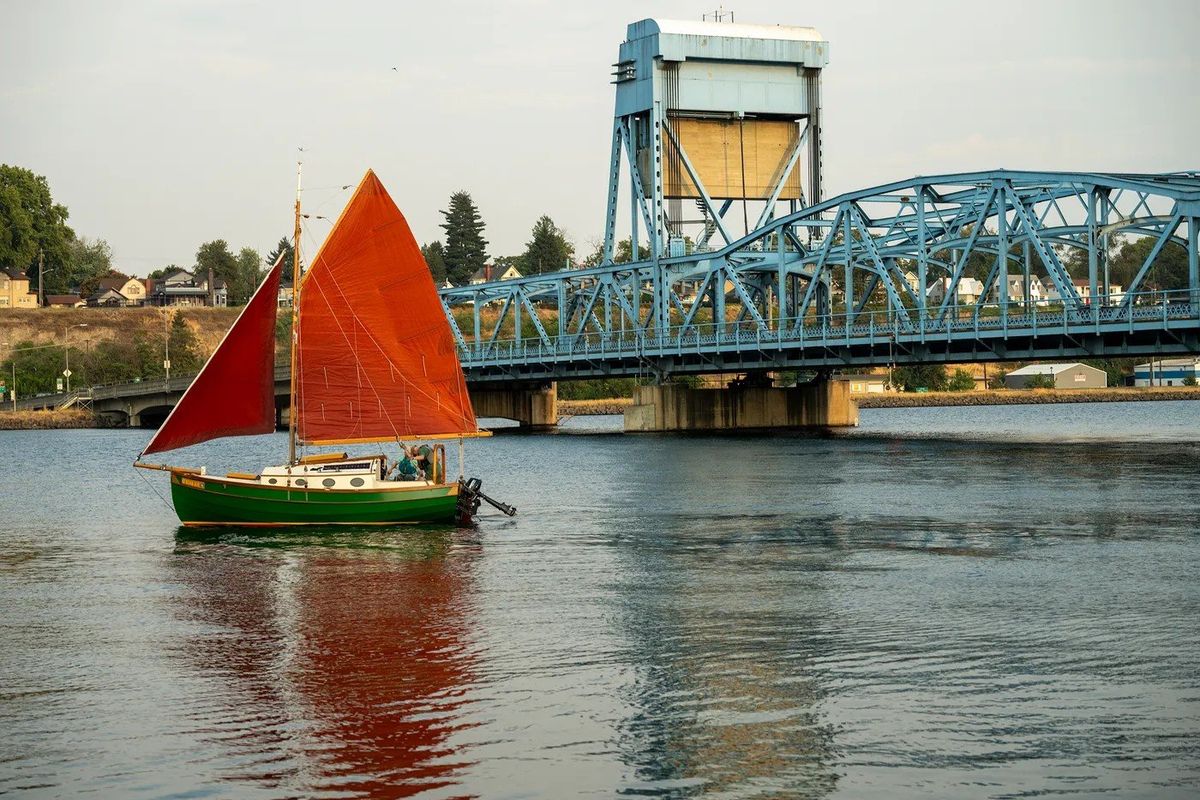
Keith Smith points into the wind while Mary Fauci pulls on a pair of ropes to raise the main sail – a gaff rig.
The Moscow couple who have been sailing since 2006 communicate the whole time.
“Let’s put a jib out, too,” says Keith. Mary pulls another rope to raise the smaller, triangular-shaped sail at the front of the boat.
The sails catch the wind and we are moving at 5.2 knots (roughly 6 miles per hour) across the confluence of the Snake and Clearwater rivers.
“That’s really fast, actually,” says Mary.
The boat, a 21-foot, 2,500-pound penguin named the Four Seas, has a top speed of about 6 knots. Even in a heavy wind, the boat they built in their shop can’t get on plane and instead must always push a wake in front of it, limiting its speed. That is typical of most sailboats.
The Moscow couple are active members of the Lewis-Clark Sailing Association and frequently sail on the lower Snake, a destination more known for its salmon and steelhead fishing and – farther upstream – for its jetboating and rafting, than it is for sailing.
They say it’s not an ideal destination but proximity has its charms.
“It’s close, which we like, but the winds are usually gusty and squirrely, and you know, you really can only sail either up or down the river usually,” Keith says. “Which means a lot of zigzagging back and forth, whereas, if we go to Coeur d’Alene Lake or the coast or something, we can sail a long way on one tack.”
The river is the home waters of the association that pulls members from the Lewiston-Clarkston Valley as well as Moscow and Pullman and is celebrating a pair of milestones. On Saturday and Sunday, the club hosted the Trib Cup. The event, sponsored by the Lewiston Tribune, started 50 years ago as a race but has evolved into a more casual, organized sailing outing that often involves a treasure hunt of sorts.
The club began about the same time, taking advantage of the arrival of slackwater with the completion of Lower Granite Dam, and will celebrate its birthday on Oct. 4.
Sailing 101
Most nonsailors assume wind propels boats simply by pushing directly against the sails. It’s more complicated than that, especially when sailing into the wind.
“Sails act like an airplane wing,” says Keith, explaining the basics of sailing.
He compares it to sticking your hand out the window of a moving car and tipping it only to have your arm rise.
“It’s not the wind on the bottom (pushing it up). It’s the wind on the top of your hand sucking up,” he says. “And so the sails do the same thing. It’s the low pressure behind the sail that’s actually pulling the boat. It’s not pushing.”
Mary says wind can push the boat when it’s moving downwind.
The boat’s center board, “basically an underwater wing,” keeps the boat from drifting sideways and allows it to move into the wind.
With the Four Seas approaching the north shore of the confluence, Mary and Keith perform a starboard tack. The result is the zigzag pattern Keith described earlier.
Later, they sail with the wind directly blowing into the side of the boat. Known as a beam reach, they say it’s the fastest and most comfortable maneuver for the Four Seas.
With instruction, sailing is reasonably easy to pick up.
“I think most people can make a boat go their first time sailing,” says Keith. “If you tell them when you’re pointing as close as you can into the wind, bring the boom over the corner of the transom. When you’re sailing straight down when let it all the way out. When you’re on a beam reach with the wind 90 degrees off your side, let your sail out halfway. And with those instructions, I think most people could make a boat go and then beyond that, it’s getting more efficient and reading the wind in the water.”
There is a whole language to learn. Tacking, gybing, heaving to, coming about and more.
“Tacking is when you’re going into the wind, and gybing is when you’re going away from the wind,” says Mary.
“The worst thing about sailing, I think what turns a lot of people off, is there’s so much language,” she says.
But without it, miscommunication would be rampant, she says.
The club doesn’t offer lessons but is keen on introducing people to sailing. It has monthly picnics during the sailing season – roughly April through September – and welcomes people interested in the sport to attend and hop on a boat for a taste. The picnics are typically held on the Saturday nearest the second Thursday of each month and announced on the Lewis-Clark Sailing Association Facebook page.
North Idaho College offers a sailing class. Mary and Keith took a series of classes to pick it up, followed by renting a boat and sailing around the San Juan Islands in the Puget Sound and longer trips serving as crew on a voyage from Mexico to Hawaii.
“It’s been great that we did that, because we both both learned all the same stuff, and the classes were so much fun,” says Keith.
The club also organizes cruises on other bodies of water like the big lakes in the Idaho Panhandle or the Puget Sound.
“When we go on these bigger cruises to the saltwater, some of the people who’ve never been before kind of get tucked under someone’s wing. We always make sure that they have the skills to succeed,” says Mary.
With the sun setting, they sail for the Greenbelt Ramp, maneuvering through a handful of salmon and steelhead anglers.