
Seattle’s Kate Powell focuses artistic lens on everyday life in D2 Gallery exhibit
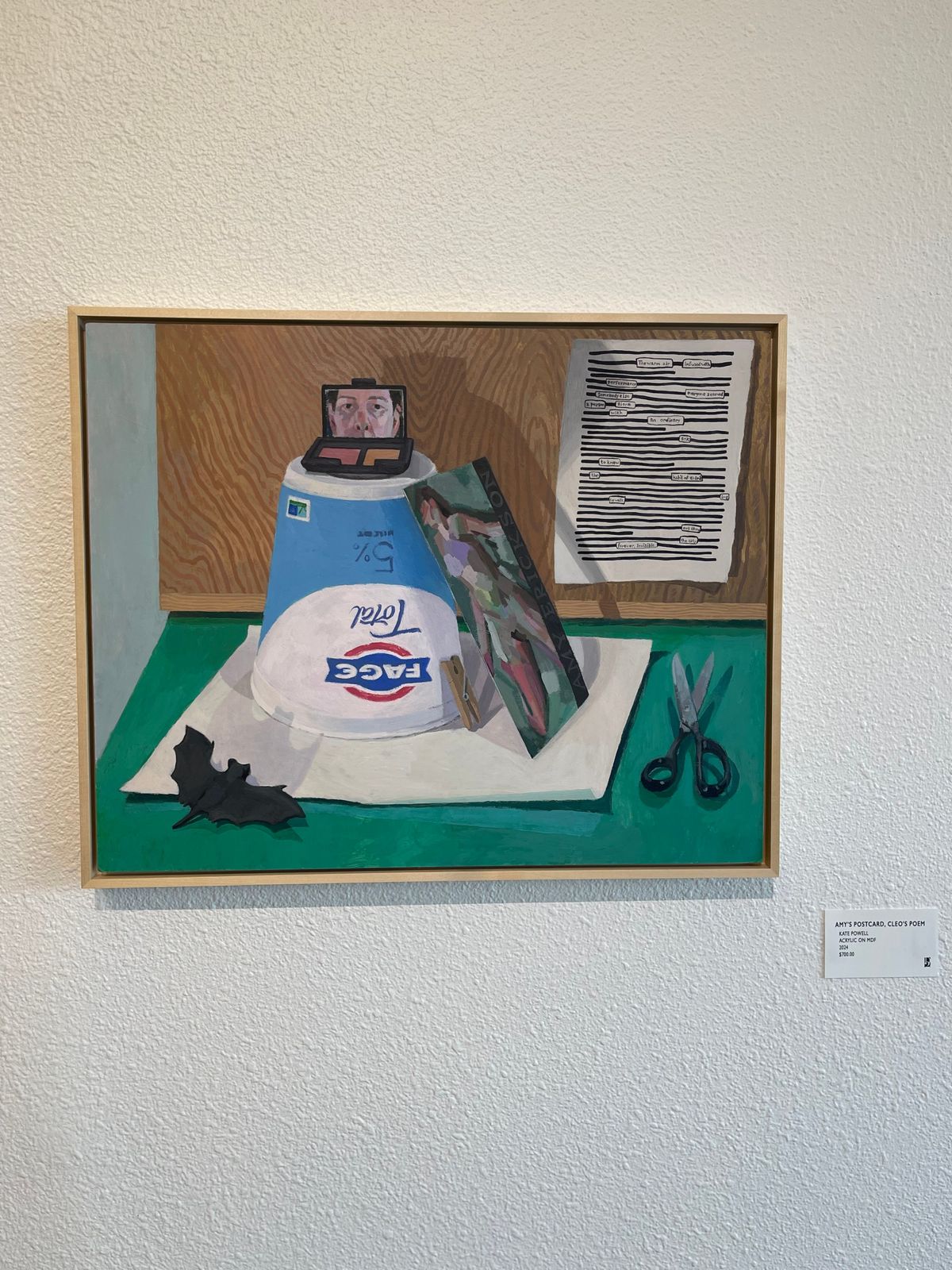
For Seattle-based artist Kate Powell, still life paintings don’t need to be confined to flower vases and fruit bowls – they can also include self portraits and pieces of trash found outside while walking the dog.
Powell’s unique approach to still life painting can be found in her first solo exhibit, “Material Girl,” which lines the walls of downtown Spokane’s D2 Gallery.
“Spatially, the one thing that all of these paintings have in common is (that) they’re representations of something that I was standing right in front of,” Powell said, referring to the 47 works that make up the exhibit. “So, when a person is standing in front of this, they’re standing where I stood to make it … I think the idea of them sort of substituting themselves for me is what excites me.”
D2 opened its doors this past May and has been highlighting local artists – Powell being their fourth – ever since. Powell’s predominantly acrylic exhibit began on Sept. 5 and will run through Sept. 27.
Originally from the Philadelphia area, Powell has been living in the Seattle area for roughly eight years. The work in “Material Girl,” however, encapsulates a four-year period during which Powell was living in Tacoma.
Despite her love of painting dating back to her high school years, Powell said the decision to become an artist didn’t happen right away.
“I was very fortunate to have, like, a real painter as my high school teacher – when I say real painter, like someone who was working as a professional artist and teaching,” said Powell. “I was exposed at an early age to the idea that you could be an artist when you grew up.”
Although creativity was encouraged throughout her childhood, Powell said her parents suggested career paths that provided steadier income while still allowing her to be creative, such as architecture.
“I started working in all of these arts-adjacent fields, where it was so close to having a creative career, but not quite,” Powell said. “At some point, I was just like, ‘If I’m not gonna make a living wage, I might as well make art.’ ”
Around the time she moved to Seattle, Powell said she wanted to start painting again. Initially, she painted on panels cut from cardboard and cereal boxes.
“I have little cookie tins full of my early efforts that are just like little coaster sizes, crappy, weird, plasticy-looking paintings,” Powell said. “It was a low-stakes way to start.”
In fall 2020, Powell decided she wanted to further her painting education and enrolled at the Gage Academy of Art – a nondegree-granting nonprofit art academy in Seattle. After completing her education at Gage, Powell continued to find her niche as well as strengthen her technical and art history skills at the Pennsylvania Academy of the Fine Arts, where she received an MFA in their low-residency program in 2024.
During her time at Gage, Powell was practicing painting from direct observation using live models as well as her own reflection as inspiration.
“I got this feeling that I really wanted to make still lifes,” Powell said. “And, this is without intending any offense to people that do make this kind of still life, but I didn’t want to make, like, the vase of flowers and bowl of oranges.”
And, just as Powell had hoped, “Material Girl” features zero flowers and orange bowls. For example, “Amy’s Postcard, Cleo’s Poem,” one of many still life pieces in the exhibit that also features a self-portrait, depicts a portion of Powell’s face reflected in a small compact makeup mirror stacked on top of an upside-down yogurt container. Also featured in the bottom-left corner of the painting is a small toy bat, a pair of black scissors and, as referenced in the title, a postcard and blackout poem.
“It’s almost like there’s more of a gradient than a binary between those two genres,” Powell said, referring to self portraits and still lifes. “If anything can be an object, then you can sort of get away with having your cake and eating it, too.”
Powell’s ability to mesh these distinct styles together was one of the aspects that stood out to local artist and D2 Gallery curator and co-owner, Michael Dinning.
“I immediately felt this connection between the two,” Dinning said. “She’s taken them and she’s built them into her own thing, and she’s put herself into still lifes – which, normally, artists do not fit themselves into a still life at all … and with her sketchbooks, it’s almost like the exhibit is an exhibit of Kate’s brain as much as it is the actual art on the walls.”
These sketchbooks, which are also on display for viewers to look through, showcase Powell’s ideas for paintings, sketches and other notes.
“I don’t think I could have made the paintings without the sketchbooks,” she said.
Some of the self-portraits featured in the exhibit are more obvious than “Amy’s Postcard, Cleo’s Poem.” Four smaller paintings hung in a cluster, titled “Teal Self Portrait,” “Baby Doll Self Portrait,” “Bare Legs Self Portrait” and “Broken Mirror Self Portrait” make the viewer feel as if they are the mirror, watching Powell paint herself.
Other paintings in the exhibit don’t contain any self-portraits at all, such as “Anonymous Objects A” and “Anonymous Objects B.” Both paintings are hung together, as they depict the same things – one is just on a much smaller scale.
“I liked that I didn’t know what they were,” Powell said, referring to the various objects in the paintings. “(And) the idea of it being a mystery to both me and the viewer, so it’s not like I’m keeping a secret. We’re both wondering.”
Powell’s use of objects often excluded in still life works particularly stood out to D2’s director and co-owner, Stephanie Dinning.
“I love that Kate gathers inspiration on ordinary items that you come across everyday,” she said. “I was drawn to her more whimsical and playful pieces. They bring a smile to my face and evoke a sense of how everyday objects live on, and touch our lives in various ways for different people.”
Like all forms of art, Powell said she acknowledges that the meaning found within a work can vary greatly depending on the person viewing it. However, she said she hopes those who do see her work walk away feeling inspired to create something themselves, and potentially bring a stronger level of attention and curiosity to the everyday objects they encounter that don’t always receive attention.
“Whether that thing is their own reflection in the mirror, or the pile of stuff that they were supposed to take out of their car three weeks ago,” she said. “That would make me feel so great if someone told me that they went home and saw the crap on their kitchen table with new eyes.”