
Trump targets domestic terrorists — but only mentions the ‘radical left’
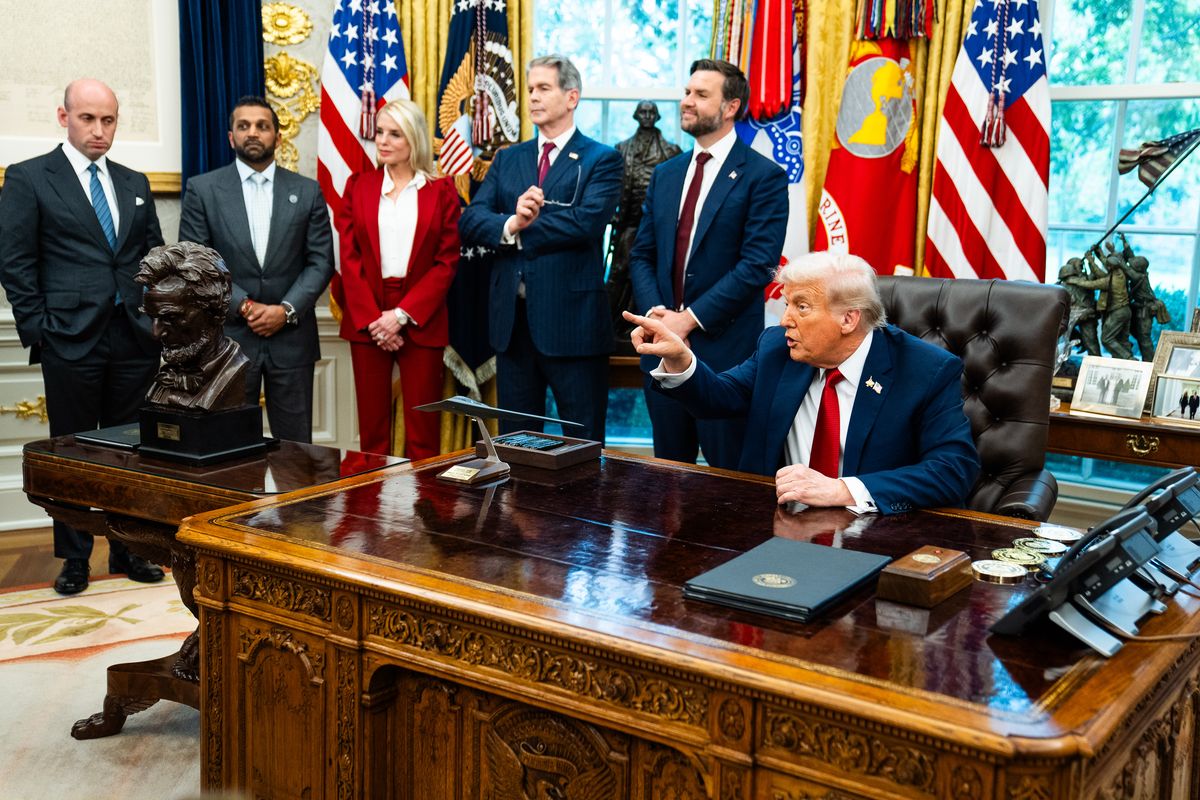
President Donald Trump publicly suggested Thursday that two prominent, wealthy donors to liberal causes should be investigated for possibly funding domestic terrorism, escalating his efforts to use the power of the presidency to punish people and institutions that have challenged him.
Trump made the comments while surrounded by law enforcement leaders in the Oval Office who had gathered to watch him sign a sweeping memorandum directing four Cabinet leaders to attack a problem for which he has repeatedly blamed the left.
“I hear names of some pretty rich people that are radical left people,” Trump said, specifically naming George Soros and Reid Hoffman, neither of whom responded to questions about the comments.
“They’re bad, and we’re going to find out if they are funding these things,” he added. “You’re going to have some problems because they’re agitators, and they’re anarchists.”
Trump’s statements and directive Thursday built on the administration’s accelerating focus on domestic terrorism - albeit only from the left - in a dramatic shift from the early days of his second term. White House officials previously presented their counterterrorism strategy in public as an effort to thwart international actors. But since the fatal shooting of conservative commentator Charlie Kirk on a college campus this month, the administration’s focus has shifted to homegrown political violence.
Trump has blamed far-left groups for Kirk’s death and pledged to go after them, although no evidence has emerged to link the man charged with killing him to any organized group. On Monday, he signed an executive order designating “antifa,” a decentralized, leftist ideology adhered to by various individuals and groups, as a “domestic terrorist organization,” though the U.S. has no legal mechanism for such a designation.
He described the memorandum Thursday as an expansion of efforts to investigate and dismantle groups that support domestic political violence. He and top administration officials alleged a sinister conspiracy of wealthy elites is funding a vast network of domestic terrorists wreaking havoc across the country.
“These are not lone, isolated events. This is part of an organized campaign of radical left terrorism. It is structured, it is sophisticated, it is well funded, it is well planned,” Deputy Chief of Staff Stephen Miller said.
Soros’s Open Society Foundations, a philanthropic organization founded in 1979 that has long supported liberal causes, has been a favored target of Trump officials. The group in a statement Thursday said it condemns and does not fund terrorism. A spokeswoman called the administration’s “accusations … politically motivated attacks on civil society, meant to silence speech the administration disagrees with and undermine the First Amendment right to free speech.”
The biggest terrorist threat to Americans in recent decades has come from far-right extremists, particularly white supremacists and anti-government extremists, said Michael Jensen, research director at the Study of Terrorism and Responses to Terrorism consortium at the University of Maryland.
“And really, it’s not close. It’s something like 5-to-1 in terms of the number of attacks and deaths that can be attributed to far-right actors as opposed to far-left actors,” Jensen said.
White House spokeswoman Abigail Jackson dismissed studies that showed that most political violence was perpetrated by right-wing actors. “Any ‘experts’ attempting to downplay left-wing political violence or point the finger at Republicans following the slew of left-wing violent attacks are not experts at all, they’re simply partisan actors ignoring reality,” Jackson told The Washington Post.
Political violence has spiked across the ideological spectrum since Trump’s term began, including on the left, Jensen said. There were nearly twice as many terrorist attacks in the first six months of 2025 than during the same stretch last year. While the Trump administration has maintained a sustained public focus on Kirk, Democrats have also suffered violence in that time, including against Melissa Hortman, a Minnesota state lawmaker who was gunned down in her house and Pennsylvania Gov. Josh Shapiro, whose home was firebombed with his family inside.
A rising number of extremists aren’t easily placed in traditional ideological categories as attackers are increasingly inspired by what authorities are calling “a salad bar” of ideologies, Jensen said. Attackers are picking and choosing from a hodgepodge, including tenets on the left and right, to create a personalized, sometimes contradictory doctrine, he said.
Last month’s deadly shooting at a Catholic school in Minneapolis is a case in point. On Aug. 31, a 23-year-old killed two students and injured 17 others at the school after posting a mishmash of memes, gaming references, political statements and odes to previous mass shooters. Four days after the shooting, the White House’s top counterterrorism official, Sebastian Gorka, called for better ways to identify potential mass shooters and get them help before they resort to violence.
“The early warning signals must be addressed if children’s lives are to be saved,” Gorka, who did not return an interview request, said in a CNN interview.
A month earlier, the Trump administration had cut a $700,000 grant to the Minnesota Department of Public Safety designed to do just that. In an Aug. 8 letter to Homeland Security Sec. Kristi L. Noem, Minnesota’s six Democratic House members and two U.S. senators condemned the cut, saying it left “our constituents and communities more vulnerable to violent attacks.”
Nixing the Minnesota grant was part of Homeland Security’s elimination of a broader grant program aimed at preventing terrorism and targeted violence like mass shootings. The Trump administration has also hollowed out the office in charge of awarding those grants, winnowing the Center for Prevention Programs and Partnerships’s staff from about 80 employees and contractors to fewer than 10 in the opening months of Trump’s term, said Bill Braniff, the center’s former executive director.
Braniff resigned in March when the staff cuts began, saying he was no longer able to effectively carry out the mission of preventing terrorism and other acts of targeted violence. Administration officials replaced him with a 22-year-old with no apparent counterterrorism experience who had graduated from college less than a year before.
Eliminating the grant program and gutting the center is “going to manifest itself in more terrorism, hate crimes and school shootings,” Braniff, now the executive director of the Polarization and Extremism Research and Innovation Lab at American University, said in an interview.
Since Kirk’s death, Trump has downplayed the threat of far-right terrorism, suggesting conservatives get radicalized by legitimate frustrations over lawlessness and immigration. When asked in a Sept. 12 interview on “Fox & Friends” about lowering the temperature and his plans to unite the country’s growing rifts, the president said he saw no need to do so.
“I couldn’t care less,” Trump said.
After Kirk’s death, the Justice Department removed a research paper reaffirming experts’ long-held conclusion that right-wing extremists have been responsible for the vast majority of domestic terrorist attacks in recent years. Researchers funded through DOJ’s National Institute of Justice determined that far-right extremists committed more than five times the number of deadly attacks from far-left extremists and radical Islamic extremists combined over the past three decades. The paper was available on DOJ’s website as recently as Sept. 11, the day after Kirk was killed but not since Sept. 12, according to archived versions preserved by the Internet Archive.
The Justice Department declined to say why the paper was no longer available.