
With Comey prosecution, Trump fulfills promise of revenge
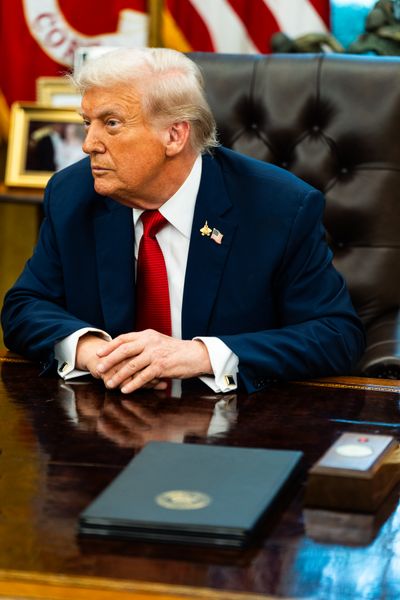

On the campaign trail, Donald Trump equivocated when the television host “Dr. Phil” McGraw asked him to swear off retribution against his political foes.
“Sometimes revenge can be justified, Phil,” Trump said. “I have to be honest.”
On Thursday night and Friday morning, Trump celebrated one of the most brazen examples of payback since his return to the White House. Soon after a federal grand jury in Virginia indicted former FBI director James B. Comey, the president declared “JUSTICE IN AMERICA!” in a social media post, following up Friday with a post calling Comey a “destroyer of lives” and “A DIRTY COP.”
Trump’s predecessors sought to distance themselves from the Justice Department’s prosecutorial decisions, declining to weigh in on pending cases, especially those that touched on politics, in deference to the agency’s tradition of independence. The fire wall, however imperfect, was established to preserve the democratic ideal of a country where justice is impartial and no one is above the law. Trump, in contrast, openly intervened in the Comey case, pushing out a prosecutor who declined to bring charges, replacing him with an ally and publicly demanding that Attorney General Pam Bondi take action.
Eight months into his second term, Trump has fulfilled his pledge to make retaliation a central feature of his presidency. He has revoked security clearances and Secret Service protection for people he does not like. He has issued executive orders punishing law firms he disfavored. His administration has fired attorneys who worked on cases against Trump and his supporters, while the president set those supporters free with pardons.
Trump’s eagerness to use the power of government to silence critics, punish opponents and reward loyalists is unparalleled since the Watergate scandal toppled the presidency of Richard M. Nixon in 1974. In the following decades, politicians, top officials and rank-and-file lawyers adopted norms intended to insulate the Justice Department from the White House. Trump and his allies chipped away at those norms during his first term and have obliterated them in the second.
“Richard Nixon understood as a lawyer – a good lawyer, actually – that he had to at least make justice look blind when he schemed against his enemies,” said Timothy Naftali, a Columbia University historian and former director of Nixon’s presidential library.
“President Trump makes no such pretense. He believes that justice is never blind, justice hasn’t been blind, and therefore that he’s in power, he’s going to use justice against his enemies the way he alleges his adversaries use it against him.”
To Trump and his allies, the actions are justified comeuppance for a group of deep-staters and politically motivated insiders who he claimed used their power to investigate, impeach and prosecute him and his supporters during and after his first term.
“It’s not a list, but I think there will be others,” Trump told reporters as he was leaving the White House on Friday.
“It’s about justice, really. Not revenge,” he added.
Trump did not hide his desire to indict Comey, who launched the investigation into Russian interference in the 2016 election. This month, the president forced out the U.S. attorney in the Eastern District of Virginia after he declined to prosecute Comey and replaced him with a White House aide with no prosecutorial experience. On Thursday, prosecutors followed his demands and put the case before a grand jury, which indicted Comey with making a false statement and obstructing Congress.
Trump’s administration could do the same soon to two other adversaries, New York Attorney General Letitia James (D), who won a civil fraud judgment against Trump last year, and Sen. Adam Schiff , D-Calif., who led the first impeachment trial against Trump. The Justice Department is investigating Schiff and James over allegations they engaged in mortgage fraud. Comey, James and Schiff have denied wrongdoing.
“Other prosecutors will feel even more pressure now to bring charges against whomever displeases the president,” said Brendan Nyhan, a professor of government at Dartmouth College. “And you don’t want to live in a country where displeasing the president can put you in jail.”
Comey will face hardships even if he ultimately beats the charges because he will have to hire lawyers and bear the stress of knowing he could go to prison if convicted, Nyhan said.
“The charges against Comey will intimidate and silence many more people than just him,” he said.
Bondi, at the same time, is reshaping the Justice Department by firing or assigning attorneys to new jobs. Some have quit, retired or taken buyout offers and left an agency they no longer recognize. They have been replaced by lawyers who are not steeped in an institutional culture that prides independence above loyalty to the president.
“He’s firing the career prosecutors who still believe in the norms and bringing in people who have zip experience,” said Kim Lane Scheppele, a Princeton University professor of sociology and international affairs. “The way you get rid of the culture is you get rid of people.”
Trump has repeatedly belittled that culture, accusing Democrats of weaponizing the justice system as he promised revenge. “I am your retribution,” he said in March 2023 at the Conservative Political Action Conference.
At times, he downplayed the extent of his plans, saying his success would be a form of getting back at his adversaries. He accused Democrats of coming after him and, in campaign rallies in the final weeks of his presidential campaign, frequently accused Vice President Kamala Harris of “running a campaign of hate, anger and retribution.”
But Trump never lost sight of Comey, depicting him as a liar and a criminal.