
Then and Now: Freedom Train
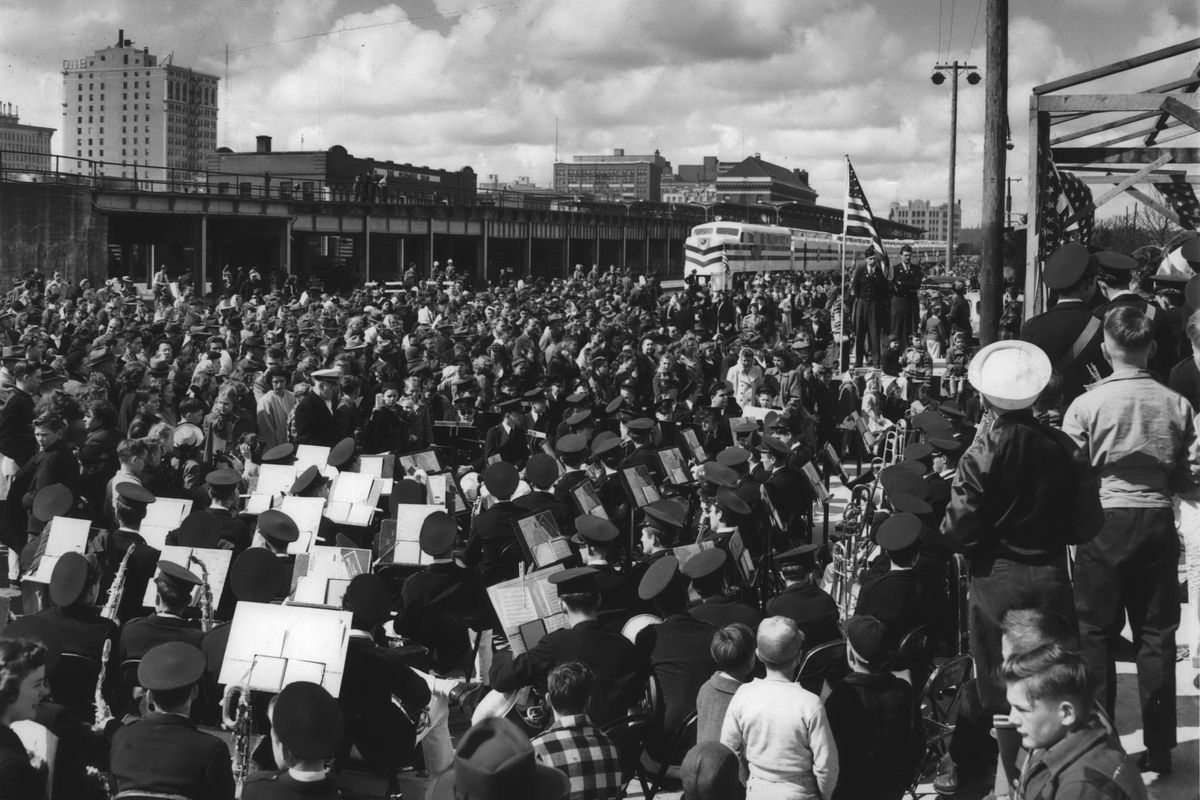
Caught between the victory of World War II and the specter of communism darkening the horizon, a group of people from advertising and business proposed a rolling exhibit about American history called the Freedom Train, calling it “a campaign to sell America to Americans.”
The traveling museum visited hundreds of cities and towns in all 48 states, starting in Philadelphia in September 1947, until it closed in January 1949.
The popular attraction drew crowds in every town, where they sold patriotic books and souvenirs. Irving Berlin’s theme song, “The Freedom Train,” was recorded by Bing Crosby and the Andrews Sisters.
The seven-car train had secure glass cases for the copies of the United States Constitution and the Declaration of Independence. The Magna Carta, a letter from Christopher Columbus, the Emancipation Proclamation and many other items were on display.
The train’s tour of southern states was followed by controversy as some cities segregated the waiting crowds by race. Visits were canceled in some cities because of racial tension.
Each scheduled city raised funds to defray costs, including approximately $8,000 from Spokane. In area schools, kids learned about the artifacts on the train. Security during each stop was provided by U.S. Marines in dress blue uniforms.
The red, white and blue engine and train cars pulled into Spokane on April 13, 1948. Spokane’s schools were closed so every child could visit the train, which parked along the south bank of the Spokane River next to the Great Northern Railway freight warehouse. Thousands began lining up as early as 4 a.m. for when doors opened at 10 a.m. A dozen brass bands from area high schools, civic clubs and veterans organizations played continuously throughout the day.
More than 10,000 people toured the train that day in Spokane before it headed to Coeur d’Alene the next day.
The Spokesman-Review story declared, “It was a cross-section of America rededicating itself. And if people arrived merely in a curious mood, they departed in a reverent one.”
In 1975 and 1976, the idea was revived and called the American Freedom Train, which toured to promote the coming bicentennial. Martin Luther King’s pulpit, Jesse Owens’ Olympic medals and Hank Aaron’s bat were among the 500 exhibit items. It stopped Oct. 26-29, 1975, in Spokane.