
‘OUR CITY, OUR RACE’: Bloomsday officials remove billboard after complaints of exclusion
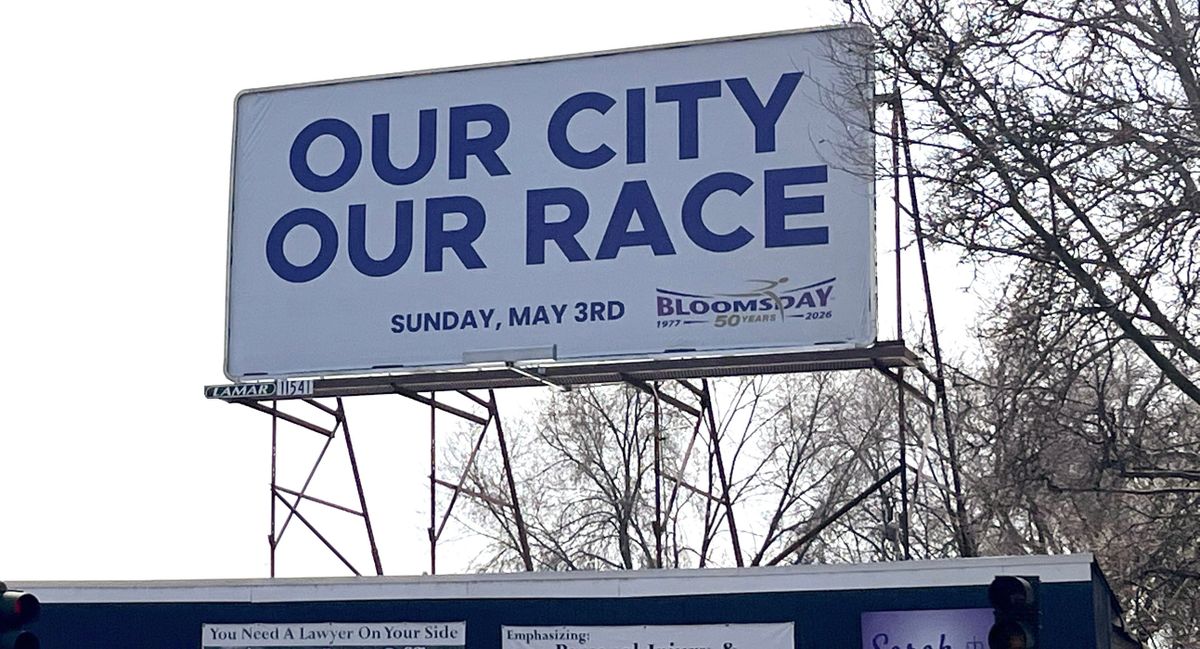
Bloomsday officials removed a billboard advertising the run that contained an unintentional double entendre associated with the word “race.”
“OUR CITY, OUR RACE” read the billboard, located at the intersection of Broadway Avenue and Ash Street in large purple block text against a plain white background. Underneath the text in a much smaller font is the Bloomsday logo and date of the race. Commuters driving south on Ash street could see the sign over the weekend, and some took to social media to share their shock, saying the sign was “tone deaf” and had racially exclusive undertones.
“I thought white supremacy was rearing its ugly head,” one Reddit user wrote.
“Oh c’mon. Ya’ll are stretching,” another wrote.
The sign was still up Monday morning, but by noon had been replaced with an advertisement for the Disabled American Veteran’s charity.
Lilac Bloomsday Association spokesperson Bethany Lueck wrote in a statement that the group opted to remove the ad after hearing feedback from the community. A new design is in the works, Lueck said, and will be installed as soon as the vinyl is available.
“We recognize that language can be interpreted in different ways. With that in mind, we’ve decided to update the billboard as the celebration of the 50th Running of Bloomsday campaign continues,” Lueck wrote.
The billboard located at Ash and Broadway gets over 40,000 impressions each week, according to Lamar, the company that owns the billboard and sells it as advertising space. It’s the only one with this particular phrasing, Lueck said. Banners on downtown lightposts, billboards with other phrases and signs in the ground have begun popping up as the 50th iteration of Spokane’s iconic 12-kilometer footrace prepares to hit Spokane streets in a month.
“The message was intended to reflect the community spirit of Bloomsday,” Lueck wrote. “For 50 years, Bloomsday has brought people together to take part in a shared, positive experience.”
Bloomsday draws athletes from around the globe; the two top finishers last year were from Kenya, among hundreds of international competitors.
While intended only to celebrate the tradition, there’s also the potential effect of a statement when perceived as racially charged to consider, wrote Lisa Gardner, president of the Spokane chapter of the NAACP.
“In my view, this is about intent versus impact. The message behind the ‘Our City, Our Race’ billboard and the way the word ‘race’ landed felt exclusionary. Intent doesn’t outweigh impact, and in a growing, diverse community, words matter,” Gardner wrote. “I appreciate the Bloomsday organizers for their quick response in removing the sign and listening to community concerns. However, this situation also shows how important it is to communicate in a timely, transparent manner with those affected to maintain trust and reputation.”
Gardner said she hadn’t seen the sign personally but heard about it online.
“I was born and raised in Spokane, and I know that the Bloomsday race is a valued tradition that has brought this city together for decades,” she wrote.
Jennyfer Mesa, former executive director of advocacy group Latinos en Spokane, posted to Facebook that the wording seemed to have an intentional double meaning.
“Just imagine there’s an entire committee, graphics design team, communication, board, and nobody saw a problem with this. They didn’t feel or see how in this political time or history of excluding Black, Native, Brown and Asian people in Spokane, this would be perceived as racist,” Mesa wrote. “In Spokane, subtle racism and playing dumb, excusing ignorance is how racism and exclusion of people is upheld by an entire community.”
Luc Jasmin III, owner of Parkview Learning Center and a community organizer, offered his kudos to Bloomsday for “true leadership” in removing the ad after hearing complaints.
“When concerns were raised, they listened, acknowledged the issue, and moved quickly to a solution,” he wrote on Facebook. “That kind of responsiveness shows genuine care for our community. As a person of color, it matters to see an institution engage this way.”