
Margaret Albaugh uses photos and prose to detail her life as daughter of Chinese immigrants and her own journey as a mother
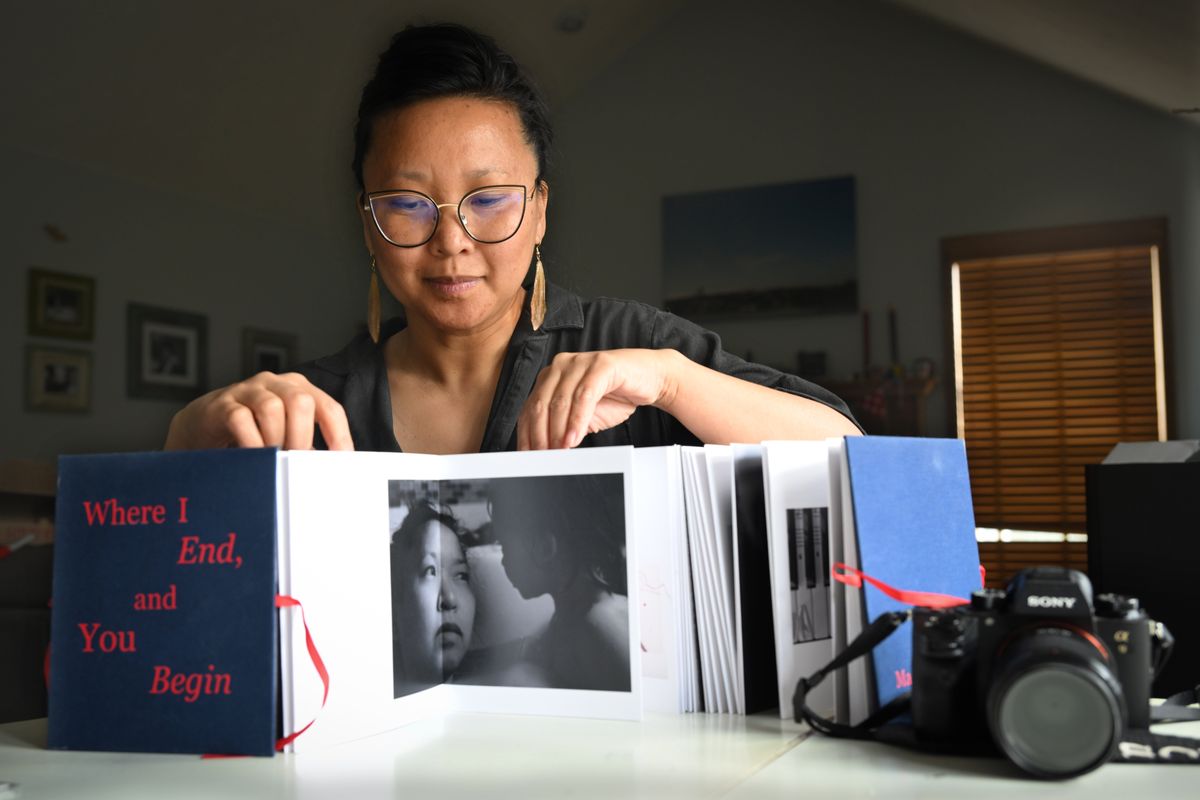
For Chinese American visual artist and photographer Margaret Albaugh, a photo is a concrete way of capturing an experience.
“It’s a memory you can hold on to,” she said.
In her book, “Where I End and You Begin” (Benschop Books, 2025), Albaugh uses photos, prose and poetry to examine the generational harms she experienced as a daughter and now manages as a parent.
Published as a handmade accordion book, it features images on one side and text on the other. On Tuesday, she’ll share her story at Liberty Park Library.
“It’s about my experience in motherhood,” she explained. “I struggled a lot with my girls when they were younger. I thought they hated each other.”
Born to immigrant parents who worked constantly, she said she was an angry kid herself.
“As a child of immigrants, the only acceptable emotion is anger,” Albaugh said. “I felt like I passed that down to them.”
Eight years ago, she started taking pictures – not just of her two daughters, but of objects and moments that illustrate her motherhood journey.
“I started seeing things in the photos that I wanted to explore.”
The conflict resulting from the way she was parented and how she parents her children versus the way she feels like she should parent informs much of her story.
One night, she handed me red thread and taught me to sew words into my arms. Before I could unravel them, I birthed daughters in the morning with needles on their tongues.
In an early photo, she was looking at her daughters’ feet from beneath a trampoline. Where some viewers might see innocence and whimsy, she saw a sense of one daughter’s dominance over the other.
Another image shows her daughter’s frustration with learning the violin. After a painstaking practice session, she smashed the bow. To Albaugh, the photo echoes with the impotent rage she felt as a child.
As she reached the halfway point with her images, a friend who owned a gallery in San Diego wanted to show them.
When she saw her work in the gallery, she knew there was more to her story.
“’Where I Leave and You Begin’ was up, but I knew it wasn’t done,” Albaugh said. “I wanted to explore generational harm from my mother and grandmother, but I didn’t want to villainize them.”
What was missing was her mother’s story, but gathering those pieces proved challenging.
Technology came to the rescue. Albaugh engaged her mother through Storyworth. It’s an online resource that sends a year’s worth of email prompts, encouraging mothers to share their memories.
The distance allowed her mother to share more than she ordinarily would have, and it gave Albaugh space to process.
Her mother was nicknamed “Earthquake.”
They named her earthquake because she snapped the earth and crumbled the ground.
“I felt like my mom was a problem solver who had a lot of problems to solve – especially as an immigrant,” Albaugh said. “It allowed me to process my triggers.”
For example, one compelling photo shows a shattered salt shaker.
“My daughter said the food was gross and didn’t want to eat.”
Albaugh responded by smashing the salt shaker, her rage triggered by memories of being raised by women who’d suffered food deprivation.
“My grandmother was a refugee of the Japanese invasion of China and was forced to flee China to Taiwan,” Albaugh said. “My mom grew up poor with food scarcity.”
Another photo reveals the soft, round belly of her 4-year-old daughter, who asked if she was fat.
“Why are we still trapped by this?” Albaugh asked. “My mom is in her 70s – still on a diet or worried about losing weight.”
Along with the bitter came the sweet.
“My mom used to rub my back as I fell asleep – it felt like a lullaby.”
Now, Albaugh does the same for one of her daughters.
“In the process of healing, I could see what was just human.”
As she recognized generational patterns, a realization dawned.
“Maybe a lot of them aren’t me,” she said of her daughters. “Maybe I’m missing something that’s actually beautiful.”
She began to see grace mixed with the rage.
“I saw magical moments – tender moments – playing in puddles, exploring the outdoors,” Albaugh said. “I saw beyond the anger.”
Her daughters are now 11 and 13, and through parenting them, Albaugh continues to learn. She said there’s still much to discover about her mother’s and her grandmother’s lives.
“It’s a lifelong journey to discover where I end and you begin.”
Contact Cindy Hval at dchval@juno.com.