
Bathroom mention in Jess Walter’s book, ‘So Far Gone,’ inspires fundraiser for West Central Abbey renovations
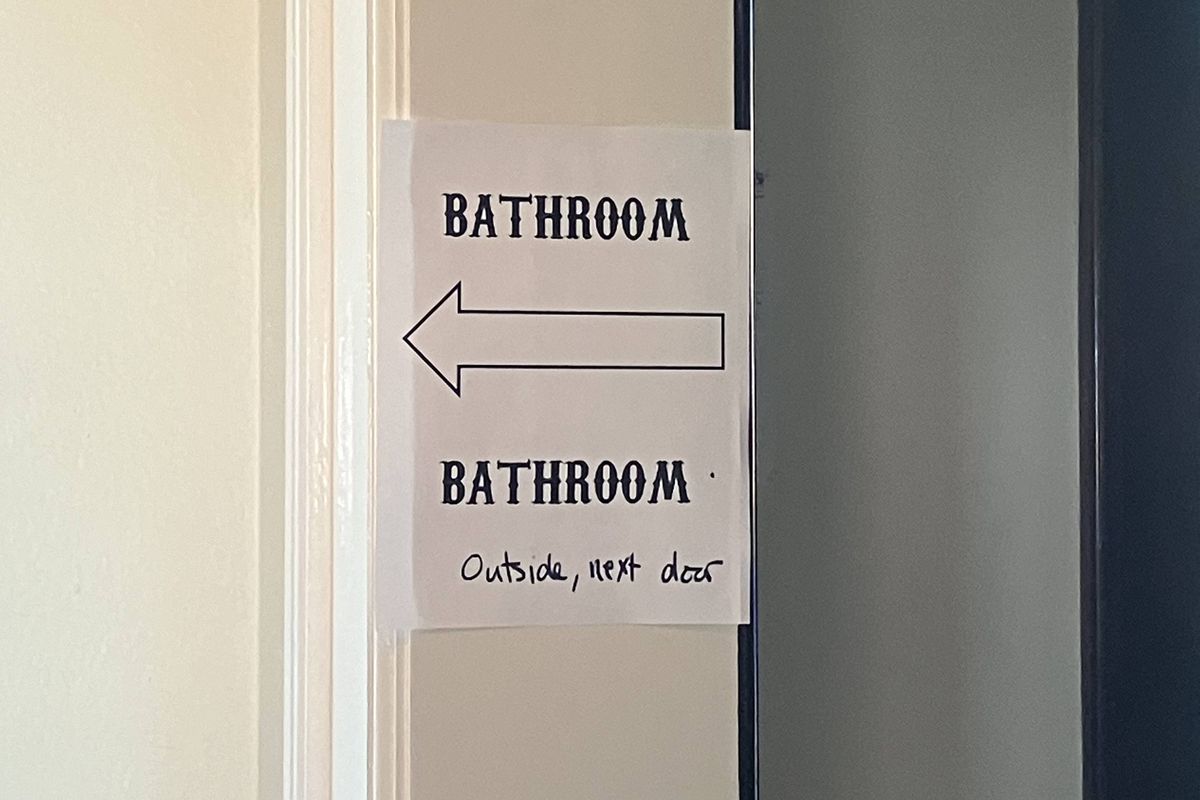
In his latest novel, “So Far Gone,” Jess Walter describes a scene where Rhys – an isolated ex-journalist who’s been estranged from his family for years – is taking his grandson Asher to a chess club because his daughter is missing.
“There were only four cars in the gravel parking lot, a few more on the street,” Walter wrote. “Rhys parked and turned back to consider his grandson. ‘You ready to go get ’em, Kasparov?’
“Asher looked up from his notebook, suddenly seeming panicked. ‘I have to pee.’
“ ‘I’m sure there’s a bathroom in there.’ ”
Walter described the building as “an old abbey in West Central Spokane.”
Katy Shedlock, vicar at West Central Abbey, was pretty sure Walter was talking about her church. The only problem? The chapel doesn’t have a bathroom, one of the items on a list of necessary renovations West Central Abbey was fundraising to fix. Shedlock contacted Walter.
“I joked that it’s easier to help raise money to put a bathroom in than to make a change in my novel,” Walter said.
On Friday, Walter and writers Thom Caraway and Leyna Krow will read at West Central Abbey to fundraise for the church. On Jan. 31, Auntie’s Bookstore celebrated Krow taking home the Pacific Northwest Book Award for her short story collection, “Sinkhole, and Other Inexplicable Voids.”
The building, located at 1832 W. Dean Ave., started as Holy Trinity Episcopal Church, built in 1895; the congregation added the parish hall in 1904, said Shedlock. There’s also a house across the street for the priest to reside in. In 2013, the congregation disbanded, and the larger diocese held the property in trust, assuming control.
“I’m really grateful that at that time, people said, ‘You know what, even if there’s no worshiping community here, we still want to serve the West Central neighborhood,’ ” said Shedlock, also a writer and editor. “And so people from other churches came together. They started doing things like the Wednesday night meal that we still continue to this day. There’s a history of using the house as kind of like a drop-in day shelter, a place where people can do laundry, check email, that kind of thing.”
In 2017, Shedlock said that Bishop Gretchen Rehberg wanted the space to have a worshipping community again, leading to the present congregation at West Central Abbey, Shedlock said. A weekly Sunday service began during Advent 2018.
Recently, the congregation received a letter from their insurance company with a laundry list of repairs: the siding needs to be replaced with new cedar shingles, window trim needs replacing and repainting, cracked concrete steps must be fixed and their big wooden front door needs repainting.
“We have insurance through our denomination, so they really try to work with churches and make sure (being dropped from insurance) doesn’t happen,” Shedlock said. “We’ve been given an extension from them, as long as we’re making progress on this project, which is really great of them.”
The church received a $50,000 matching grant from the National Fund for Sacred Places, based out of Philadelphia.
“They help active and living congregations preserve their historic buildings,” Shedlock said. “They look for a really interesting combination. They look for congregations that have a really cool historic building, but they’re not just interested in preserving museum pieces, right? They also want to help congregations that are really actively serving their neighborhood and are part of their community.”
The renovations will cost $343,0000. West Central Abbey needs to raise in excess of the matching $50,000 grant to receive it, and they’ve raised about $45,000 so far, and are hoping to close that gap with this event, Shedlock said.
In addition to the readings, the authors will have a Q&A period. The theme of the evening is a reflection on the places that shape our creative culture. All of the writers have a deep connection to the West Central community.
“One of my three manuscripts takes place entirely in West Central, having lived there for so long, kind of in some of my more creative periods,” said Caraway, author of “What the Sky Lacks.” “I think you know, in a way, West Central, the neighborhood itself, the tensions, the conflicts, the juxtapositions that West Central embodies, kind of are at the heart of my creative imagination.”
Krow and Walter also describe the neighborhood as being important to their creative processes.
“There are a lot of people who live in the neighborhood, writers, visual artists, and so it kind of has this feeling of like, ‘Oh, they’re just a lot of people here who are making art,’ ” Krow said, also referencing organizations in the community that support the arts, such as Spark Central, West Central Abbey, West Central Community Center, and others. “… we just have, like, a low key arty vibe here, and it just becomes self-perpetuating.”
Krow, Caraway and Walter referenced the economic diversity of the area as something that sets West Central apart.
“I jokingly wrote in ‘We Live in Water’ that no matter where you live in Spokane, you’re never more than four blocks from a bad neighborhood, and that I love that fact,” Walter said. “It means we can afford to live, that people can afford to live next to one another, and what we think of as a bad neighborhood is actually a place where a teacher might be able to afford a house or a police officer. And that’s more rare in America than you can ever think.”
Shedlock talked about the importance of spaces like West Central Abbey to the larger community.
“I think churches are a hedge against gentrification,” Shedlock said. “Churches have various degrees of how open they are to people beyond their own congregations, but I think at least in principle, most churches would say, ‘We’re for everybody.’ I think we work really, really hard to make that be true and real for people who don’t have anything to do with our religious services.
“I think projects like this that keep the historic character of a neighborhood like West Central, and keep gathering spaces that are beautiful and meaningful available to people, are just really important.”