
4 new graphic novels to get you through the winter doldrums
The season’s latest comics include a collection of new short stories by Joe Ollmann, a bizarre story of Paris overrun by monsters and a sedate reflection on restaurant life.
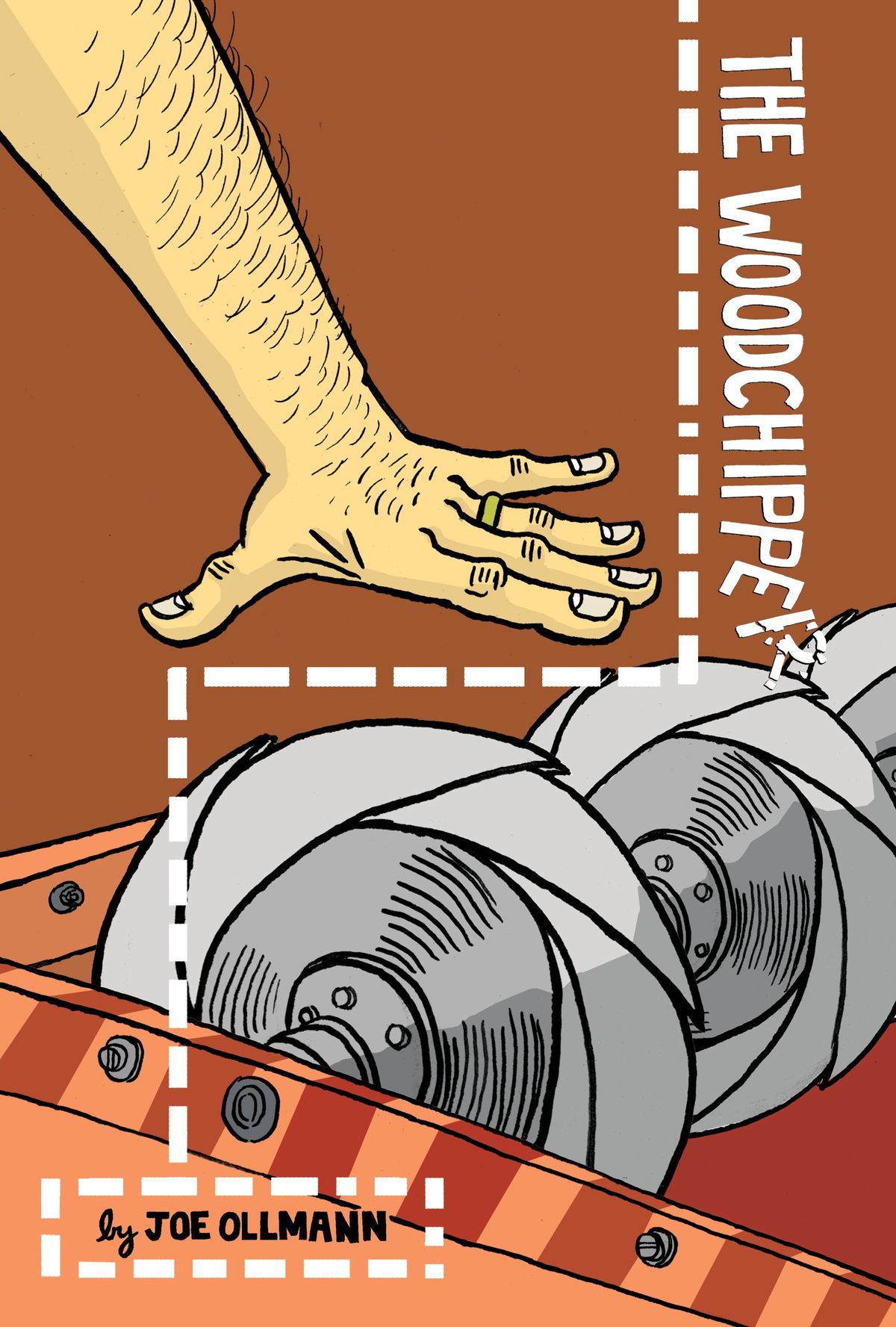
‘The Woodchipper’ by Joe Ollmann
In the title story of Canadian cartoonist Joe Ollmann’s collection of short graphic fiction, a man witnesses a near catastrophe at work. In the weeks and months that follow, he collapses into depression, rage and addiction, making sawdust from the solid struts of his life. In the end, he claws his way back to something like normalcy, recovering, as he puts it, “from nothing happening.”
All of the stories in this quietly moving book are similarly attentive to the tension between inner worlds and outer realities, a binary that Ollmann renders throughout as metaphor and literal fact: “Nestled All Snug” finds a woman trapped over Christmas in the bathroom of the bookstore where she works after her boyfriend has departed to spend the holiday without her. She spends the time reflecting on the ongoing collapse of her relationship while making increasingly futile attempts to break out of the room that is, perhaps, a representation of the prison she’s built for herself. And in “Meat,” the longest of the five stories, a slaughterhouse security guard stumbles into a friendship with one of the radical vegan activists who protests outside of her facility’s gates. In each of these fictions, Ollmann’s characters are ensnared by circumstances as much as they are by the malfunctioning machinery of their own minds.
Ollmann is the inheritor of an underground comics movement in which self-loathing almost inevitably gives way to contempt for others, but he is cruel only to himself – and even then only fleetingly, in an introduction that mocks his literary aspirations. As in one of his previous graphic novels, “Fictional Father,” from 2021, Ollmann treats his protagonists with a compassion that never slips into condescension, almost always allowing them self-knowledge even when he shows them falling flat on their faces. It’s an approach that sits well with his visual style: woodcut crude, all thick lines accented by barely textured washes of color, such that his characters pop out of the background, fully present despite the spareness of style. This is a simplicity that is proximate to intimacy, art as raw and real as a skinned knee.
‘The Pass’ by Katriona Chapman
Professional kitchens are famously volatile environments, at least in fiction, which makes Katriona Chapman’s graphic novel “The Pass” surprising and refreshing. Less “The Bear” than a warm bath, Chapman’s story follows the key staff members of Alley, a recently opened but already acclaimed London restaurant overseen by Claudia, a rising culinary star whose father was himself an imposingly famous chef. We dip in and out of the lives of Claudia’s staff, especially Lisa, a talented pastry chef whose husband suffers from a debilitating ailment, and Ben, Alley’s talented bar manager. Through it all, Claudia prepares to compete in a culinary competition that might affirm her status as her father’s successor.
Chapman paints her story in a color palette as subtle as her story is calm, but the murkiness of her crayon-like line work lends her whole world the visual texture of vegetables left too long in the stockpot. She aggressively shades the area beneath the heavy-lidded eyes of her characters, which makes them look Ambien-addled in even the most high-energy scenes and suicidally depressed in its quieter ones, which are legion. There is, however, a welcome compression-and-release dynamism to her page compositions, in which sprawling, open vistas that bleed off the edge of the page are interrupted by smaller panels that capture more tightly contained moments. It’s a style that makes the book proceed in the way of meditative box breathing, a steady in and out on a regular count that settles the heart instead of setting it pounding.
There’s nothing wrong with that stillness, but one does sometimes long to hear the buzz of the kitchen, paradoxically muted as it is by Chapman’s artistic skill. There is little other tension to be found here, and apart from one crisis that briefly threatens the restaurant, most of the problems facing Claudia, Lisa and Ben come at them more like tortoises than hares. Despite that, the book ends on an intriguingly ambiguous note, one that encourages rereading and rethinking. Ultimately, “The Pass” might best be read as a reflection on the gap between what we think we’re supposed to do and the lives we might yet live. If it wants for passion, that may be because it is a story about people still trying to find more honest access to theirs.
‘The Dragons of Paris’ by Joann Sfar, illustrated by Tony Sandoval and translated from French by Dan Christensen
It’s hard to know where to begin with “The Dragons of Paris.” This is a story in which a seemingly immortal monk sleeps beneath the millennia-old floorboards of the church of Saint-Germain-des-Prés, and every statue in the streets of Paris is a disguised dragon. It is also a story in which a muscle-bound Hawaiian princess falls in love with a psychotically bloodthirsty siren and accidentally unleashes an apocalypse on the belle-epoque-era city while attempting to save said siren from being sacrificed. Most of all, it is very silly, a half-baked, fully stoned fable that goes down easy and is sure to leave some readers befuddled, others charmed and more still both.
Joann Sfar, a giant of contemporary French comics, is best known to English-language readers for his marvelous Rabbi’s Cat books. “The Dragons of Paris,” however, has more in common with Dungeon, his long-running series of comics with Lewis Trondheim that began as a sort of parodic Dungeons and Dragons pastiche, and gradually acquired a sprawling mythology of its own.
Here, Sfar collaborates with the Mexican cartoonist Tony Sandoval. The script is Sfar’s and the art Sandoval’s, but Sandoval draws it in two distinct styles that alternate throughout; one of them – the jagged quicksilver pen work of a cubist trying his hand at boardwalk caricature – rhymes with Sfar’s warmly harried art in his own solo projects, while the other, lusher approach has a distinctive sensuality. The shifts can feel puzzlingly anarchic, but they also resound with the energy of a city in the midst of a creative awakening.
That visual disparity is echoed by the book’s bawdy, gory narrative, which skips along at a madcap, improvisatory pace that makes one suspect it was crafted over the course of a game of exquisite corpse. Here, we have firefighters spraying their hoses into the mouth of a dragon who might literally be Voltaire, there a “Cthulhuian creature” meets its fate under the wheels of a subway car. I thrilled at each new page, even as the one before it slid immediately out of my memory and back into the dizzy dark. “The Dragons of Paris” is a minor book, but it is also a weirdly wonderful and wonderfully handsome one, and that may be more than enough.
‘Mama Came Callin’ ’ by Ezra Claytan Daniels, illustrated by Camilla Sucre
In the swampy margins of Florida, Kirah serves as a social worker, caring for troubled youths in a home that her late mother helped to establish. Soon, she finds herself spiraling back in time, confronting her memories of an incident in her childhood when she was attacked by someone in a patchwork alligator costume, a crime that her mother, who is Black, pinned on Kirah’s father, who is white. Those recollections intensify after Kirah’s father is released from prison, and an alligator-costume-wearing killer begins stalking her again.
Daniels is biracial and no stranger to horror stories rooted in the history of American racism, as he proved in the excellent “BTTM FDRS,” his graphic novel with the artist Ben Passmore. (Disclosure: I moderated a panel that Daniels and Passmore appeared on sometime after the release of that book in 2019.) In “Mama Came Callin’,” the threat of white violence is omnipresent and acutely rendered, such a constant for Daniels’s characters that it is sometimes almost invisible in its particulars. He captures the relationships between those characters with a similarly deft touch, sensitive to their desire for connection and the weight of their individual histories.
Unfortunately, the book’s storytelling is muddled by the amateurishness of Sucre’s art. Overwhelmingly, her panels feature simplistic head-and-shoulders images of the characters’ faces, and the action – which comes in violent bursts that should thrill – is often hard to follow. All of this might be excusable were it not for her shading work, which leans so heavily into the darkness that background details tend to be almost unintelligible. In a book about the monsters – historical, familial, political – that lurk in the dark, we should be able to at least tell the shadows apart, but “Mama Came Callin’” is the rare slasher story that would be improved by cracking open the curtains.