
Cigarette tax in Washington may go up by $2 per pack. Here’s how it would compare with other states
OLYMPIA – Smokers in Washington may soon face a sharp spike in the cost of cigarettes.
Lawmakers are considering an increase in the tobacco tax, which would again give Washington among the highest cigarette taxes in the country.
The House Finance Committee approved legislation Monday that would increase the tax by $2 per pack. The new rate would be $5.03 per pack in state tax.
It’s an idea that supporters say will raise much-needed revenue and improve public health outcomes. Opponents, however, say the increase will punish small retailers and encourage smokers to shop out of state.
The change would take effect on July 1.
“This is very important revenue,” sponsor Rep. Lisa Parshley, D-Olympia, said during a Jan. 30 committee hearing, noting that the state is struggling to balance the budget.
The proposal comes after lawmakers amended the state’s tobacco tax to include synthetic nicotine pouches last session. The change, which took effect at the beginning of the year, means a 95% tax on ZYN pouches and other brands is now imposed, effectively doubling their price.
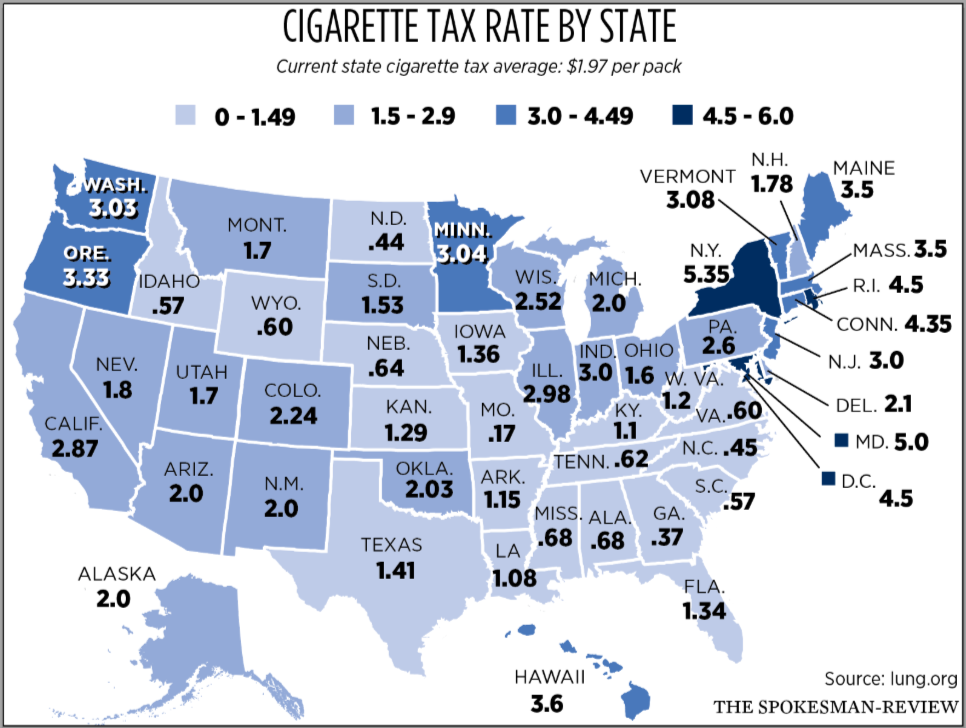
During a Jan. 30 House Finance Committee hearing, Parshley said it has been more than 16 years since the state increased its tax on cigarettes. In 2010, Washington raised the tax by $1 per pack to the current rate of $3.03. When the change took effect, Washington had among the highest cigarette taxes in the country.
“And in that time, the state’s health care impact is now estimated to be $3.2 billion a year,” Parshley said.
Parshley said the legislation followed “very intensive” work since lawmakers last met, which included meeting with stakeholders “from all sides of this issue.”
The first $10 million collected from the tax would help the Department of Health fund a “time-sensitive emergency system” for heart attacks, cardiac arrest and strokes, while $2 million would pay for better enforcement of tobacco sales.
Parshley said as lawmakers drafted the bill, they heard from “people in the industry” who said there needed to be stricter enforcement on the black market.
The remaining money collected would be deposited in the general fund. Beginning in 2028, 10% of the money collected above $12 million would be deposited into the foundational public health services account. Parshley said the fund has “a lot of uses.”
“And they’re very concerned that this bucket stays full,” Parshley said of the account, which is administered by the Department of Health.
Parshley said the proposal is not about penalizing those who smoke, but is intended to ensure the state can help those impacted by smoking.
Audrey Miller Garcia, who testified on behalf of the American Cancer Society Cancer Action Network, said during testimony that tobacco taxes are the “most effective tool” to discourage people from smoking.
“With a $2 per pack increase in Washington’s cigarette tax, we could save Washington $350.7 million in long-term health care costs,” Miller Garcia said. “Most importantly, when we increase these taxes, they must be significant, like this proposed $2 increase, otherwise the industry can easily absorb these increases with coupons and discounts, and won’t help people quit.”
However, Molly Pfaffenroth, who represented the Washington Food Industry Association, said the bill could have an outsized impact on small retailers.
“Washington already has one of the highest tobacco and vapor product tax structures in the nation, and this bill would further increase costs for neighborhood stores operating on less than 1% margin,” Pfaffenroth said.
Pfaffenroth said as the cost of cigarettes increases, consumers shift strategies, including going out of state, which puts small retailers at a disadvantage.
Ahead of Monday’s committee vote, Rep. Ed Orcutt, R-Kalama, said the cigarette tax is among the most regressive the state has. Orcutt added that the tax will particularly impact stores in communities that neighbor other states.
“When I look out my window, I don’t see Russia, but I do see Oregon. I literally can look across the Columbia River and see the state of Oregon,” Orcutt said. “And it’s a constant reminder for me that the difference in our taxes can lead to decisions being made.”
Oregon currently has a cigarette tax of $3.33 per pack. Idaho has a cigarette tax of $0.57 per pack.
New York has the highest cigarette tax, at $5.35 per pack.