
No snow? No problem for this extreme winter sport combining skiing and horses
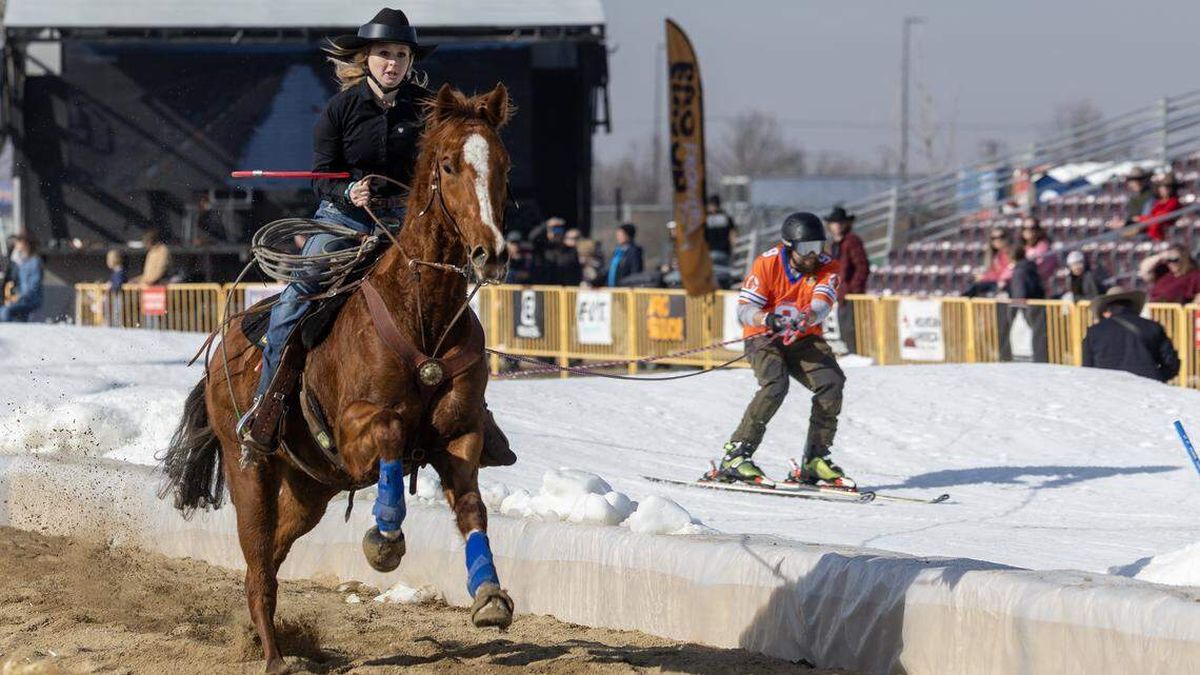
Devon and Tyler Peterson are no strangers to skijoring – an extreme winter sport in which a horse and rider pull a skier on a tow rope over a snowy course with challenges like jumps, slalom gates and rings that the rider or skier must collect.
What they’re not used to is skijor racing in the Treasure Valley, and certainly not in 50-degree weather when the only snow on the ground has been painstakingly scraped together with the use of snow guns.
The father and daughter arrived on a recent Thursday at the Ford Idaho Center in Nampa with a trailer full of horses. They’re originally from Bellevue in the Wood River Valley, though Devon is studying nursing at Boise State University, and they’ve been part of the sport for decades.
But the Boise area hasn’t.
The Friday and Saturday races – the first of their kind in the Treasure Valley, to Tyler’s knowledge – were put on by Pro Skijor, a company out of Utah that organized five races on its inaugural Frontier Tour. The tour culminates in a championship race in Salt Lake City for the top competitors.
Competitions are held in the U.S. in towns primarily across the West, but the sport has never had an organized association. Tyler said some Idaho competitors briefly held an Idaho Cup, but that effort was short-lived.
“For the first time ever, we’ll be able to name world champions of skijoring,” Pro Skijor cofounder Brian Gardner told the Idaho Statesman.
The prospect is exciting for a competitor who grew up pulling a sled behind her horses in a small town in Idaho.
“Putting so many years into the sport and having a chance to go this big, it’s a pretty incredible opportunity,” Devon said.
The Petersons said there was a time when Devon wasn’t sure what her future would look like in the sport. She was diagnosed with acute myeloid leukemia as a teenager and, after a bone marrow transplant, had to regain her balance, her confidence and the muscle memory to ride a horse and compete.
“I had cancer treatment here in Boise, and it was just about 10 years ago now,” said Devon. “So it’s kind of like a full-circle moment, people coming out to see me here, rather than in a hospital setting, like doing something that I love that I didn’t think I was going to get back to.”
Boise competitors could head to Salt Lake City or beyond
Devon entered as part of three different team configurations, with different horses or skiers for each team. One of her teammates, Cody Smith, has been skiing in skijor for years and was called out of retirement for the event, Tyler said.
“He has taken this sport to new levels,” Tyler said. “Thirty years ago, he was winning everything as a skier, and today he’s still winning everything. I don’t know that anyone will ever touch him, but we’re honored to have him still skiing behind us.”
Devon said finding the perfect blend of horse, rider and skier is the most challenging part of the sport. She’s riding two horses in the Pro Skijor event: quarter horses named Hercules and Usari.
Around 230 teams signed up to compete across various divisions, including professional, women’s, snowboard teen and buckaroo – a kids division. Competitors can win belt buckles and other prizes totaling $50,000, organizers said Friday.
The teams ran the outdoor course each day, with their scores combined for a final tally. Scoring is based on the fastest run time – as little as 15 seconds or so for professional teams to run the 2,000-foot course – with two-second penalties added for missed slalom gates or rings.
“You can get over 40 (mph) on these faster horses,” Tyler Peterson said. “We’ve told the skiers who haven’t done this … to start behind a snow machine.”
Competitors at the Idaho Center had an unusual racetrack. Typically, the horse and skier are on snow, but the warm temperatures and lack of snow meant it was a precious commodity. The skiers were gliding on snow as usual, but the horses were running on a dirt lane.
Gardner said Pro Skijor spent about a month observing overnight temperatures and waiting for the perfect times to create a stockpile of snow that it used to create the course on Friday.
“Mother Nature has thrown us a few challenges,” he said. “For every event on the tour, it’s been the same struggle.”
The tour has already held races in Heber City, Utah; Bozeman, Montana; and Logan, Utah. It will head to Driggs next before the final stop in Salt Lake City.
Gardner said Pro Skijor has been hosting skijoring events in Utah for a decade, and its ties to the community in Salt Lake City have led to hopes about the potential for even bigger things.
Salt Lake City has been selected to host the Winter Olympics in 2034, and skijor teams were set to take to downtown Salt Lake on Saturday for a skijor exhibition at the same time racers were hitting the course in Boise. Gardner said the exhibition was in partnership with the city, and the Olympic committee is also involved – and could potentially take interest in the sport for the 2034 games.
Skijoring has appeared once before at the Olympics in 1928 as a demonstration sport in St. Moritz, Switzerland.
“There is quite a bit of chatter, as this sport continues to grow, that we very well might see it as an exhibition sport, at least for 2034 in Utah,” Gardner said. “No guarantees on that, but there is a lot of talk.”