
Spokane moving ahead with Grand Boulevard lane reduction
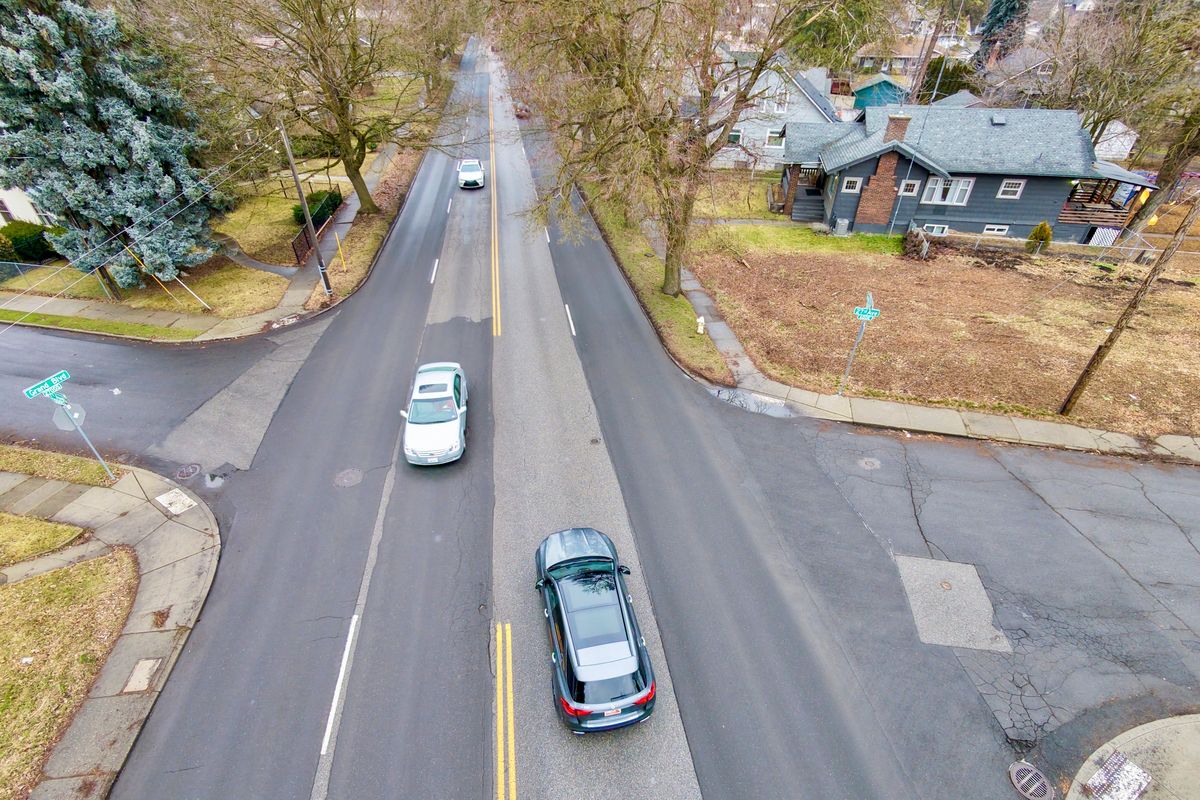
Grand Boulevard is being put on a diet.
A unanimous vote by the Spokane Transportation Commission calls on City Hall to reduce travel lanes on the busy South Hill street between 14th and 29th avenues from two in each direction to one in each direction with a center turn lane, which city engineers estimate will reduce crashes by up to 24% while adding 30-60 seconds of travel time during peak traffic.
The modifications would accompany pedestrian improvements, including a flashing crosswalk beacon at 27th and roughly four concrete islands in the roadway at as-yet undecided intersections. The city has also not yet decided how to handle merging where Grand’s lanes are reduced south of 14th and north of 29th.
The remaining lanes will be widened from 10 feet to 11 feet. No new bike lanes are planned.
The corridor is among Spokane’s busiest, with an average of at least 14,000 vehicles passing along its length each day. City officials argue reducing lanes would eliminate a significant number of crashes.
Without a turn lane, vehicles on Grand Boulevard attempting to turn left frequently have to come to a complete stop in a through lane. In addition, the lack of a turn lane or something separating oncoming traffic allows for more sideswiping accidents. Of the 42 reported crashes along this stretch from 2020 to 2024, city engineers estimated eight could have been prevented with a separated turn lane.
The most obvious cost would be slower average travel times and an inability to legally pass slow commercial vehicles or buses. City engineer Brian Brisendine estimated the change would add roughly 60 seconds of travel time going southbound during peak traffic and 30 seconds going northbound, which accounted for delays caused by stopped buses. Brisendine also clarified these estimates might be “conservative,” noting they relied on unusually long waiting times for stopped buses.
The decision proved no less controversial Wednesday than it has in prior public forums, with residents and business owners around Grand clashing over whether to prioritize safety on Grand or traffic flows, with some arguing the city wasn’t going far enough to slow traffic and others claiming the reduced lanes would have unintended consequences.
Gavin Cooley and Brad Barnett, both executives with the Spokane Business Association political lobbying group, argued against lane reductions. The association was formed by developer Larry Stone, who has been a vocal opponent of so-called “road diets” in Spokane wherever they have been proposed.
“We’re strongly in favor of striping, any safety measures, beautification – where we’re getting hung up is lane reductions,” said Cooley, who noted he also lives roughly a block from 14th and Grand.
He said that the road diet would lead to congestion, pushing more cars onto parallel streets that are already burdened with traffic, and that irresponsible drivers would use the center turn lane to dangerously pass slow vehicles, such as a bus at a stop. Instead, he argued the city should rely on crosswalk improvements and traffic citations to improve safety.
Barnett suggested that the road would become so undesirable that commuters would no longer travel to offices downtown for work, exacerbating the downtown office vacancies.
Supporters included Brian Trimble, owner of Herzog Family Center, a child care business on the corner of 27th and Grand, who said that the city should not wait for a pedestrian to die on Grand before it acts.
“The roads are not just for vehicles but for pedestrians,” Trimble said. “(The Herzog Family Center) has been there for nearly 30 years, I’ve owned it for 12, and the challenge we’ve run into all the time is people trying to cross the street at 27th and Grand.”
Jake Madewell, a resident near Manito Park, said that the reduced speeds would enhance the park and that safety improvements are clearly worth the longer commutes.
“The potential overestimated increase of peak commute times of 30 to 60 seconds would not materially affect your life,” he said. “You, your child or your grandchild being struck by a car crossing Grand going home or to the park would materially affect your life.”
Sarah Rose, co-director for transportation safety activist group Spokane Reimagined, expressed support for the proposal but argued it doesn’t go far enough. Widening the remaining lanes could encourage speeding, she noted, and prevents the city from creating bike lanes on Grand.
“I am disappointed a solution with three 10-foot lanes wasn’t put forward, which would have allowed 5 feet for bicycle lanes on either side, or an option for making Grand a two-lane complete with fully protected bike lanes or a cycle track,” she said.
Brisendine said that the city’s standards for lanes is at least 11 feet wide and noted that the Spokane Transit Authority has requested 11-foot lanes for its fleet. He also noted the city’s approach to building out bike lanes is to prioritize low-traffic streets.
Lauren Pangborn, who serves on the Transportation Commission as a liaison from the city’s Bicycle Advisory Board, noted that the board’s general opinion has been that “regardless of the facility put on Grand, I still wouldn’t ride it.”