
Pigs and perfect skin: WSU researchers uncover microstructure shared between porcine and people skin that holds the key to aging
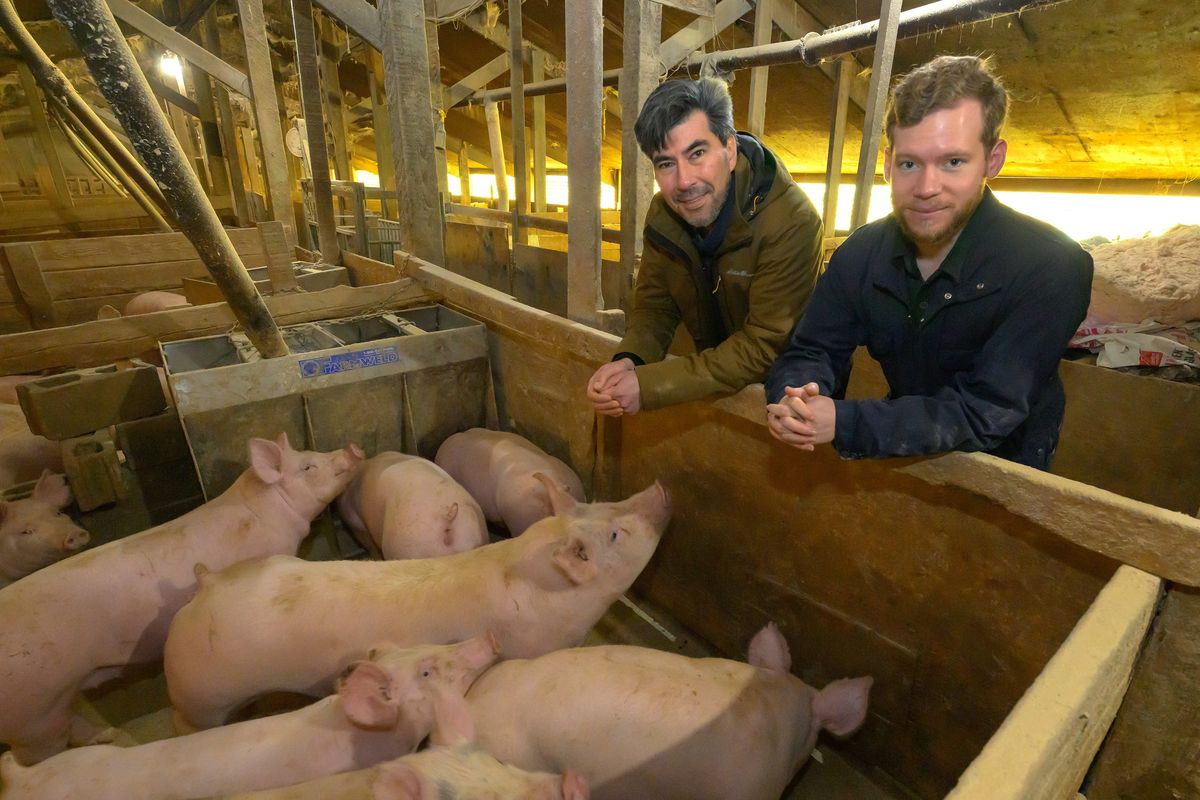
Step aside, Botox. The secret to healthy, young skin is oinking in a pen.
A team at Washington State University’s College of Veterinary Medicine recently published work that suggests the key to regenerating skin and healing wounds comes from a microscopic skin structure that humans share with pigs and grizzly bears. Strangely enough, monkeys, with whom humans share a distant common ancestor, do not have these structures, known as rete ridges.
“My laboratory’s goal is to get skin to regenerate,” said Ryan Driskell, an associate professor in the College of Veterinary Medicine’s School of Molecular Biosciences at WSU and senior author of the paper. “And in order to get skin to regenerate, we need to have the blueprints for how to build it.”
Grizzlies, humans, rhinoceros, elephants, hippos and pigs all have rete ridges. Driskell said there’s a correlation between rete ridges and thick-skinned animals with low hair density.
A person might look at a 500-pound grizzly and rightfully notice that they’re quite furry, Driskell said, “but in reality, the hair density of the bear is actually much, much lower than a mouse.”
With a lower hair density comes room for rete ridges, he said. And unlike hair follicles and sweat glands, rete ridges form by their own unique mechanism.
Driskell likens rete ridges to a kind of biological Velcro. This keeps the dermis, or the inner layer of skin, attached to the epidermis, the outer layer. For a long time, it was thought that rete ridges form during early embryonic development, but their research suggests that the wavelike crests develop not long after birth and that there’s a key molecular signal, called bone morphogenetic proteins, that spurs their growth.
Prior to the study, the scientific consensus was that rete ridges form in a similar fashion as hair follicles and sweat glands. Driskell’s work disproves this.
To illustrate his point, Driskell compared the formation of rete ridges to developing a piece of land. In the contrasting case of hair follicles, the body sends out signals informing where hair is supposed to form. Like a drill rig boring straight down into the Earth’s crust, cells replicate and burrow their way deep into the dermis, creating either hair follicles or sweat glands.
But with the creation of undulating rete ridges, Driskell said to imagine taking a flat piece of land and converting it into a terrain littered with rivers and valleys. Instead of drilling holes, like what happens for sweat glands and hair follicles, the body “digs” a ditch.
“You’re not drilling, you’re creating a ditch,” Driskell said. “We are still trying to figure that out. Now that we’ve proven that it’s totally different, now is where the real work starts to come in to see how that topography is actually being created at a cellular level.”
There is still considerable work left before an older person can possess the smooth, moisturized skin tone of someone 60 years younger, he acknowledged. But Driskell said his team’s research revealed “one part of the grand design of the house that we live in.”
It’s common knowledge, at least among skin biologists, Driskell said, that pig skin is the animal hide most akin to human skin. Since human skin is hard to acquire, pig skin was the next best thing. That doesn’t mean it was the first choice.
Mice, monkeys, naked mole rats, dolphins and grizzly bears were all assessed to see which was the most similar to human skin. In the end, the team picked a patchwork of pink porcelain porcine skin .
Maksim Plikus, a professor of developmental and cell biology at University of California Irvine’s School of Biological Sciences, studied rete ridges in dolphin skin and then gave that data to Driskell’s team to use. Since it’s a felony to take dolphin skin from the beach, Plikus said he has a special agreement with the National Oceanic and Atmospheric Administration to acquire samples of cetacean skin to study.
Plikus said that dolphins have the deepest rete ridges of any animal that he knows of. He speculates that their rete ridges are as deep as they are because of how swiftly and gracefully dolphins swim in the ocean. If humans could swim through water at the same speed as dolphins, then our soft skin, particularly on our face, would peel away in days, he said.
For context, Olympic swimmer Michael Phelps’ top speed in water is about 6 mph. The short-beaked common dolphin can reach speeds of up to 37 miles per hour in water.
For skin that’s under more stress, like dolphins traversing the ocean, the “biological Velcro” needs to latch itself even deeper into the skin than what a terrestrial animal, like a pig, requires.
Driskell and his team partnered with local farmers and received chunks of pig skin across various stages of development until they began to see rete ridges take shape.
Not only was the idea of when and how rete ridges form drastically altered, but their work also showed that rete ridges change over time.
As one ages, rete ridges tend to flatten. Think of it as Velcro not being able to stick as well. Because of this, skin often sags, becomes thinner and is more susceptible to bruising.
Plikus said they’re not entirely sure why rete ridges tend to flatten. It could be that the communication between skin cells and signaling molecules, like BMP, break down with time. It also could just be the way tissue ages.
If bone morphogenetic proteins, or what spurs the growth of rete ridges by guiding cells, could be turned on or enhanced in certain cases, it’s possible that aging skin could see new life and scars could heal faster.
Even the proliferation of psoriasis and other skin diseases could be slowed or stopped if BMP pathways could be harnessed, the researchers said. Whatever innovation is discovered to stop aging and improve scar repair, the key seems to lie in rete ridges.
The next steps for Plikus, Driskell and other scientists interested in skin regeneration is to find a way to “turn on” the BMP pathway and translate their findings into some sort of clinical drug.
While there’s still considerable work to be done before anti-aging or scar-reduction therapies hit the market, the research done at WSU is a critical first step.
Driskell has spent his entire adult life studying the human body and working to find solutions to numerous health challenges. He coupled his love for beautiful images in microscopy with his innate scientific curiosity, which eventually brought him to studying skin after years of looking at lungs.
Driskell started his career at the University of Iowa and spent 10 years in Cambridge, but it seems Pullman is the place that captured his heart.
“I think that I have a passion for rural science,” Driskell said. “Some of the most important biological questions probably can only be answered in places that have animals, land and people willing to work together. And WSU is one of those places.”