
‘America’s Time Capsule’ will bury artifacts underground for 250 years
When West Point archeologists pried open a 200-year-old time capsule left by cadets in the early 1800s, they expected to discover forgotten treasures and historic documents. Instead, they found gray clumps of dust and a few old coins.
This is the nightmare situation organizers with the America250 Commission are hoping to avoid this year as they work to bury priceless artifacts at Independence National Historical Park in Philadelphia for future Americans to open in 2276.
The project, mandated by Congress in 2016, has been no easy feat.
“Two hundred and fifty years is a really long time,” said Jacob Ricker, an engineer with the National Institute of Standards & Technology who has been working to build the capsule. The materials scientists plan to use to create a lasting vessel have never been tested for that length of time.
“Stainless steels have been around less than 100 years,” Ricker said. “Material choice overall is just very hard.”
Building an impenetrable capsule
The project is unlike anything undertaken for other national milestone anniversaries. Organizers for the bicentennial, for instance, opted to shelve that time capsule in a climate-controlled room at the National Archives, rather than deep in the ground.
For more than a year, Ricker has worked with government engineers, archivists and National Parks personnel to develop a device that will insulate and preserve dozens of present-day documents from natural elements, like water, oxygen and temperature fluctuations, for the country’s 500th anniversary.
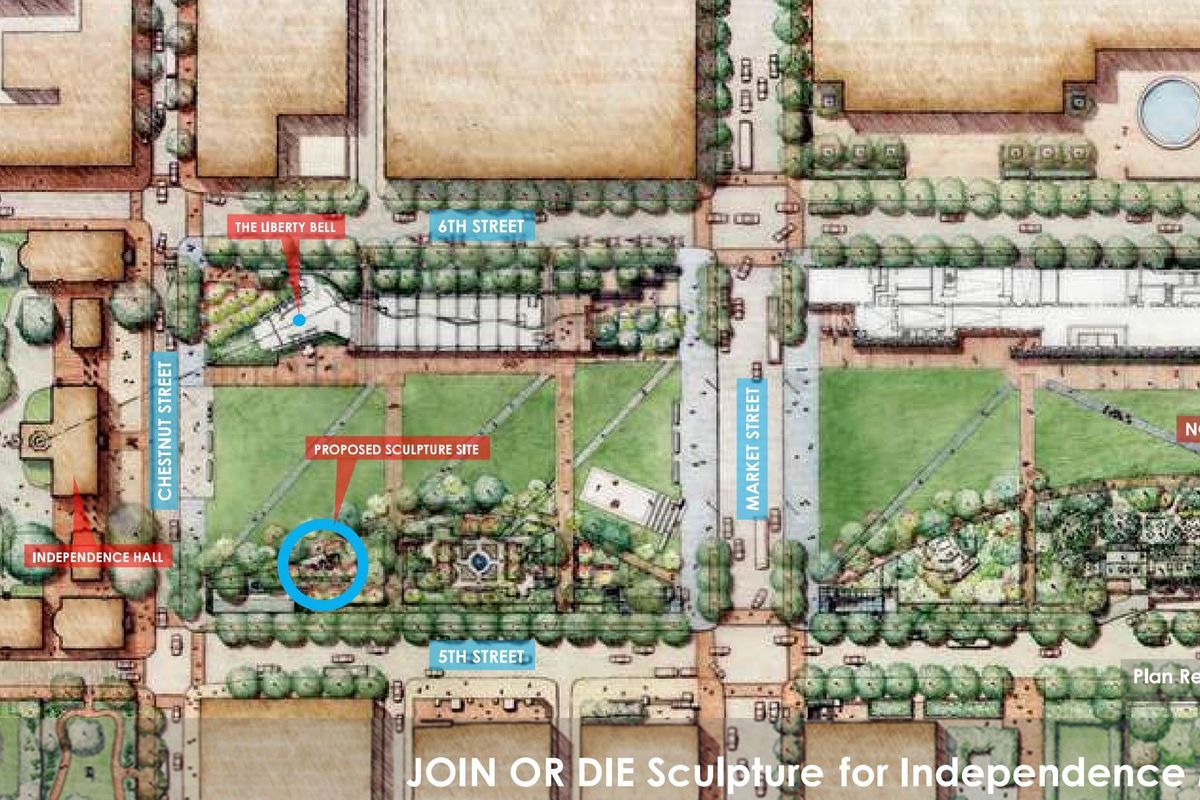
Originally, they planned to enclose the capsule in a 46-foot-long snake sculpture inspired by Benjamin Franklin’s 1754 “JOIN OR DIE” cartoon that’s planned for Independence Mall in Philadelphia.
But questions swirled about whether even that would survive nature’s wrath for 2 ½ centuries.
Plan B is a 3-foot-by-2-foot stainless steel cylindrical vessel with a metal bell jar cover that will envelope the capsule in an air pocket. It’s designed to provide several layers of protection from water intrusion.
“If you’ve ever been in a swimming pool and you take a bucket, you turn it upside down, and you pull it down into the water, it traps an air bubble in the bucket. That’s exactly what we’re doing here,” Ricker said.
Documents and memorabilia will sit inside individual chambers within the capsule. Each state and territory will have its own shelf in the artifact box, and archival papers will be placed in a separate sealed chamber.
“We can’t have things that will be off-gassing, for example, and affecting other things within the capsule,” said Tom Medema, the project manager of America‘s Time Capsule. “The chemical makeup of the items that go in here over 250 years have to be stable enough to not impact the others.”
As for the location, Medema said he expects the National Park Service to care for Independence Mall for centuries to come. The area is about 30 feet above sea-level, but should it see flooding or other climate change impacts, preservationists will move the capsule to another location, along with the Liberty Bell and other historical structures in the area.
Once the capsule is buried on July 4, the Park Service will take ownership of it and will be responsible for eventually unearthing it.
What history will the capsule hold?
In its final form, the capsule will hold materials from all 50 states, the three branches of the federal government and the America250 Commission’s commemoration events. So far, the Commission has chosen items from the 2026 Rose Parade, sports memorabilia, an American flag and student submissions to include.
States and territories have until March 15 to submit the relics and memorabilia they hope to include. Whatever they choose, will need to fit within the confines of the capsule.
The commission initially gave each state a prescribed list of items they could choose from, and has fielded a flurry of questions that give hints into what might ultimately end up in the cylinder.
Hawaii, for instance, asked for an exception to a rule asking states to only submit one piece of paper, noting that any letter written in Native Hawaiian would run at least several pages.
Medema said the commission has also fielded “questions about pewter as a metal going in there from one of the states, if their object could be pewter, and gold and some of the other elements.”
As for the federal government, America250 Chair Rosie Rios said she’s been in contact with the Supreme Court, Congress and the White House about artifacts they might want to highlight for future generations.
America250 will reveal the capsule’s content in May or June. It will be displayed in Philadelphia before it’s placed in the ground on July 4 for the next 250 years.
“This is typical America to me,” Ricker said. “You come with a huge challenge, and then we overcome it.”