
‘We can protest in our quiet way by knitting’: Several Spokanites knit red hats to protest ICE, Trump adminstration
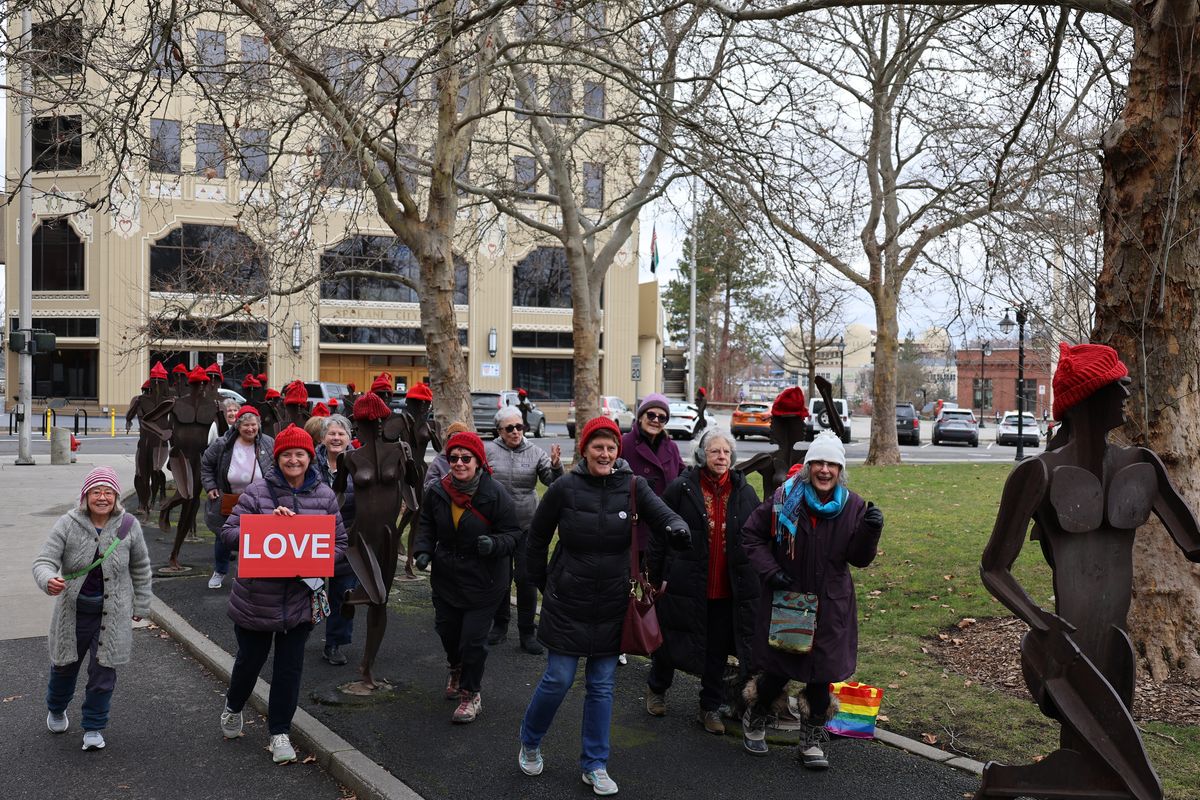
On this day, exactly 84 years ago, Nazis in occupied Norway outlawed red hats.
Inspired by a Santa Claus-esque gnome from Norwegian folklore, women took to knitting hats as a way of opposing the authoritarian regime of Nazi Germany. The Nazis saw the nonviolent action as a threat to their power. So it was outlawed.
After Alex Pretti and Renee Good died at the hands of federal immigration agents in Minnesota, the red hat resistance saw a resurgence when a yarn shop in Minneapolis started selling the “Melt the ICE” hat pattern. Since Jan. 15, that Minnesota yarn shop has raised $650,000 for local immigration groups. A month and a half later, what started in “The Land of 10,000 Lakes” has now made its way to the Lilac City.
On Tuesday afternoon, about 15 women put 40 red tasseled hats on the heads of all of the Bloomsday runners in the Joy of Running Together statue in Riverfront Park .
“There’s a lot of people here that will not stand out there and hold a sign in the park,” Ilene Martin said. “But we can protest in our own quiet way by knitting and being a supportive community.”
Martin is part of a group of knitters that meets each Tuesday. For Martin, it’s become something of a therapy session. In the time it takes to make a single hat – for Martin, about four hours – the women talk about their personal lives and the world around them.
Most of the women belong to the Inland Northwest Unitarian Universalist Community, though there are other Spokane knitting groups who have been creating red tasseled hats over the past month and a half.
So far, Martin said they’ve given out at least 50 hats. Each hat sells for around $25 and all of the proceeds go toward erecting anti-ICE and anti-Trump billboards in rural areas north of Spokane.
Mary Lu Vait is another knitter who said she has a hard time recognizing her country these days. The America she remembers is most aptly summed up by the words scrawled across a bronze plaque below the Statue of Liberty.
“Give me your tired, your poor,” the inscription reads. “Your huddled masses yearning to breathe free, the wretched refuse of your teeming shore.”
She said that many of the women in the knitting groups are children or grandchildren of European immigrants. The words below the Statue of Liberty acknowledged America as a diverse, yet strong country, where people facing persecution, starvation and even death could build a new life for themselves.
Salem McDonald, the youngest person in their group, is really scared about the trajectory of the nation.
“Things are happening that directly affect my community in really harmful ways,” McDonald, who is transgender. “So it’s really good to see this group of people, who maybe have more privilege than I do, still coming out and standing up for my community and other communities that don’t have the luxury of being this visible right now.”
Meanwhile, Sheila Rawls admitted that many retired people don’t have much to lose anymore. Besides there’s nothing very threatening about a group of grandmothers knitting red hats . Several of the women were involved in civic demonstrations years ago, especially during the Civil Rights movement and the Vietnam War.
“When we did those marches, we could count on the fact that (the United States) would still follow the Constitution and there was still a rule of law,” Rawls said. “I believe that’s not the case this time. That’s what’s scary.”
From actions taken to arrest the president of Venezuela, to the death of protestors at the hands of ICE to immigrants granted asylum status being detained in facilities, Rawls believes the government has deteriorated from what it once was.
Donning a red hat like all the rest, Brian Flick wasn’t a part of any knitting group, but still decided to show up to Riverfront Park to support the cause. His wife taught him how to knit and now it takes up much of his free time, he said.
Flick said the other way he protests, other than attending rallies and knitting, is by putting signs in his front yard. They say things like, “Why are you more afraid of diversity than dictatorship,” and “Are we great yet?” He chooses to not put up any “angrier” ones for a simple reason.
“I live with neighbors that are Trump supporters. I want to be their friend later,” he said.