
Trump says U.S. will run Venezuela, won’t rule out U.S. boots on the ground
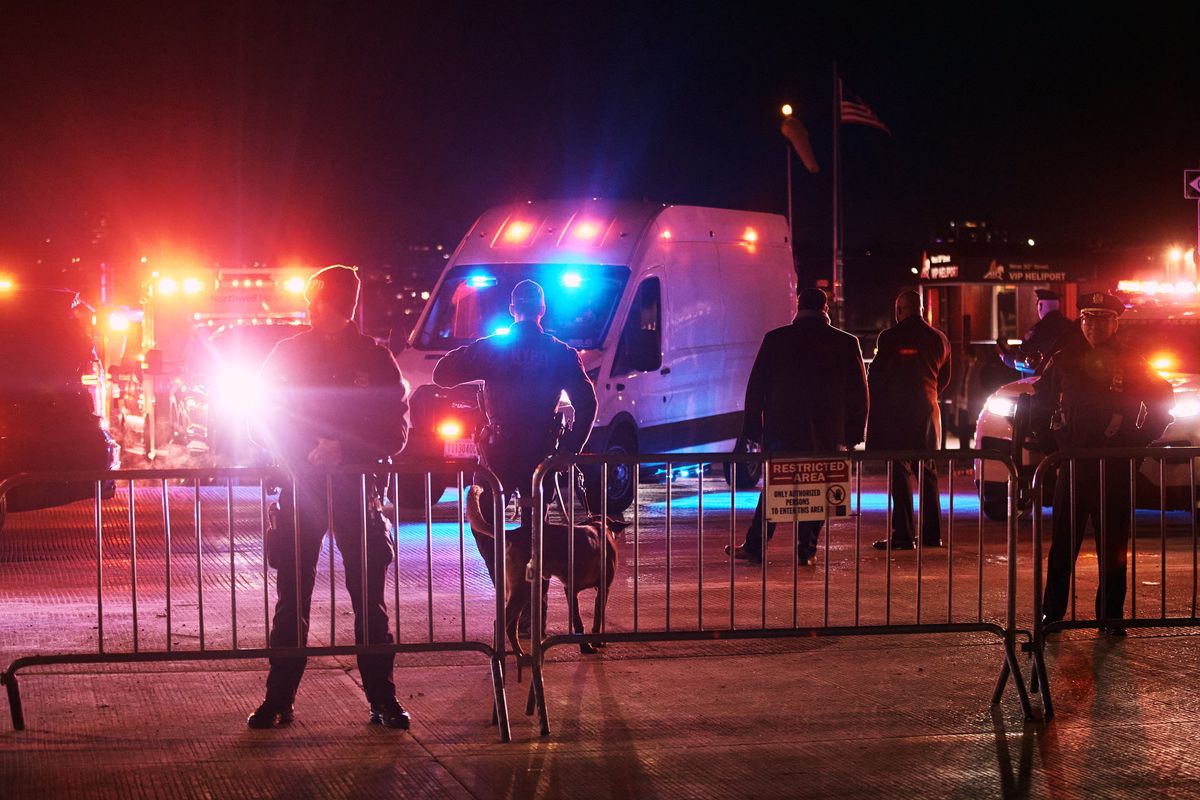
CARACAS, Venezuela – President Donald Trump said Saturday at his Mar-a-Lago Club that the United States will control Venezuela for an unspecified period after a U.S. operation captured Venezuelan President Nicolás Maduro and his wife.
“We’ll run it properly. We’ll run it professionally. We’ll have the greatest oil companies in the world go in and invest billions,” he said, while declining to rule out U.S. military deployments. “We’re not afraid of boots on the ground.”
The operation, named “Operation Absolute Resolve,” involved more than 150 aircraft, including strike and intelligence assets, Gen. Dan Caine, chairman of the Joint Chiefs of Staff, said after Trump’s remarks. “On arrival into the target area, the helicopters came under fire, and they replied with that fire with overwhelming force,” Caine added. “One of our aircraft was hit but remained flyable.”
The operation began at 10:46 p.m. U.S. forces descended onto Maduro’s compound at 1:01 a.m. Eastern time, or 2:01 a.m. local Caracas, taking fire from Venezuelan forces, Joint Chiefs Chairman Gen. Dan Caine said. One of the helicopters was hit but was able to still fly. Those U.S. troops, with Maduro and his wife in custody, were back over the water by 3:29 a.m. Eastern time, Caine said.
Maduro and his wife, Cilia Flores, “gave up and were taken into custody” by U.S. forces, Caine said. The couple was removed from the country by helicopter, taken aboard the USS Iwo Jima and will be brought to New York, where both are facing federal charges.
The Venezuelan military was “rendered powerless” by U.S. forces, Trump said at the start of his news conference. Speaking at his Mar-a-Lago Club in Florida, Trump alluded to a potential attack on Venezuela’s electrical grid, saying “the lights of Caracas were largely turned off” by the United States.
Trump, who posted on social media about the Venezuelan strike at 4:21 a.m. and appears to have been awake much of the night, repeatedly closed his eyes and swayed while his deputies delivered remarks.
It continues a pattern of the president appearing to struggle to fight off sleep at several recent events.
Caracas, Venezuela’s capital, hasn’t been entirely closed off. Residents report that they are still able to move about, but there is one checkpoint at a tunnel that leads into the city. In some places, lines have formed at gas stations.
There is not much police or military presence in La Guaira, a coastal state where blasts had been reported overnight.
Trump said the U.S. had prepared to mount a second-wave attack in Venezuela but that he doubted it would be needed.
Trump told reporters that Colombian President Gustavo Petro, who has condemned the U.S. operation, needs to “watch his ass.”
“(Petro) has cocaine mills. He has factories where he makes cocaine. … He’s making cocaine. They’re sending it into the United States,” Trump claimed. “So he does have to watch his ass.”
Secretary of State Marco Rubio in remarks Saturday called Maduro a “fugitive of American justice with a $50 million reward” for information that would lead to his arrest.
“But don’t let anybody claim it,” Trump interjected. “Nobody deserves it but us.”
María Corina Machado – the Venezuelan opposition leader who received the 2025 Nobel Peace Prize – would not be accepted by the Venezuelan people as a leader to replace Maduro, Trump told reporters Saturday. “I think it would be very tough for her to be the leader,” he said. “She doesn’t have the support within or the respect within the country. A very nice woman, but she doesn’t have the respect.” He said the U.S. had not been in contact with her about the operation to remove Maduro.
In a televised address, Venezuelan Vice President Delcy Rodríguez struck a defiant tone and demanded the immediate release of Maduro.
“There is only one president in this country, and his name is Nicolás Maduro,” Rodríguez said.
She said she convened a national council for the defense of the nation that included top government and military officials.
The show of unity appeared at odds with earlier comments by Trump, who said during a news conference that Rodríguez had been sworn in as head of the country and that she is “essentially willing to do what we think is necessary to make Venezuela great again.”
Trump officials describe final moments before Maduro capture
The final minutes of Maduro’s time as president of Venezuela unfolded in dramatic and rapid fashion, and seemed to maintain the element of surprise up until the very final moments before he and his wife were overcome by U.S. military forces and then taken into custody by U.S. law enforcement.
Maduro and his wife were taken as both tried to reach the steel door of a safe room inside his presidential compound, Trump said Saturday.
“He wasn’t able to make it to the door because our guys were so fast,” Trump said. “Did we get him by surprise? Sort of surprise, but they were waiting for something. It was a lot of opposition. There was a lot of gunfire.”
Trump had launched the operation just about 70 minutes earlier, at 10:46 p.m., sending helicopters carrying an extraction team and ground team speeding at 100 feet above the water toward Caracas.
As the helicopters approached the target, U.S. fighter jets and bombers launched strikes and disabled Venezuela’s air defense systems to protect the helicopters and ground forces they were carrying.
At 1:01 a.m. Eastern time, the helicopters reached Maduro’s compound, where they took and returned fire, Joint Chiefs chairman Gen. Dan Caine said.
“On arrival into the target area, the helicopters came under fire and they replied with that fire with overwhelming force and self-defense,” Caine said. “One of our aircraft was hit but remained flyable.”
Maduro and his wife, Cilia Flores, were taken and loaded onto helicopters, while fighter aircraft and drones protected overhead. By 3:29 a.m., those aircraft were back over the water, heading toward the amphibious warship USS Iwo Jima, where the two were detained.
Trump leaves door open to U.S. military on Venezuelan soil
Trump said Saturday that the United States is “not afraid of boots on the ground” in Venezuela, raising the possibility of U.S. military deployments in the country following the capture of Maduro.
“We’re not afraid of it,” Trump said. “We don’t mind saying it, but we’re going to make sure that that country is run properly. We’re not doing this in vain.”
Trump later downplayed the role he thought U.S. forces might have. Asked a second time about a potential military role, he said the United States will have a “presence in Venezuela as it pertains to oil.” That presence, he said, would be “not very much” in size.
Trump dismissed the mixed history that the United States has had after toppling other governments abroad, citing the fatal strike on Iranian general Qasem Soleimani and the raid against Islamic State leader Abu Bakr al-Baghdadi during the president’s first term that resulted in his suicide. Trump also cited the bombing of Iranian nuclear facilities last summer.
“We’ve had a perfect track record of winning,” he said. “We win a lot.”
None of those operations toppled governments. Trump has criticized U.S. nation-building efforts in the past.
Hundreds of flights canceled amid Venezuela crisis
Major U.S. airlines have canceled flights following the Federal Aviation Administration’s temporary bans on travel to Venezuela and parts of the Caribbean.
It’s unclear how many total flights have been canceled due to the U.S. attack on Venezuela, but more than 670 flights traveling through U.S. airports have been canceled and nearly 2,000 had been delayed as of 10:30 a.m. Saturday, according to the flight tracking site FlightAware.
JetBlue said it canceled more than 200 flights because of the airspace closures, noting that flights to the Dominican Republic and Jamaica are not affected: Customers whose flights are canceled “may rebook their travel or request a refund. … Customers with travel plans should check their flight status on jetblue.com or the JetBlue app. For customers with upcoming travel, a fee waiver is in place to provide additional flexibility to adjust their travel plans.”
JetBlue’s fee waiver covers travel on Saturday and Sunday to or from 15 airports, including those in Puerto Rico, Curaçao and Aruba. Affected travelers can rebook through Jan. 10.
American Airlines said it was closely monitoring the situation in the eastern Caribbean: “We are making schedule adjustments as necessary with the safety and security of our customers and team members top of mind. To provide options for customers, we have issued a travel alert allowing those traveling in the region to change their travel plans without a fee.”
A Southwest spokeswoman said that all flights to Queen Beatrix International Airport, in Aruba, have been canceled for Saturday. Flights to Luis Muñoz Marín International Airport in Puerto Rico are being suspended until at least 3:30 p.m. Central time. For now, scheduled flights to Punta Cana International Airport in the Dominican Republic are unaffected.
Southwest’s travel advisory states that customers holding reservations to, from, or through Aruba, Puerto Rico or the Dominican Republic on Saturday who want to alter their travel plans may rebook or travel standby within 14 days without paying a change in airfare. Fliers could also be eligible for a refund for unused tickets due to canceled or significantly delayed flights.
Delta said it started canceling flights early Saturday morning, informing its customers via the Fly Delta app and contact information listed in their reservations.
United Airlines issued a travel alert stating that it will waive change fees and fare differences for customers rescheduling their trip, as long as the new flight is a United flight departing between Tuesday and Jan. 13.
China formally condemns strikes, warns citizens not to travel to Venezuela
Beijing has issued a strong condemnation of the U.S. strike that resulted in Maduro’s capture, saying China’s government was “deeply shocked” by the sudden maneuver and accusing the United States of using “blatant” force to upend the regime.
“We call on the U.S. to abide by international law and the purposes and principles of the UN Charter, and stop violating other countries’ sovereignty and security,” a foreign ministry statement reported by Chinese state media said on Saturday.
Separately, the foreign ministry and China’s embassy in Venezuela issued an advisory that warned citizens not to travel to the country.
U.S. oil companies will take over Venezuelan oil industry, Trump says
U.S. oil companies are going to take over Venezuela’s oil fields and industry, Trump said Saturday, declaring that U.S. oil interests will revive oil production in a country with one of the world’s largest reserves.
Trump cited oil as one of the motivations for the U.S. intervention that led to the capture Saturday of Maduro.
“As everyone knows, the oil business in Venezuela has been a bust, a total bust, for a long period of time,” Trump said. “They were pumping almost nothing, by comparison to what they could have been pumping, and what could have taken place.
“We’re going to have our very large United States oil companies, the biggest anywhere in the world, go in, spend billions of dollars, fix the badly broken infrastructure, the oil infrastructure, and start making money for the country, and we are ready to stage a second and much larger attack if we need to do so,” Trump said.
Trump claimed that Venezuela had stolen the oil investments that U.S. companies had made in the country over time. Now, Trump said, the oil companies would recover their investments.
Small group of Republicans object to Trump’s invasion of Venezuela
Some of Trump’s harshest critics rejected his decision to invade Venezuela and extract the country’s leader and his wife.
Rep. Marjorie Taylor Greene (R-Georgia), who will leave office Jan. 6 after a public spat with the president, criticized the administration for prioritizing regime change and funding foreign wars while Americans face rising housing and health care costs.
“Americans disgust with our own government’s never ending military aggression and support of foreign wars is justified because we are forced to pay for it and both parties, Republicans and Democrats, always keep the Washington military machine funded and going,” Greene (R-Georgia) said in a social media post. “This is what many in MAGA thought they voted to end. Boy were we wrong.”
At least one GOP member questioned the constitutionality of the operation.
“If this action were constitutionally sound, the Attorney General wouldn’t be tweeting that they’ve arrested the President of a sovereign country and his wife for possessing guns in violation of a 1934 U.S. firearm law,” Rep. Thomas Massie (R-Kentucky) posted on social media Saturday.
Still a majority of GOP House members, including Speaker Mike Johnson (R-Louisiana), lauded the president’s decision, characterizing the military action as “decisive” and justified.”
Democratic lawmakers call operation ‘illegal’ and an ‘act of war’
Democratic lawmakers on Saturday condemned the Trump administration for not having informed Congress about its operation to extract Maduro from the country until after the action took place, calling Trump’s actions an abuse of power.
Sen. Jeanne Shaheen (New Hampshire), the top-ranking Democrat on the Senate Foreign Relations Committee, in a statement called Maduro “a tyrant,” but said that the operation “is entirely inconsistent with what his cabinet repeatedly briefed to Congress and goes against the expressed wishes of the American people. These strikes draw America even deeper into open conflict at grave risk to our service members and reportedly resulted in injured American troops – which we need more information about immediately.”
Rep. Jim Himes (Connecticut), the ranking Democrat on the House Intelligence Committee, said the Pentagon notified committee staff about the operation after it took place. And Rep. Gregory W. Meeks (New York), the top Democrat on the House Foreign Affairs Committee, confirmed that he “had absolutely no briefing or heads up.”
“I also have huge questions about what comes next,” Meeks added.
Sen. Jacky Rosen (D-Nevada), a member of the Senate Armed Services Committee and the Senate Foreign Relations Committee, called the extraction an “illegal regime change operation.”
“The decision to jeopardize the safety of our brave men and women in this way is a heavy responsibility that cannot be made without the input of the American people through its representatives in Congress,” she continued in a statement. “The Trump Administration needs to be held accountable and explain why it lied to us when it claimed in its briefings that regime change wasn’t the U.S. goal in Venezuela.”
Sen. Tim Kaine (D-Virginia), who also sits on the Senate’s Armed Services and Foreign Relations committees, said the operation was “a sickening return to a day when the United States asserted the right to dominate the internal political affairs of all nations in the Western Hemisphere.”
“Where will this go next? Will the President deploy our troops to protect Iranian protesters? To enforce the fragile ceasefire in Gaza? To battle terrorists in Nigeria? To seize Greenland or the Panama Canal? To suppress Americans peacefully assembling to protest his policies? Trump has threatened to do all this and more and sees no need to seek legal authorization from people’s elected legislature before putting servicemembers at risk,” Kaine added.
Sen. Chris Van Hollen (D-Maryland), who also sits on the Senate Foreign Relations Committee, called the operation an “act of war” and “a grave abuse of power by the President.” The senator also dismissed the Trump administration’s motive behind Maduro’s extraction, pointing out that Trump recently pardoned former Honduran president Juan Orlando Hernández, who had been convicted by a U.S. court on charges that he ran the Central American nation as a “narco-state” that helped send South American cocaine to the United States.
“This is not about demolishing a dictatorship, as we’ve seen Trump cozy up to dictators around the world. This is about trying to grab Venezuela’s oil for Trump’s billionaire buddies,” Van Hollen added.
No ‘legal basis’ for Maduro seizure, expert says, but case will stand
The U.S. military’s overnight operation to capture Maduro lacked any “plausible legal basis,” but its extrajudicial nature probably won’t affect the case against Maduro, an international-law expert said Saturday.
Geoffrey Corn, who heads the Center for Military Law & Policy at Texas Tech University and previously served as the Army’s senior law-of-war expert adviser, said Supreme Court precedent makes clear that a defendant in Maduro’s situation can’t argue that his case should be dismissed because of an unlawful arrest.
“Maduro is not going to be able to avoid being brought to trial because he was abducted, so to speak, even if he can establish it violated international law,” Corn said.
Maduro will still probably argue the legality of his apprehension, Corn said, adding that he could also seek prisoner-of-war status.
A prisoner-of-war designation would give him certain protections while in U.S. custody but would not interfere with his prosecution in federal court, Corn said.
Corn, who recently co-wrote an op-ed in the Washington Post defending Trump’s military operations in Iran without congressional oversight, said the Trump administration has been using flimsy legal arguments to justify his strikes on Venezuela – arguments that are widely rejected by experts.
“Alleging that the drug threat is analogous to attacks by al-Qaeda has never been credible,” Corn said. “Almost all international law experts have categorically rejected that interpretation of self-defense.”
European leaders urge peaceful transition
European heads of state were split over the U.S. military operation in Venezuela that led to the capture of President Nicolás Maduro and his wife.
Leaders acknowledged Maduro’s increasingly authoritarian rule over the country, but they questioned the legality of the Trump administration’s actions.
“Spain did not recognize the Maduro regime. But neither will it recognize an intervention that violates international law and pushes the region toward a horizon of uncertainty and militarism,” Spanish Prime Minister Pedro Sánchez said in a post on X.
Others took a more measured approach.
“The legal assessment of the U.S. intervention is complex and requires careful consideration. International law remains the guiding framework,” German Chancellor Friedrich Merz wrote on X.
In Britain, Prime Minister Keir Starmer expressed his “support for international law.” He said his government would meet with its U.S. counterparts in the days ahead “as we seek a safe and peaceful transition to a legitimate government.”
French President Emmanuel Macron called for a peaceful transition, adding that Edmundo González Urrutia – Maduro’s challenger in Venezuela’s 2024 presidential election – “can swiftly ensure this.”
Canada urges
‘all parties to respect international law’
Canadian Foreign Minister Anita Anand on Saturday called on “all parties to respect international law” and said Canada stands by “the people of Venezuela and their desire to live in a peaceful and democratic society.”
In a statement posted to social media, Anand said Canada did not recognize the Maduro government as legitimate and condemned its “repression of the Venezuelan people” and critics of the regime.
The statement did not mention President Donald Trump or the United States. U.S.-Canada ties have nose-dived since Trump returned to the White House and began imposing tariffs on Canadian goods while also threatening to use “economic” force to make Canada the 51st state.
Protesters meet at Times Square
A crowd formed in New York City’s Times Square on Saturday afternoon to protest U.S. military action in Venezuela. Some held Venezuelan flags and signs that demanded “no blood for oil” and the end to U.S. intervention in the Caribbean.
ANSWER coalition, an anti-war group, publicized the protest, along with other demonstrations across the country, including in Chicago, Los Angeles and Washington, D.C. Venezuelan President Nicolás Maduro and his wife were indicted in the Southern District of New York and are expected to be brought to the city to face charges.