
See the ‘freezing fogbow’ that formed during a Hawaii snowstorm
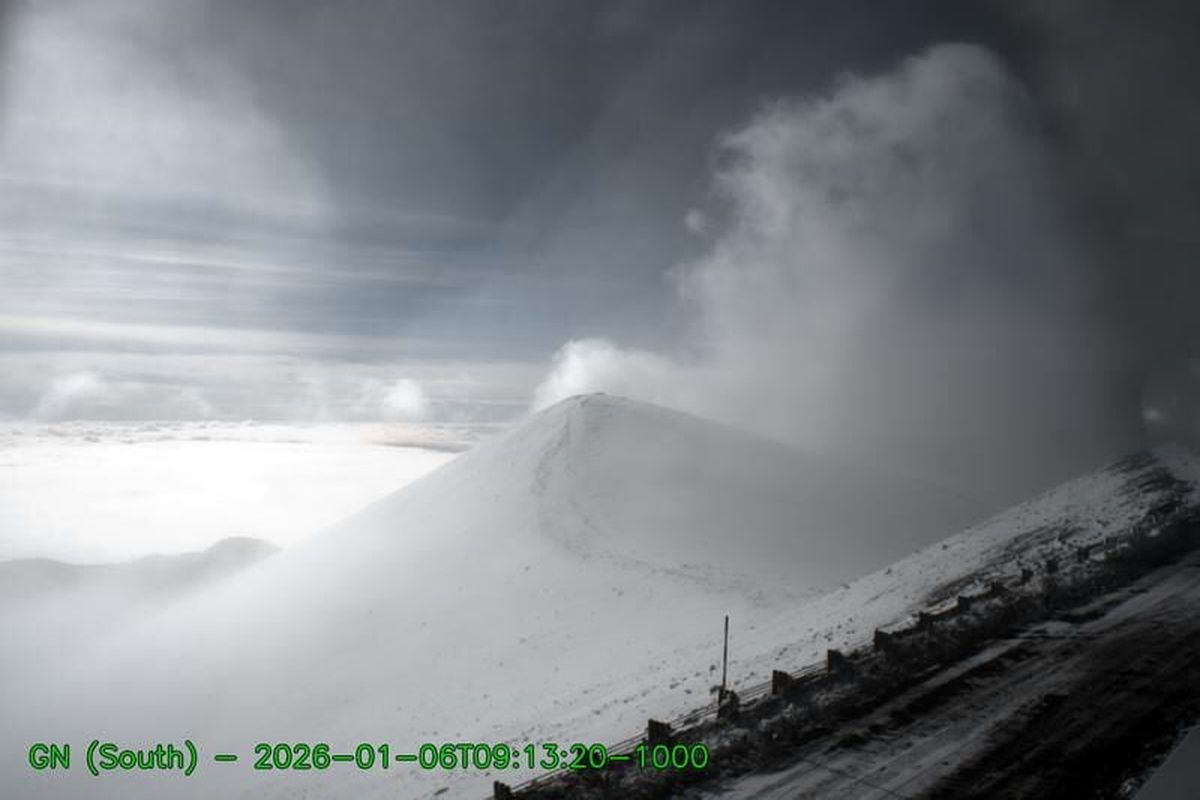
After a winter storm dumped 8 to 10 inches of snow on a dormant volcano on Hawaii’s Big Island, the system left behind what’s known as a freezing fogbow.
The system that preceded the phenomenon was what’s called a “Kona low,” or a low-pressure system that approaches from the west, using a name that refers to leeward winds. The storm brought localized flooding to the lower elevations but subfreezing temperatures above 10,000 feet that led to a wintry wallop on Mauna Kea, the highest peak on the Big Island. Trade winds in Hawaii typically come from the east, except during the wintertime, when Kona lows are more common.
On Monday, webcams revealed a ghostly white arch over the snowcapped landscape. It was likely a fogbow (or cloudbow, depending on droplet size) – the dull cousin of the rainbow.
As the sun shone through the small, fine fog droplets, its light was refracted, or bent. Sunlight is made up of a combination of wavelengths spanning the visible spectrum; each wavelength represents a different color.
Rainbows result when bigger raindrops refract each wavelength, or color, a slightly different amount. That means the differing wavelengths exit the raindrop at slightly different angles, which allows them to separate and each color to be distinctly visible.
But because a fogbow forms in fog, the droplets are much smaller. Fog and cloud droplets may be only one-tenth or even one-hundredth the size of a raindrop.
Since the droplets in fog are small, there is only a bit of refraction (bending) of each color, and the colors don’t get separated, as they mostly overlap still. That’s why fogbows are white whereas rainbows are colorful. Only a subtle reddish tinge is visible on the outside of the fogbow.
The arch in Hawaii this week also seemed to be a freezing fogbow, since air temperatures were probably below freezing. This doesn’t make for any visible difference but may have been a headache for scientists and weather observers on the summit. That’s because freezing fog is made up of supercooled water droplets – subfreezing liquid droplets suspended in midair with nothing to freeze onto. When those droplets land on a surface, however, they freeze almost instantly, accreting into a slick rime.
It also appears the fogbow may have been a supernumerary fogbow – a term given to the extra bands of light inside the fogbow.
Supernumeraries form thanks to a high number of small, uniformly sized cloud droplets present in the atmosphere. Consider it an interference pattern of sorts. When two beams of sunlight enter a droplet, even though they’re parallel when they enter, they strike the back edge of the droplet in slightly different places and subsequently are bounced in different directions when they exit.
The central pocket of “constructive” interference produces the bright band of light we see in the primary fogbow; then each iteration of a supernumerary band is the product of subsequent instances of constructive interference, which grow dimmer each time before fading away.