
Spokane County to remove litany of black locust trees along Liberty Lake Golf Course
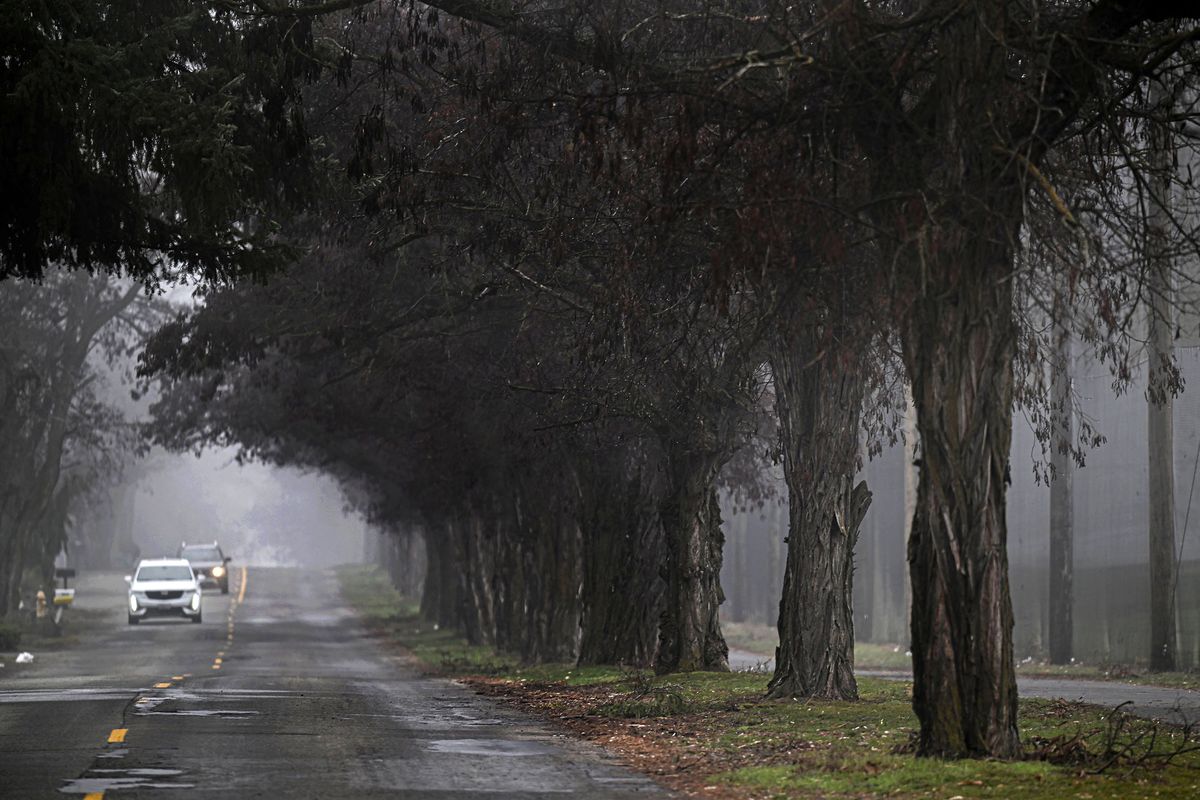
The entrance to Liberty Lake Golf Course soon will look a little barren.
Spokane County is moving forward with plans to remove 50 black locust trees along Sprague Avenue that run the length of the course’s south end, pending approval from the county commissioners in the coming weeks.
The plans for removal come after a request from the city of Liberty Lake last August to address the poor condition of the trees as required of property owners by the city’s code. The city sent a letter to Spokane County officials last August stating that they have received complaints about the trees, and that a large amount of deadwood in the upper canopies posed a “safety hazard to passing vehicles, pedestrians and cyclists.”
“This needs to be addressed as dead tree branches are more likely to break off in high winds and may injure people or property,” the letter reads.
Ben Turner, public works director for Liberty Lake, said the windstorm that ripped through the Inland Northwest in December highlighted the risk posed by the deadwood. The winds toppled a large branch on of one of the trees, blocking the adjacent pathway and taking down a portion of the golf course’s fence in the process.
“It’ll be a little ugly for a few years, we understand that,” Turner said. “We’d love to keep them but the public safety thing has to come first. We’ll need some residents to exercise some patience.”
In the letter to county officials, Liberty Lake recommended that the county trim all deadwood 3 inches in diameter or larger – at the minimum.
Doug Chase, director of Spokane County Parks, Recreation and Golf, said the county examined the best path forward and determined it would be more cost effective and timely to remove the trees entirely.
If the county trimmed all 50 trees, work crews would need to come back through for more maintenance, at an additional cost, within a few years, he said. The county requested bids for the trimming route and complete removal from Budget Arbor & Logging, and the latter cost $25,500 more. The company will be paid $71,400 to leave nothing but low stumps, once the county commissioners approve the work, according to county records.
Chase said the city of Liberty Lake has agreed to make up the difference in the two bids by providing $30,000 and traffic control work for the project.
“We’re pleased to be working with Liberty Lake on a collaborative approach that will provide a more permanent solution from a safety standpoint, and I’m excited to see how that area may be improved in the future,” Chase said.
Liberty Lake also intends to reconstruct Sprague Avenue in the coming years, Turner said. It was not built to modern standards, and will need to be completely rebuilt, which would have led to the removal of the trees. Turner said the project could begin in 2030, or as soon as the city has enough funding.
That funding could be hard to secure from outside city limits. Liberty Lake may need to save enough to pay the entire cost of the reconstruction out of pocket, Turner said.
“That road is never really a good project for grant funding,” Turner said. “It’s not in front of a school, it’s not a major thoroughfare and it’s a pretty extensive project.”
Turner said his department’s research did not yield results on the origins of the lengthy strip of trees. They believe the trees are around 60 to 70 years old, but it’s still a mystery who planted them decades ago.
Black locust trees are native to North America, with two main concentrations in the Appalachian Mountains, and around the Ozarks, according to the U.S. Forest Service. They have been cultivated and introduced across North America and Europe as park and street trees due to their high tolerance to pollution, but the species’ sweet smelling blooms turn into troublesome seed pods that fall en masse around the base.
“They drop a bunch of junk,” Turner said. “They probably work better in a park.”
Black locust trees are also short-lived, lasting around 50-75 years on average, according to the U.S. Department of Agriculture. The trees along the golf course are nearing the end of their life span, which was confirmed by the city’s arborists and county’s own experts, Turner said.
“There’s 50 now, because of the windstorm,” Turner said. “And about 60% of the remaining are dead or will be dead soon.”
That wind storm also brought down five poles that held up a large net for the course’s driving range, Chase said. The county intends to get a replacement net that’s taller and sturdier by the time the golf season begins.
“Were doing everything we can, working through the processes we have to work through,” Chase said.
George Menegas has lived across the street from the golf course for more than 30 years, after relocating to the neighborhood from the Shadle Park area he grew up in for better access to the game he loves. He eyed the once empty plot where his home stands for years, until one day, a for sale sign popped up.
“I bought it the next day,” Menegas said.
The trees have always welcomed him home, and he’ll be sad to see them go, he said.
“I have always liked the tunnel effect, while you’re driving down the street and they overhang,” Menegas said. “Especially when it snows.”
Menegas said he was not aware of the safety concerns surrounding the aging trees, but he understands why the county has decided to take them down. He and a lot of his neighbors make use of the path they overhang, and he’d hate to see anyone injured from falling branches.
The upgrades to the driving range will be a welcome addition, he added.
“There’s pros and cons,” Menegas said. “Just like with anything.”